Search results for: “nursing care plan”

  • 90+ Lucrative Nurse Business Ideas to Transform Your Career in 2025

    Are you looking for business ideas that leverage your unique skills as a nurse? Look no further than this 90+ list of lucrative nurse business ideas, all carefully curated with the nurse entrepreneur in mind. As healthcare continues to evolve, nurses are discovering unprecedented opportunities to leverage their expertise beyond traditional clinical settings. Whether you’re a seasoned registered nurse seeking a career pivot or a nursing student contemplating future possibilities, the landscape for nurse entrepreneurs has never been more promising.

    Top Business Ideas for Nurses in 2025

    Nurse Business Ideas

    Health Coaching and Wellness Consulting

    One of the most accessible business idea for nurses is health coaching. As a nurse health coach, you can guide clients toward better lifestyle choices, chronic disease management, and preventive care strategies. This nurse business allows you to apply your clinical expertise in a more flexible, personalized setting.

    Many nurses who want to explore this path begin by obtaining additional certifications in health coaching or specific wellness niches. From there, you can develop programs for individuals or groups, focusing on areas like:

    • Weight management
    • Stress reduction
    • Chronic illness support
    • Nutritional guidance
    • Lifestyle modifications

    A holistic nurse approach to coaching can differentiate your services in this growing market, as clients increasingly seek providers who understand both medical science and complementary therapies.

    Legal Nurse Consulting

    For the analytical nurse with an interest in law, legal nurse consulting represents a profitable business opportunity. A legal nurse consultant bridges the gap between healthcare and legal systems, reviewing medical records, identifying standards of care, and serving as an expert witness in medical-related cases.

    To establish yourself in legal nurse consulting, consider:

    • Obtaining Legal Nurse Consultant Certification (LNCC)
    • Networking with law firms that handle medical cases
    • Developing clear service packages and fee structures
    • Creating educational materials that demonstrate your expertise

    Legal nurse consulting can be particularly rewarding for nurses with backgrounds in high-acuity or specialized areas of practice, as these cases often require detailed analysis and expert testimony.

    Medical Spa Services

    The aesthetic medicine industry continues to flourish, creating excellent business opportunities for nurses with clinical skills and an eye for beauty. A medical spa business combines therapeutic treatments with cosmetic procedures, all under proper medical supervision.

    As a nurse practitioner or RN with appropriate training, you might offer:

    • Injectable treatments (with proper certification)
    • Laser therapies
    • Chemical peels
    • Medical-grade facials
    • Weight management programs

    Starting a medical spa requires careful attention to regulatory requirements, which vary by state. Some nurse entrepreneurs partner with physicians to meet supervision requirements while maintaining significant ownership in the business.

    Home Health Care Agency

    The aging population and preference for receiving care at home have created substantial demand for quality home health services. Starting a home health business allows nurses to address this need while building a scalable business model.

    A home healthcare business typically provides:

    • Skilled nursing visits
    • Medication management
    • Wound care
    • Post-surgical support
    • Chronic disease monitoring

    While launching a home health care agency requires navigating licensing, accreditation, and insurance hurdles, it represents one of the best business ideas for nurses looking to create a substantial enterprise with growth potential.

    Nurse Staffing Agency

    Healthcare facilities consistently struggle with staffing challenges, creating an opportunity for nurse entrepreneurs to develop nurse staffing solutions. A nurse staffing agency connects qualified nurses with facilities needing temporary or permanent staff.

    This type of business leverages your understanding of both nursing skills and healthcare environments to make successful placements. As the business owner, you’ll:

    • Recruit and screen nursing professionals
    • Develop relationships with healthcare facilities
    • Handle scheduling and administrative details
    • Ensure compliance with regulatory requirements
    • Manage payroll and billing processes

    Though starting a staffing agency requires significant organizational skills and initial investment, it offers excellent scaling potential as a successful business venture.

    Educational Ventures for Nurse Entrepreneurs

    Nursing Continuing Education Provider

    Nurses require ongoing education to maintain licensure and stay current with evolving practices. Creating and delivering continuing education represents a promising business idea for nurses with teaching aptitude and specialized knowledge.

    You might develop:

    • Online courses for license renewal
    • Skill-specific workshops (IV therapy, wound care, etc.)
    • Certification preparation programs
    • Specialized training for specific nursing populations

    This business model benefits from relatively low startup costs, especially if you begin with virtual offerings. Many nurse entrepreneurs start by creating a single online course and gradually expand their educational catalog.

    Nursing School Tutoring and NCLEX Preparation

    Supporting nursing students through their educational journey offers another avenue for entrepreneurial nurses. Tutoring services specifically designed for nursing school challenges or NCLEX preparation can become a profitable business with minimal overhead.

    As a former nursing student yourself, you understand the unique pressures and learning requirements of nursing education. This insight allows you to create targeted resources that address common struggles and knowledge gaps.

    Consulting Opportunities for the Nurse Entrepreneur

    Healthcare Facility Consulting

    Healthcare organizations frequently seek external expertise to improve operations, clinical outcomes, and patient satisfaction. A nurse consultant with specialized knowledge can provide valuable insights in areas such as:

    • Infection control protocols
    • Patient safety initiatives
    • Quality improvement processes
    • Staff education and development
    • Regulatory compliance and accreditation preparation

    This business idea for nurses works particularly well for those with management experience or specialized certifications who can position themselves as subject matter experts.

    Medical Equipment Consulting

    Nurses who understand the practical application of medical devices and equipment can build a business advising on procurement, utilization, and staff training. Healthcare facilities and even medical equipment manufacturers value input from clinicians who can evaluate products from a user perspective.

    As a consultant in this space, you might:

    • Evaluate new medical equipment before purchase decisions
    • Develop training programs for equipment users
    • Advise on inventory management and equipment lifecycle planning
    • Help facilities optimize equipment utilization
    • Assist manufacturers in product development and improvement

    This niche allows you to sell medical expertise rather than products, positioning you as an unbiased advisor.

    Digital and Telehealth Nurse Business Ideas

    Telehealth Services

    The expansion of telehealth presents numerous business opportunities for nurse practitioners with entrepreneurial ambitions. Depending on your state’s scope of practice regulations, you might establish:

    • A virtual primary care practice
    • Specialized telehealth services (mental health, dermatology, etc.)
    • Remote monitoring programs for chronic conditions
    • Medication management services
    • Virtual second opinion consultations

    While regulatory considerations vary by location, telehealth continues to gain acceptance among patients, providers, and insurers, making it one of the innovative business ideas for nurses with an interest in technology.

    Health Content Creation

    Healthcare information remains one of the most searched topics online, creating demand for accurate, understandable content from qualified professionals. Nurses with communication skills can build businesses around:

    • Health-focused blogs and websites
    • Medical writing services for publications
    • Social media health education channels
    • Podcasts addressing health topics
    • Video content explaining medical concepts

    This business model can begin as a side hustle and gradually grow into a full-time venture as you build an audience and attract sponsorships or clients.

    Product-Based Nurse Business Ideas

    Medical Product Development

    Nurses regularly identify problems that could be solved with better products. If you’ve thought, “There should be a better way to do this,” product development might be your path to entrepreneurship.

    Examples of successful nurse-developed products include:

    • Specialized wound care supplies
    • Improved IV securement devices
    • Innovative patient transfer equipment
    • Better personal protective equipment
    • Patient education tools

    While product development involves more initial investment than service-based businesses, it can also offer greater scalability and potential return.

    Subscription Boxes for Healthcare Professionals

    Curated subscription services continue to grow in popularity, and healthcare-focused options represent an underserved market. A nurse entrepreneur could create subscription boxes featuring:

    • Self-care items for healthcare workers
    • Professional development resources
    • Trending medical gadgets and tools
    • Specially formulated skincare for those wearing masks all day
    • Healthy snacks for long shifts

    This business model combines product curation with recurring revenue, creating predictable cash flow once established.

    Building Your Nurse Business: Essential Considerations

    Building Your Nurse Business Ideas

    Developing a Solid Business Plan

    Every successful business venture begins with thorough planning. Your business plan should outline:

    • Your unique value proposition
    • Target market analysis
    • Competitive landscape
    • Marketing strategy
    • Financial projections
    • Operational considerations
    • Growth milestones

    A well-crafted business plan not only guides your decisions but also proves essential when seeking funding or partners for your nurse business.

    Legal and Regulatory Considerations

    Healthcare businesses face specific regulatory requirements that vary by business type and location. Depending on your chosen path, you may need to address:

    • Professional licensing requirements
    • Business structure decisions (LLC, corporation, etc.)
    • Insurance considerations (professional liability, business insurance)
    • HIPAA compliance for patient data
    • Employment laws if hiring staff
    • Contractual relationships with clients or facilities

    Consulting with an attorney familiar with healthcare businesses can help navigate these complex considerations.

    Marketing Your Nurse Business

    Even the best business ideas for nurses require effective marketing to succeed. Consider these strategies to grow your business:

    • Develop a professional website highlighting your nursing background
    • Create content that demonstrates your expertise
    • Network with healthcare professionals who might refer clients
    • Join professional associations related to your specialty
    • Consider targeted digital advertising to reach ideal clients
    • Collect and showcase testimonials from satisfied customers

    Marketing approaches should emphasize your unique combination of nursing knowledge and business solutions, differentiating you from non-clinical competitors.

    Getting Started: From Nurse to Business Owner

    Assessing Your Entrepreneurial Fit

    Before launching any business, honestly evaluate your:

    • Risk tolerance
    • Financial resources
    • Support systems
    • Time availability
    • Passion for your business concept

    Starting your own business requires significant commitment, especially while transitioning from traditional nursing roles.

    Testing Your Concept

    Many nurse entrepreneurs begin exploring business ideas as a side hustle while maintaining clinical positions. This approach allows you to:

    • Test market demand
    • Refine your offerings
    • Build a client base
    • Develop business acumen
    • Create financial stability before full transition

    Starting small helps minimize risk while confirming that your chosen type of business aligns with both market needs and your personal goals.

    Finding Support for Your Journey

    No entrepreneur succeeds entirely alone. Consider seeking:

    • Mentorship from established nurse entrepreneurs
    • Business education through courses or programs
    • Networking with other healthcare business owners
    • Professional associations specific to your business niche
    • Online communities of healthcare entrepreneurs

    These resources can provide guidance, encouragement, and practical advice as you build your business.

    Frequently Asked Questions

    What are the most profitable business ideas for aesthetics nurses who want to go beyond traditional medical spas?

    Beyond traditional medical spa services, aesthetics nurses can explore mobile beauty services, specialized training programs for other providers, product development partnerships with skincare companies, and concierge aesthetic services for high-net-worth clients. Each of these extensions leverages clinical expertise while potentially increasing profit margins and creating multiple revenue streams.

    How can nursing students begin developing entrepreneurial skills while still in nursing school?

    Nursing students can start building entrepreneurial mindsets by joining healthcare innovation clubs, participating in business plan competitions, seeking mentorship from nurse entrepreneurs, developing side projects addressing challenges they observe during clinical rotations, and taking business electives or minors if their program allows. These activities build foundational skills that will prove valuable after graduation.

    What franchise business opportunities are particularly suitable for nurses looking to minimize the risks of starting from scratch?

    Several franchise opportunities align well with nursing backgrounds, including home healthcare franchises, medical staffing agencies, senior care services, medical transportation companies, and wellness-focused businesses. These franchises provide established systems and support while allowing nurses to apply their healthcare knowledge in a business context with reduced startup uncertainty.

    How are nurses using emerging technologies like artificial intelligence and virtual reality to create innovative business opportunities?

    Forward-thinking nurse entrepreneurs are incorporating AI for predictive health analytics, developing VR-based patient education tools, creating augmented reality applications for healthcare training, designing remote monitoring platforms enhanced by machine learning, and launching digital therapeutics backed by clinical expertise. These technology-focused ventures often attract investment interest and offer significant scaling potential.

  • Write My Nursing Paper – Nursing Paper Writing Service: Expert Nursing Writing Assistance

    Are you struggling to write your nursing paper with a looming deadline? Many nursing students find themselves overwhelmed by the demands of academic writing, which they must balance with clinical rotations and nursing classes. Our comprehensive guide explores how to excel in your nursing papers and when to seek professional assistance from a writing expert.

    Nursing Paper Writing Service

    Finding the right nursing paper writing service can make all the difference in your academic journey. As the #1 nursing paper writing service, we understand the unique challenges nursing students face in writing research papers and provide tailored solutions that meet academic standards while helping you develop as a healthcare professional. Our writing service at your fingertips ensures you never have to struggle alone with complex assignments.

    Write My Nursing Paper

    Write My Nursing Paper, nursing paper, nursing paper writing service
    How to Write a Nursing Paper

    When professors assign a nursing paper, they’re looking for specific elements that demonstrate your understanding of nursing concepts and your ability to apply critical thinking to healthcare scenarios. A professional writer for your paper can help you structure your work to meet these expectations, ensuring every paper you submit is an excellent paper worthy of top marks.

    Professional Nursing Essay Writer | Nursing Writer

    Finding a professional nursing essay writer can make all the difference when deadlines are tight and expectations are high. Our experienced nursing writing service understands the complexity of every nursing paper, whether it’s community health nursing, mental health, or patient care. We write nursing papers that reflect a deep understanding of the nursing field and academic precision. Each nursing writer in our team is trained to meet university standards and deliver papers on time without compromising quality.

    When you need someone to write your essay, you deserve a writing company that’s reliable and experienced. Our writing service is here to help every nursing student who needs expert writing assistance. With free revisions and a dedicated support team, we ensure you get exactly what you need. Whether you want to buy nursing papers online or request nursing paper help, our service offers a stress-free process. We’re ready to help you achieve excellence in your nursing studies with the best nursing paper writing service available today.

    Write My Nursing Essay | Write My Essay

    When you ask, “write my nursing essay” or “write my nursing paper,” you want results you can trust. Our professional nursing writing service handles every type of paper, from short reflections to complex case studies. We write a paper tailored to your specific topic, ensuring it meets the highest academic standards in the nursing field.

    Our writing company is built on reliability, confidentiality, and excellence. Whether you need nursing research paper help, a term project, or a final dissertation, we’re ready to help. You can get nursing essay writing help that ensures your project is delivered accurately and on time.

    We know how stressful it can be to manage multiple writing assignments, so our service offers flexible options — from buy nursing essay packages to free revisions. Every nursing paper we deliver is original and customized, ensuring you meet your instructor’s expectations. So next time you think, “I need someone to write my nursing essay,” remember that our service is here to help you succeed in every aspect of your nursing education.

    Nursing Paper Writers

    Our expert nursing paper writers bring years of experience in the nursing profession and academic writing. We don’t just write — we provide nursing expertise through evidence-based arguments, critical analysis, and structured presentation. Every nursing paper is handled by a professional nursing writing specialist who understands what your professor expects.

    Whether you need help with community health nursing or want to buy nursing papers online, we’ve got you covered. Our writing company is known for reliability and the ability to deliver papers on time. Students come to us when they need nursing paper help that truly makes an impact.

    We’re proud to be among the best nursing paper writing service providers in the industry. Every nursing essay or report we create is designed to enhance your understanding while earning top grades. And with our free revisions policy, we make sure you’re completely satisfied. If you ever find yourself saying, “I need someone to write my paper,” our professional nursing writing service is ready to help — ensuring your writing tasks are handled with care and precision.

    Nursing Research Paper Writing Service

    Our nursing research paper writing service specializes in creating detailed, evidence-based research tailored to your curriculum. When you say, “write my nursing research paper,” we assign expert writers with deep experience in the nursing field. Each paper includes proper formatting, accurate sources, and a clear connection to nursing theory and practice.

    We know that every nursing paper requires focus, accuracy, and analysis. That’s why our writing company ensures each writer understands how to develop and interpret clinical data effectively. You can get nursing essay writing help or nursing research paper help anytime, and we’ll provide nursing research that meets top academic standards.

    Our service offers affordable pricing, free revisions, and 24/7 support. We deliver papers on time, making it easy for students to meet submission deadlines. Whether it’s a literature review or experimental study, our professional nursing writing experts are ready to help. Choose our best nursing paper writing service today and order nursing papers online that showcase true academic excellence in nursing.

    Online Nursing Paper

    Finding nursing papers online that meet your standards can be challenging, but our platform makes it easy. We offer a secure, user-friendly way to order nursing papers online with full control over deadlines, writers, and revisions. Whether you’re working on community health nursing or a specialized clinical topic, our professional nursing writing service ensures you receive a paper that reflects your academic goals.

    When you buy nursing papers online, you benefit from our writing assistance, which includes editing, proofreading, and free revisions. Each type of paper is customized to your specific instructions, ensuring every requirement is met.

    Our writing company has built its reputation on trust and quality, delivering nursing papers on time every time. We’re ready to help you achieve excellence with online nursing essays that reflect critical thinking and practical application. From nursing term projects to reports and essays, we make it simple to get help and succeed in your studies.

    Nursing Report Writing Services

    Our nursing report writing services are designed to help students handle clinical reports, case studies, and reflective journals with confidence. We know every nursing report requires accuracy, clarity, and proper structure. That’s why our professional nursing writing service ensures that your report is tailored to meet your school’s standards and reflects real-world nursing practice.

    You can get nursing essay writing help or nursing paper help for any type of paper — from patient care reports to community health nursing assessments. Our writing company assigns a qualified nursing writer to each task, ensuring subject expertise.

    We write nursing papers that are 100% original and supported by current references. Students who order nursing papers online from us enjoy free revisions and guaranteed delivery on time. Whether you’re preparing for a practical assessment or research presentation, our service offers everything you need. The benefits of our nursing writing services include affordability, reliability, and complete confidentiality.

    Nursing Essay Help

    Getting nursing essay help from professionals can save time and stress. Our service offers custom nursing papers online for students at all levels — from undergraduates to advanced practice nurses. We write a paper that fits your topic, ensuring your ideas are clearly expressed and well-supported with evidence.

    Our professional nursing writing experts are familiar with APA, MLA, and other academic formats. Whether it’s a nursing term project or a critical analysis, you can rely on us to provide nursing papers that impress your instructors. We also include free revisions to ensure your satisfaction.

    When you say, “I need someone to write my essay,” our service is here to help. You can buy nursing papers online safely and receive them on time. With years of experience in the nursing field, we know how to craft high-quality essays that meet academic and clinical expectations. Get nursing paper help now and work with the best nursing paper writing service trusted by thousands of students.

    Nursing Dissertation Writing Service

    Our nursing dissertation writing service is ideal for graduate and doctoral students who need in-depth research and structured writing. We understand that every nursing paper must demonstrate original thought and advanced understanding of the nursing field.

    When you buy nursing essay or dissertation support from us, you receive assistance from experts with experience in the nursing profession. Whether you need a literature review, data analysis, or discussion chapter, we’re ready to help.

    Our writing company provides nursing research paper help and dissertation editing at affordable rates. Plus, we offer free revisions to guarantee satisfaction. You can order nursing papers online or request nursing paper help for any section of your dissertation.

    Our service offers personalized support to make complex writing tasks manageable. With our professional nursing writing service, you’ll receive guidance every step of the way — from proposal to final submission. Choose the best nursing paper writing service today and achieve your academic goals with ease.

    Nursing Essay Writing Help

    Looking for nursing essay writing help you can count on? Our professional nursing writing service delivers custom essays, research papers, and term projects with precision and speed. We understand every nursing student faces multiple deadlines, and that’s why our service is here to help with reliable writing assistance.

    You can get nursing essay writing help from our team of experts who have experience in the nursing field. Whether you need a short essay or an analytical paper, we’ll write nursing papers that meet your exact needs.

    With free revisions, plagiarism checks, and guaranteed delivery on time, our writing company ensures peace of mind. You can easily buy nursing papers online or hire someone to write your assignments. We provide nursing support for any type of paper, including community health nursing projects.

    Join hundreds of satisfied students who trust our best nursing paper writing service for excellence and affordability. When you need nursing paper help, we’re always ready to help you succeed.

    Buy Nursing Papers

    When you buy nursing papers, you invest in quality, reliability, and professionalism. Our writing company makes it easy to order nursing papers online safely and quickly. We write nursing papers that demonstrate critical thinking, evidence-based reasoning, and practical application in the nursing field.

    Our service offers comprehensive writing assistance, including research, editing, and free revisions. Whether you need to buy nursing essay or get nursing research paper help, our experts are ready to help.

    We specialize in professional nursing writing across all specialties — including community health nursing, pediatrics, and leadership. Students trust our best nursing paper writing service because we deliver papers on time and ensure confidentiality.

    With our professional nursing writing service, you’ll always receive original, well-structured content. So, if you’re wondering where to find reliable nursing essay writing, look no further. You can get nursing essay writing help and buy nursing papers online today — and experience the benefits of our nursing writing team firsthand.

    Nursing Paper Writing Service
    Nursing Paper Writing Service

    Common Types of Nursing Assignment Papers

    Throughout your nursing course experience, you’ll face various types of assignments, each with unique requirements:

    • Nursing research papers that require in-depth investigation
    • Case studies applying theory to patient scenarios
    • Nursing dissertation projects for advanced degrees
    • Literature reviews synthesizing current research
    • Term papers demonstrating comprehensive knowledge

    Students can order nursing papers for any of these assignment types and receive customized, professional writing support.

    Nursing Assignment Help

    Many students in nursing classes seek paper help when faced with complex topics or tight deadlines. Whether you need help writing nursing research papers or assistance with a nursing dissertation, having the right resources can significantly improve your nursing paper quality. Studyingnurse.com offers comprehensive support for all your academic writing needs.

    Nursing Writing Service: What to Look for in Quality Providers

    A reputable nursing writing service employs writers who understand nursing practices, current research methodologies, and academic standards. They should provide original papers tailored to your specific nursing assignment while maintaining open communication throughout the writing process. Every paper is polished through rigorous quality control before delivery.

    Different academic levels require different approaches to nursing papers:

    • Undergraduate nursing students often need help with basic research and structure
    • Graduate nursing students might require assistance with advanced theoretical frameworks
    • Doctoral candidates may seek support with nursing dissertation development

    Our nursing assignment services cater to all these levels with specialized expertise.

    Best Nursing Paper Writing Service/ Top Features
    Best Nursing Paper Writing Service/ Top Features

    The best nursing essay writing service will offer:

    • Original, plagiarism-free content
    • Direct communication with your assigned writer
    • Multiple revisions if needed
    • On-time delivery
    • Confidentiality guarantees
    • Affordable pricing options

    These features contribute to a good service experience for nursing students.

    Nursing Essays: Developing Critical Thinking Through Writing

    Writing nursing essays develops essential critical thinking skills that translate directly to clinical practice, including:

    • Evaluating evidence quality
    • Considering multiple perspectives
    • Applying theoretical knowledge to practical situations
    • Developing logical arguments

    Our nursing essay writing help supports the development of these crucial skills.

    Professional Nursing Paper Standards and Expectations

    Writing Process: Steps to Creating Outstanding Nursing Papers

    nursing papers

    The writing process for a quality nursingpaper includes:

    1. Understanding assignment requirements
    2. Researching relevant nursing literature
    3. Organizing information logically
    4. Drafting with clear, precise language
    5. Revising for content and clarity
    6. Ensuring every paper is polished before submission

    Nursing Paper Example

    Developmental Assessment and the School-Aged Child

    Child development assessment entails the determination of the functioning of a child based on various aspects like cognitive, behavioral, motor, sensory, and communication abilities. Bildiren (2018) explains that it helps identify potential developmental problems and appropriate interventions. The paper explores the developmental needs of children aged 5-12, focusing on the typical developmental stages of 6-year-old children based on Piaget’s Theory of development. 

    Physical Characteristics of School-Aged Children between 5-12

    Children between 5-12 years exhibit various physical characteristics as they transition from preschool to puberty (Bildiren, 2018). For instance, a 6-year-old can handle tools skillfully, such as riding bikes. Besides, they grow slowly but steadily, based on height and body weight. Additionally, they experience challenges controlling smaller muscles than larger ones (Lobelo et al., 2020). They can also snap their fingers and whistle successfully. Therefore, when assessing such a child, the pediatrician can modify the assessment technique by reading the standardized test questions to the child and writing down answers on their behalf. They can also utilize observation-based assessment methods to construct an assessment of the individual child sensitively. It enables the pediatrician to collect child-specific characteristics which may not be captured in standard testing techniques.

    Typical Developmental Stages of Children Aged 6

     Alex is a 6-year-old child who is physically active and social. He prefers playing with other children, though he is choosy in selecting playmates and gets frustrated when they don’t want to play with him. Alex is also talkative, can count from 1-10, and can accurately identify what day it is. Notably, children the same age as Alex should be physically active, show skillful motor coordination like jumping a rope and perform most activities like repeatedly riding a bike until they master it (Martínez, Camacho & Madrona, 2018). Also, they should exhibit curiosity, understand themselves and be sensitive to other people’s emotions. Moreover, they should have tricky emotions, like getting moody easily when upset. They should also be able to form friendships and interact well with others, especially around their families.

    Developmental Assessment of the Child using Piaget’s Developmental Theory

    Piaget’s Theory of development posits that children’s behavior changes based on the development of their thinking from one stage to the next. The theorist explains that children construct knowledge continuously as they encounter new ideas, leading to long-term changes. According to Carpendale, Lewis, and Müller (2019), Piaget suggested four stages of development: sensorimotor, preoperational, concrete operational, and formal operational. Alex falls under the preoperational stage (2-7 years), where children are expected to utilize mental abstractions, recognize viewpoints and perspectives, and should perform dramatic play reflecting real-life experiences. In this case, when assessing the child, the pediatrician should request the input of the child’s parent based on aspects like the child’s social interaction and physical activity. Besides, the pediatrician can create imaginative scenarios matching the assessment criteria to determine the child’s metacognition, such as narrating a story and asking the child to recount it (Carpendale, Lewis & Müller, 2019). Additionally, the child can be given at least a series of three commands to follow to determine their cognitive ability.

    Notably, the pediatrician can explain the assessments using simple and plain language, providing diagrammatic illustrations, and asking the child questions. In addition, they can attract the child’s attention and cooperation by asking open-ended questions and allowing the child to assume control of the process (Lobelo et al., 2020). This can instill confidence in them, making it easy to display their true character and skills. Praising them for cooperating and offering suggestions for the questions is also essential. Finally, potential assessment results can include the excellent memory to accurately recount a narrated story, social skills like the ability to interact and make friends, and good motor coordination.

    The potential findings show that the child’s cognitive, physical, and behavioral development reflect those of peers of the same age. For example, Alex exhibits proficient motor skills, curiosity, can form friendships, and is active. The pediatrician can apply Piaget’s Theory to assess the child’s development by creating imaginative stories and asking the child to recount them. It is also necessary to use simple-to-understand language when explaining the assessment. Henceforth, children should be subjected to regular developmental assessments to identify their problems and devise strategies to help them improve.

    References

    Bildiren, A. (2018). Developmental characteristics of gifted children aged 0–6 years: parental observations. Early Child Development and Care188(8), 997–1011. https://doi.org/10.1080/03004430.2017.1389919

    Carpendale, J. I., Lewis, C., & Müller, U. (2019). Piaget’s Theory. The Encyclopedia of Child and Adolescent Development, 1-11. https://doi.org/10.1002/9781119171492.wecad100

    Lobelo, F., Muth, N. D., Hanson, S., Nemeth, B. A., LaBella, C. R., Brooks, M. A., … & Walsh, S. M. (2020). Physical activity assessment and counseling in pediatric clinical settings. Pediatrics145(3). https://doi.org/10.1542/peds.2019-3992

    Martínez, S. J., Camacho, X. G., & Madrona, P. G. (2018). Development of the checklist of psychomotor activities for 5-to 6-year-old children. Perceptual and motor skills125(6), 1070-1092. https://doi.org/10.1177/0031512518804359

    Looking for a Reliable Nursing Paper Writing Service? Contact Us Today!

    Are you balancing nursing school demands while struggling to meet paper deadlines? At Studyingnurse.com, we understand the challenges nursing students face when writing complex assignments. Our team of professional nursing writers provides the support you need to excel academically while developing essential writing skills for your nursing career.

    Why Nursing Students Choose Our Paper Help Services:

    • Expert nursing writers with clinical and academic experience
    • On-time delivery to meet your most urgent deadlines
    • Original, plagiarism-free content tailored to your specific assignment
    • Affordable rates designed for student budgets
    • 24/7 support throughout the writing process
    • Confidential service that protects your privacy

    Don’t let writing challenges prevent you from reaching your full potential in nursing education. Whether you need help with nursing research papers, term papers, or essays, our writers can provide the guidance you need.

    Take action now! Visit Studyingnurse.com today to discuss your nursingpaper requirements. Let us help you transform your academic performance and reduce stress while you focus on developing clinical skills. Your success in nursing school is our priority!

    Frequently Asked Questions

    What makes Studyingnurse.com the #1 nursing paper writing service for students?

    Studyingnurse.com specializes in nursing dissertation and research paper writing with a team of writers who understand the unique demands of nursing education. Our platform offers comprehensive support for every paper, from simple assignments to complex nursing dissertations, and we’ve helped thousands of nursing students achieve academic excellence.

    How can your writing expert help you write nursing research papers effectively?

    Our team can help you write nursing research papers by assisting with topic selection, literature reviews, methodology development, data analysis, and proper formatting. Each writer for your paper provides guidance throughout the research process while ensuring you develop the skills to write independently in the future.

    What makes your professional writing service better than other nursing paper services?

    Our professional writing team adheres to APA formatting, uses evidence-based sources, maintains academic integrity, and ensures every paper is polished before delivery. We also offer unlimited revisions, direct writer communication, and specialized expertise in all nursing specialties, making us a good service for academic excellence.

    How do I order nursing papers through your writing service at your fingertips?

    To order nursing papers, simply complete our online form detailing your requirements, select your deadline and academic level, review the quote, and proceed with payment. After submitting your order, you’ll be matched with a qualified nursing writer who will begin working immediately on your excellent paper.

    What nursing course assignments do you provide help with?

    We offer best nursing assignment support for all nursing classes requirements, including care plans, case studies, reflections, and research projects. Our nursing essay writing help extends to all specialties including medical-surgical, pediatrics, mental health, community health, and leadership.

    How does your best nursing essay writing service ensure quality?

    As the best nursing essay writing service, we ensure quality by employing only experienced nursing professionals, implementing a rigorous quality control process, checking every paper for plagiarism, and making sure each assignment meets academic standards. Looking for nursing excellence is our primary goal.

    What should I do after I get your nursing paper from your service?

    After you get your nursing paper, we recommend reviewing it thoroughly to understand the content and structure, using it as a reference for future assignments, reaching out if you need clarification on any points, and providing feedback on your experience. Remember that every paper we provide is meant to be a learning tool to enhance your own writing skills.

  • Lydia Hall Core Nursing Theory: Revolutionizing Patient Care Through the Core, Care, and Cure Model

    Lydia Hall Core Nursing Theory: Revolutionizing Patient Care Through the Core, Care, and Cure Model

    Lydia Hall stands as a pioneering figure in nursing theory whose innovative approach continues to shape modern nursing practice. Her Core Nursing Theory transformed how nurses conceptualize their roles in patient care by dividing nursing into three interconnected aspects: core, care, and cure.

    This comprehensive article explores Hall’s groundbreaking theoretical framework, its practical applications, and its enduring impact on the nursing profession. Whether you’re a nursing student, practicing nurse, or healthcare professional interested in theoretical foundations, understanding Lydia Hall’s contributions will deepen your appreciation of nursing’s intellectual heritage and enhance your approach to patient care.

    Lydia Hall Core Nursing Theory
    Lydia Hall Core Nursing Theory

    Lydia Hall – The Nursing Theorist Behind the Core Theory

    Lydia Eloise Hall was born on September 21, 1906, and emerged as an influential nursing theorist during a pivotal time in the profession’s development. With a diploma in nursing and later a degree in public health nursing, Hall developed her theoretical framework through extensive practical experience. Hall was always interested in rehabilitative nursing and the role nurses play in patient recovery.

    As a nursing theorist who developed innovative approaches to care, her background in both clinical practice and nursing education provided the foundation for her revolutionary ideas. Hall then worked in various settings before establishing the Loeb Center for Nursing and Rehabilitation, where she implemented her theoretical concepts. Hall died in 1969, but her thoughts about nursing continue to influence the profession today.

    Biography

    Lydia Eloise Hall was born on September 21, 1906, in New York City. Her early life of Lydia Hall unfolded in a family immersed in healthcare, with her father serving as a physician. This background played a crucial role in influencing her decision to pursue a nursing career.

    Hall graduated from York Hospital School of Nursing in 1927, marking the beginning of her nursing beginnings. Over the years, her achievements included employment with the New York Heart Association and the Life Extension Institute, where she focused on preventative health measures.

    Early Life

    The childhood influences that shaped Lydia Hall were deeply rooted in her family’s commitment to healthcare. Growing up surrounded by medical discussions and practices fostered her interest in nursing. This engagement with the healthcare field laid the groundwork for her empathetic approach to patient care, which defined her career trajectory and later informed her distinctive nursing philosophy.

    Education

    The education of Lydia Hall was extensive and instrumental in her development as a healthcare professional. She earned a Bachelor of Science degree in public health nursing from Teacher’s College at Columbia University in 1932. Hall continued her academic pursuits, obtaining a master’s degree in the teaching of natural life sciences in 1942. Her nursing credentials, encompassing various nursing degrees and extensive educational achievements, provided a solid foundation for her future endeavors, including a distinguished career as a professor at Columbia University.

    YearAchievement
    1906Birth in New York City
    1927Graduated from York Hospital School of Nursing
    1932B.Sc. in Public Health Nursing from Columbia University
    1942M.A. in Teaching Natural Life Sciences from Columbia University
    1950Professor at Teacher’s College, Columbia University
    1962Established the Loeb Center for Nursing and Rehabilitation
    1984Inducted into the American Nurses Association Hall of Fame

    What is the Core Nursing Theory?

    Understanding Hall’s Three-Circle Model within the nursing process 

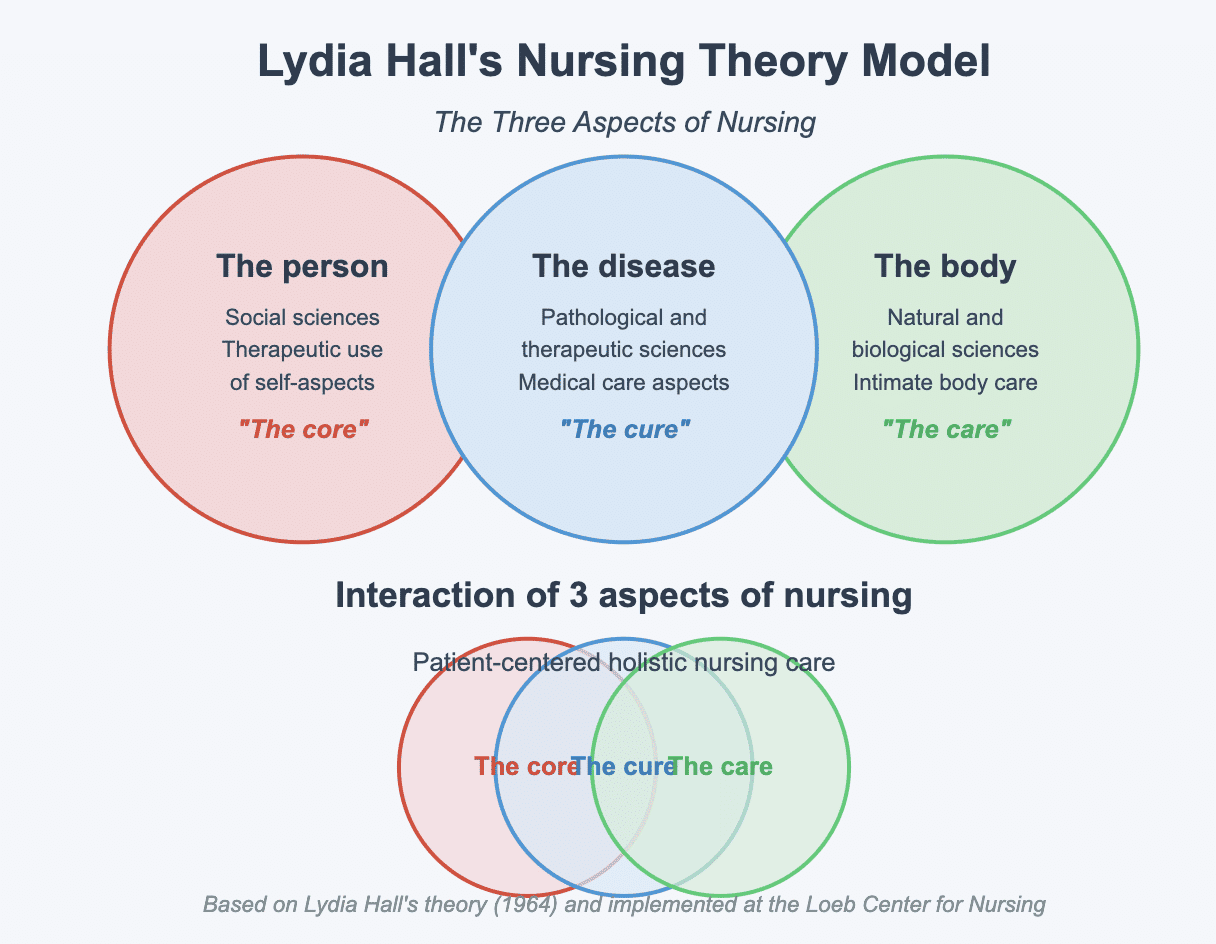
    Lydia Hall’s theory centers around three interconnected aspects of nursing: core, care, and cure. According to the theory, these three elements work together to provide comprehensive patient care. The core is the patient as a person with their individual needs, feelings, and goals. The care circle represents the nurturing component of nursing practice, involving bodily care and comfort.

    The cure aspect encompasses the medical interventions and therapeutic treatments administered by healthcare professionals. Hall’s theory was unique in its approach to patient care, emphasizing that these three aspects must be balanced for effective nursing.

    By dividing nursing into these three components, Lydia Hall’s nursing theory offered a clear framework for understanding the complexity of the nursing profession and the importance of the total patient experience.

    How Does the Core Component Function in Lydia Hall’s Nursing Theory?

    In Lydia Hall’s theoretical framework, the core is the patient as a whole person with their unique identity, values, and needs.

    Core is the patient’s internal self, encompassing their social, emotional, and psychological dimensions. According to Lydia, the core component requires nurses to develop therapeutic relationships based on understanding the individual care recipient as more than just their medical condition.

    The core is fundamentally about the patient as a whole person – not just their physical body or medical condition, but their complete identity with all its psychological, emotional, and social dimensions. Think of the core as addressing the question, “Who is this person beyond their illness?”

    In Hall’s conceptualization, the core deals with:

    1. The patient’s internal self – This includes their feelings, thoughts, values, beliefs, and experiences that shape how they perceive their illness and treatment. When nurses engage with the core component, they recognize that each patient brings their unique life story and perspective to the healthcare encounter.
    2. Therapeutic relationships – The core component functions through meaningful nurse-patient interactions that go beyond procedural care. Hall believed that by developing authentic connections with patients, nurses could help them tap into their own internal resources for healing.
    3. Patient autonomy and self-determination – The core component emphasizes the patient’s right and capacity to participate in their own care decisions. According to Lydia Hall, nursing that addresses the core helps patients express their needs and preferences, empowering them to take an active role in their recovery process.

    The functioning of the core component requires specific nursing knowledge and skills. Nurses working within this dimension draw upon psychological understanding, communication techniques, active listening, and therapeutic presence. Unlike the care component (which focuses on physical body care) or the cure component (which deals with medical treatments), the core represents nursing’s unique attention to the person’s sense of self and identity.

    How Does the Care Component Function in Lydia Hall’s Nursing Theory?

    The care circle in Lydia Hall’s theory represents the nurturing aspects of nursing practice. This dimension focuses on providing bodily care, physical comfort, and meeting basic human needs.

    Hall’s care component involves direct nursing interventions such as bathing, feeding, and positioning—the intimate aspects of patient care that define the nursing profession. The care provided forms the foundation of the nurse-patient relationship and establishes trust.

    The care component in Lydia Hall’s nursing theory focuses on the hands-on, physical aspects of nursing. Here’s how it works:

    What the care component is about:

    • Physical, and bodily care of patients
    • The nurturing dimension of nursing practice
    • Direct hands-on nursing interventions

    Key functions of the care component:

    1. Meeting physical needs
      • Bathing, feeding, and positioning patients
      • Helping with movement and comfort
      • Providing personal hygiene assistance
      • Managing physical symptoms
    2. Building trust through physical care
      • Creating connection through therapeutic touch
      • Establishing rapport during care activities
      • Demonstrating compassion through comfort measures
    3. Serving as a gateway to other components
      • Using care moments to assess emotional needs (core)
      • Identifying medical treatment needs (cure) during physical care
      • Integrating all aspects of nursing during bodily care

    Cure Theory in Lydia Eloise Hall Nursing Model

    The integration of the Cure Theory aspect into Hall’s Nursing Model enhances its comprehensiveness by addressing the medical dimension of patient care, thereby completing the model’s holistic framework. Here’s a structured breakdown:

    Lydia Hall Core Nursing Theory Model
    Lydia Hall Core Nursing Theory Model
    1. Hall’s Three Components:
      • Care: Hands-on, nurturing support (e.g., hygiene, comfort).
      • Core: Emotional, psychological, and identity-focused care (therapeutic communication, self-awareness).
      • Cure: Medical interventions and collaboration with healthcare professionals.
    2. Role of Cure Theory:
      • Medical Expertise: Strengthens the “cure” component by emphasizing evidence-based practices, clinical judgment, and adherence to medical protocols, ensuring nurses actively participate in treatment beyond passive task execution.
      • Interdisciplinary Collaboration: Highlights the nurse’s role as a collaborator with physicians and other professionals, fostering teamwork for optimal patient outcomes.
      • Patient Education: Integrates teaching patients about their conditions and treatments, empowering them to engage in their own care.
      • Monitoring and Adaptation: Encourages dynamic assessment of patient responses to treatments, enabling timely adjustments to care plans.
    3. Holistic Completion:
      • Without the cure aspect, Hall’s model would lack actionable medical strategies. Cure Theory ensures that scientific, procedural, and educational elements are systematically incorporated, balancing the physical (care), emotional (core), and clinical (cure) needs of patients.
      • Modern advancements in Cure Theory (e.g., technology integration, patient-centered care) update Hall’s 1960s model, making it relevant to contemporary practice.
    4. Synergy:
      • The Cure Theory bridges the gap between compassionate care (care/core) and medical rigor, ensuring nurses address all facets of healing. This synergy fosters a patient-centered approach where medical treatment is delivered alongside empathetic support, promoting holistic recovery.

    In essence, the Cure Theory completes Hall’s model by solidifying the nurse’s role in medical interventions, ensuring a triad of care that is physically nurturing, emotionally supportive, and clinically effective.

    Lydia Hall’s Approach to Patient Care Revolutionary

    Lydia Hall’s approach to care was revolutionary because it challenged the traditional disease-focused medical model. By emphasizing the interconnection between core, care, and cure, Hall elevated nursing beyond task-oriented practice to a holistic profession. Her philosophy of care recognized the patient as an active participant rather than a passive recipient—a concept that was ahead of its time.

    The nursing theorist developed her ideas when the role of nurses was primarily viewed as physician assistants rather than autonomous practitioners. Hall’s theory working together with her practical implementation at the Loeb Center for Nursing and Rehabilitation demonstrated the effectiveness of patient-centered nursing care. Her approach to care emphasized rehabilitation and recovery rather than just disease management. The patient receiving nursing care was seen as a complex individual with physical, emotional, and social needs, not merely a collection of symptoms. This revolutionary perspective continues to influence nursing education and patient care today.

    Core Nursing Theory’s Influence on Modern Nursing Practice

    Lydia Hall’s core nursing theory has significantly shaped modern nursing practice by emphasizing patient-centered care and holistic approaches. Concepts from her theory appear in contemporary nursing care plans and guide nursing interventions across various specialties. The theory has influenced nursing diagnosis processes by encouraging consideration of psychosocial factors alongside physical symptoms.

    In nursing education, Hall’s three aspects of nursing—core, care, and cure—provide a framework for teaching comprehensive patient assessment. Modern nursing theories study guides often reference Hall’s work as foundational to understanding nursing’s theoretical development.

    Her emphasis on rehabilitation has particularly influenced areas like long-term care and chronic disease management. The philosophy of nursing that emerged from Hall’s work continues to shape professional identity and practice standards. By establishing that the core is the patient rather than the disease, Hall helped shift nursing’s focus toward person-centered care that characterizes the best of modern practice.

    What Are the Practical Applications of Hall’s Theory in Nursing Care Plans

    Lydia Hall’s theory provides practical guidance for developing comprehensive nursing care plans. When applying Hall’s framework, nursing assessment incorporates all three dimensions—evaluating physical needs (care), medical requirements (cure), and psychological well-being (core). Care plans based on this theory include interventions addressing physical comfort, medical treatment, and emotional support.

    The nursing process guided by Hall’s theory ensures attention to the whole person rather than just presenting symptoms. Nursing diagnosis within this framework considers how physical ailments affect the patient’s sense of self and social functioning. The three aspects of patient care—core, care, and cure—provide a checklist for ensuring comprehensive planning.

    In specialized areas like psychiatric nursing, Hall’s emphasis on the core component is particularly valuable for treatment planning. Lydia Hall used her knowledge of psychiatry and nursing experiences in the Loeb Center to demonstrate how theory could be translated into practical care guidelines. This practical application of theory to patient care remains one of Hall’s most significant contributions to the nursing profession.

    How Does Hall’s Theory Compare to Other Major Nursing Theories?

    When compared to other nursing theories, Lydia Hall’s framework offers a unique perspective focused on the three interrelated dimensions of nursing. Unlike Virginia Henderson’s 14 fundamental needs, or Dorothy Orem’s self-care deficit theory, Hall emphasizes the integration of psychological, nurturing, and medical aspects of care. While Martha Rogers’ Science of Unitary Human Beings presents abstract concepts, Hall’s theory provides more concrete guidance for everyday nursing practice.

    Jean Watson’s Theory of Human Caring shares Hall’s emphasis on the therapeutic relationship but focuses more explicitly on caring as the moral ideal of nursing. In contrast to Hildegard Peplau’s interpersonal relations model, which centers entirely on the nurse-patient relationship, Hall’s theory acknowledges the importance of medical interventions alongside relational work. Dorothy Johnson’s Behavioral System Model and Hall’s theory both categorize nursing activities, but Hall specifically addresses the interconnection between psychological, physical, and medical domains. When compared to Faye Abdellah’s 21 Nursing Problems Theory, Hall’s model provides a broader conceptual framework rather than specific problem areas. This comparative analysis highlights the distinctive contribution Hall made to nursing theoretical development.

    Why Should Modern Nurses Learn About Lydia Hall and Her Nursing Theory?

    Modern nurses should study Lydia Hall and her nursing theory because it provides a foundational framework for understanding holistic patient care. In today’s healthcare environment, where technical skills often overshadow interpersonal aspects of nursing, Hall’s emphasis on the core component reminds practitioners of the human dimension of their work. Her theory helps nurses articulate the unique contribution they make to healthcare that differs from but complements medical practice.

    For nursing students, Hall’s three aspects of the theory offer a straightforward model for organizing their approach to patient care. Understanding Hall’s core theory assumptions helps practitioners balance the competing demands of modern healthcare systems while maintaining patient-centered focus. As a pioneer in nursing who advocated for nursing autonomy, Hall’s legacy inspires new generations of nurses to develop the profession’s distinct knowledge base and practice standards. By learning about Lydia Hall’s core nursing theory, contemporary nurses connect with the intellectual heritage of their profession and gain perspectives that enhance their clinical judgment and patient advocacy.

    Key Takeaways from Lydia Hall’s Core, Care, and Cure Theory

    Lydia Hall’s care component forms a central pillar of her nursing theory, highlighting the essential role of hands-on physical caregiving in the therapeutic process. Through her innovative framework, Hall elevated nursing care from routine tasks to meaningful interventions, establishing that participation in care by both nurse and patient creates healing opportunities beyond medical treatment alone.

    At the Loeb Center, which Hall also managed, she taught nursing students to function within all three aspects of nursing—core, care, and cure—while emphasizing that providing this care with intention and skill distinguishes nursing from other healthcare disciplines. Her approach recognized that care to the patient extends beyond physical interventions to encompass the relationship formed during caregiving activities.

    The concepts of care Hall developed reflected her background in science in public health nursing and her deep understanding of the nature of nursing as both art and science. While cure is the attention given to medical aspects and core addresses psychological dimensions, Hall maintained that care and core must work together to support the patient’s overall wellbeing.

    In advancing nursing practice through her theory, Hall established that cure is nursing’s collaborative component with medicine, whereas care represents nursing’s unique contribution. By developing the care dimension of her framework, Hall created a foundation for understanding nursing’s distinctive role in the care of the patient, influencing the nursing need theory movement and establishing care as the nurturing heart of the nursing profession.

    • Lydia Eloise Hall developed a three-part theoretical model consisting of core (person), care (body), and cure (disease) components that must work in balance for effective nursing.

    • The core represents the patient as a person with social, emotional, and psychological dimensions requiring therapeutic communication and relationship-building.

    • The care circle encompasses bodily care, comfort measures, and the nurturing aspects of nursing that establish trust and meet basic human needs.

    • The cure component involves medical interventions, treatments, and technical aspects of care that address the patient’s disease or condition.

    • Hall’s theory emphasizes patient participation in care and rehabilitation rather than passive treatment.

    • The Loeb Center for Nursing and Rehabilitation served as a practical implementation site where Hall demonstrated her theoretical concepts.

    • Hall’s approach revolutionized nursing by challenging the disease-focused medical model and establishing nursing as a holistic profession.

    • The theory continues to influence modern nursing practice, education, and care planning by providing a framework for comprehensive patient care.

    • Hall was a nursing theorist who developed her ideas through extensive practical experience in public health nursing and rehabilitation.

    • Understanding Hall’s theory helps modern nurses balance technical skills with interpersonal aspects of care in increasingly complex healthcare environments.

    FAQ

    What is the “Care, Core, Cure” model developed by Lydia E. Hall?

    The “Care, Core, Cure” model is a framework created by Lydia E. Hall that emphasizes the interrelated aspects of nursing care. It highlights the role of nurses in providing care, the individual patient as the core, and the collaborative “cure” efforts shared with other healthcare professionals.

    How did Lydia Hall’s upbringing influence her career in nursing?

    Growing up in a family involved in healthcare, particularly with her father as a physician, significantly shaped Lydia Hall’s passion for patient care. Her early exposure to healthcare principles instilled in her a commitment to compassionate and comprehensive nursing practice.

    What are the key assumptions of Hall’s nursing model?

    Key assumptions of Hall’s model include the belief that healing motivation originates from within the patient and that the care, core, and cure aspects are interrelated. These areas influence one another and vary in importance based on the patient’s needs.

    How does the “Care, Core, Cure” model apply to contemporary nursing practice?

    Hall’s model promotes a holistic approach to nursing care by encouraging nurses to address both physical and emotional needs of patients. For instance, in rehabilitative settings, nurses applying her principles might provide physical assistance while also engaging patients in supportive discussions about their health.

    In what ways is Lydia E. Hall recognized as a trailblazer?

    Lydia E. Hall is celebrated as an African American trailblazer for her contributions to nursing theory and her advocacy for women’s rights. Her innovative “Care, Core, Cure” model has had a lasting impact on nursing education and practice, making her an inspirational leader in the field.

    Can you explain the importance of interdisciplinary collaboration in Hall’s model?

    Interdisciplinary collaboration is central to Hall’s model as it promotes an integrated approach to patient treatment. By collaborating with other healthcare professionals, nurses can ensure that patients receive comprehensive care that addresses both their medical and emotional needs.

    What legacy did Lydia Hall leave in the field of nursing?

    Lydia Hall’s legacy includes her pioneering contributions to nursing theory, particularly her “Care, Core, Cure” model, which continues to influence nursing practices and education today. Her emphasis on holistic care and interdisciplinary collaboration has paved the way for future advancements in nursing and healthcare.

  • Madeleine Leininger Culture Care Theory

    Madeleine Leininger Culture Care Theory represents a notable advancement in the nursing field, emphasizing the essential connection between cultural understanding and effective nursing practices. In 1995, Leininger defined transcultural nursing as a vital area of study, focusing on the comparative cultural care values, beliefs, and practices that impact patient care. She identified a significant gap in nursing education, advocating for culturally congruent care, which can lead to improved health outcomes for individuals from diverse backgrounds.

    The Leininger Culture Care Theory highlights that nursing care must be collaboratively developed through the coparticipation of nurses and clients. This process of identifying, planning, implementing, and evaluating care is critical for delivering culturally congruent nursing. Moreover, Leininger’s model illustrates how multiple cultural and social dimensions—such as spirituality, social structure, political concerns, and economics—influence nursing care practices.

    Leininger’s work also acknowledges the complexities involved in assessing cultural factors, including communication, gender considerations, and socioeconomic status. The theory underscores that effective nursing care, centered on cultural congruence, is the essence of nursing and essential for promoting well-being, health, healing, and growth. This framework, while established, may be underutilized in nursing education, necessitating a renewed focus on cultural competence within the curricula to better prepare future healthcare professionals.

    Introduction to Madeleine Leininger and Her Contributions

    Madeleine Leininger is a revered figure in the field of nursing, particularly known for her groundbreaking work in transcultural nursing. Born in 1925 in Sutton, Nebraska, she embarked on her nursing career in the 1940s. Leininger’s profound understanding of culture’s role in healthcare led to the development of the Culture Care Theory, which emphasizes the significance of culturally sensitive nursing practices. Her academic journey included a Bachelor’s degree from Benedictine College, a Master’s degree in Psychiatric Nursing from Catholic University of America, and a PhD in anthropology from the University of Washington. This interdisciplinary background allowed Leininger to cultivate an insightful perspective on the interactions between culture and care.

    Throughout her esteemed career, Madeleine Leininger authored twenty-seven books, significantly contributing to the canon of nursing education. In the 1970s, she founded the Transcultural Nursing Society, establishing the Transcultural Nursing Theory, which is recognized as the first nursing theory prioritizing the necessity of culturally competent care. The advancement of this theory saw notable progress in 1995 with her publication focusing on transcultural nursing, which laid a solid foundation for integrating cultural understandings into nursing practice.

    Leininger Culture Care Theory

    The Culture Care Theory, developed by Madeleine Leininger, focuses on the essential relationship between culture and care in nursing. This framework provides healthcare professionals with strategies to deliver care that respects and integrates patients’ diverse cultural backgrounds.

    Definition of Culture Care Theory

    Culture Care Theory is defined as a nursing approach that aligns care with the cultural values, beliefs, and practices of patients. The theory emphasizes the importance of understanding patients’ cultural contexts, facilitating a deeper connection between healthcare providers and those they serve. Through ethnonursing, practitioners assess how cultural factors shape health behaviors, thereby fostering culturally congruent care.

    Core Principles of the Leininger Culture Care Theory
    Core Principles of the Leininger Culture Care Theory

    Core Principles of the Leininger Culture Care Theory

    The following table outlines the core principles of Leininger Culture Care Theory, their definitions, practical applications, and illustrative examples:

    Primary Concepts

    ConceptDefinition
    Transcultural NursingA learned subfield or branch of nursing that focuses upon the comparative study and analysis of cultures concerning nursing and health-illness caring practices, beliefs, and values to provide meaningful and efficacious nursing care services to people according to their cultural values and health-illness context.
    EthnonursingThe study of nursing care beliefs, values, and practices as cognitively perceived and known by a designated culture through their direct experience, beliefs, and value system.
    NursingA learned humanistic and scientific profession and discipline which is focused on human care phenomena and activities to assist, support, facilitate, or enable individuals or groups to maintain or regain their well-being (or health) in culturally meaningful and beneficial ways, or to help people face handicaps or death.
    Professional Nursing Care (Caring)Formal and cognitively learned professional care knowledge and practice skills obtained through educational institutions that are used to provide assistive, supportive, enabling, or facilitative acts to or for another individual or group to improve a human health condition (or well-being), disability, lifeway, or to work with dying clients.
    Cultural Congruent (Nursing) CareCognitively based assistive, supportive, facilitative, or enabling acts or decisions that are tailor-made to fit with individual, group, or institutional cultural values, beliefs, and lifeways to provide or support meaningful, beneficial, and satisfying health care, or well-being services.

    Person-Related Concepts

    ConceptDefinition
    HealthA state of well-being that is culturally defined, valued, and practiced. It reflects individuals’ (or groups’) ability to perform their daily role activities in culturally expressed, beneficial, and patterned lifeways.
    Human BeingsBelieved to be caring and capable of being concerned about others’ needs, well-being, and survival. Nursing as a caring science should focus beyond traditional nurse-patient interactions and dyads to include families, groups, communities, total cultures, and institutions.

    Environmental Concepts

    ConceptDefinition
    Society and EnvironmentLeininger did not explicitly define these terms but speaks instead of worldview, social structure, and environmental context.
    WorldviewHow people look at the world, or the universe, and form a “picture or value stance” about the world and their lives.
    Cultural and Social Structure DimensionsThe dynamic patterns and features of interrelated structural and organizational factors of a particular culture (subculture or society) which includes religious, kinship (social), political (and legal), economic, educational, technological, and cultural values, ethnohistorical factors, and how these factors may be interrelated and function to influence human behavior in different environmental contexts.
    Environmental ContextThe totality of an event, situation, or particular experience that gives meaning to human expressions, interpretations, and social interactions in particular physical, ecological, sociopolitical, and/or cultural settings.

    Cultural Concepts

    ConceptDefinition
    CultureLearned, shared, and transmitted values, beliefs, norms, and lifeways of a particular group that guides their thinking, decisions, and actions in patterned ways.
    Culture CareThe subjectively and objectively learned and transmitted values, beliefs, and patterned lifeways that assist, support, facilitate, or enable another individual or group to maintain their well-being, health, improve their human condition lifeway, or deal with illness, handicaps or death.
    Culture Care DiversityThe variabilities and/or differences in meanings, patterns, values, lifeways, or symbols of care within or between collectives related to assistive, supportive, or enabling human care expressions.
    Culture Care UniversalityThe common, similar, or dominant uniform care meanings, patterns, values, lifeways, or symbols manifest among many cultures and reflect assistive, supportive, facilitative, or enabling ways to help people.

    Three Modes of Nursing Decisions and Actions

    These three modes guide nursing decisions and actions in providing culturally congruent care:

    ModeDefinitionApplication
    Cultural Care Preservation/MaintenanceActions and decisions that help people of a particular culture to retain and preserve relevant care values so that they can maintain their well-being, recover from illness, or face handicaps and/or death.Respecting and incorporating beneficial cultural practices into care plans.
    Cultural Care Accommodation/NegotiationActions and decisions that help people of a designated culture adapt to or negotiate with others for culturally congruent, safe, and effective care.Adapting care approaches to accommodate cultural beliefs and practices.
    Cultural Care Repatterning/RestructuringActions and decisions that help clients change or modify their lifeways for new, different, and beneficial health care outcomes.Collaboratively helping patients modify harmful cultural practices while maintaining cultural respect.

    The Sunrise Model

    Leininger’s Sunrise Model serves as a cognitive map to guide assessment of cultural factors that influence health and care. It consists of four levels:

    Core Principles of the Leininger Culture Care Theory - The Sunrise Model
    Core Principles of the Leininger Culture Care Theory – The Sunrise Model
    1. Cultural and Social Structure Dimensions (Level 1):
      • Technological factors
      • Religious and philosophical factors
      • Kinship and social factors
      • Cultural values and lifeways
      • Political and legal factors
      • Economic factors
      • Educational factors
      • Language and ethnohistory
    2. Care Expressions, Patterns, and Practices (Level 2):
      • Folk (traditional) care systems
      • Professional care systems
      • Nursing care systems
    3. Nursing Care Decisions and Actions (Level 3):
      • Cultural care preservation/maintenance
      • Cultural care accommodation/negotiation
      • Cultural care repatterning/restructuring
    4. Culturally Congruent Care (Level 4):
      • The ultimate goal of culturally competent nursing care

    Examples of Application of the Leininger Culture Care Theory

    Cultural FactorAssessment QuestionNursing Application
    Religious Beliefs“How do your religious beliefs influence your health practices?”Arrange care schedule to accommodate prayer times or religious rituals
    Family Structure“Who makes health decisions in your family?”Include key family decision-makers in care conferences
    Food Practices“Are there any foods that are important for healing in your culture?”Incorporate culturally appropriate foods into nutrition plans
    Communication Styles“How do people in your culture express pain?”Adapt pain assessment tools to account for cultural expressions of pain
    Traditional Healing“Are there any traditional healers or remedies you use?”Integrate safe traditional practices with conventional medical care

    Leininger’s Culture Care Theory provides a comprehensive framework for understanding and addressing cultural factors in nursing care. By applying these concepts, nurses can deliver care that is both culturally sensitive and clinically effective, ultimately improving health outcomes for diverse populations.

    FAQ

    What is the Culture Care Theory proposed by Madeleine Leininger?

    The Culture Care Theory is a framework developed by Madeleine Leininger that emphasizes the relationship between cultural understanding and nursing practice. It posits that culturally congruent care, which aligns with patients’ cultural values and beliefs, leads to improved health outcomes.

    How does the Culture Care Theory enhance nursing education?

    Leininger’s work has shaped nursing education by highlighting the significance of cultural competence. She advocated for incorporating cultural understanding into nursing curricula, enabling nurses to respect and respond to the diverse cultural needs of their patients.

    What are the core concepts of Culture Care Theory?

    The Culture Care Theory is anchored in two main concepts: Culture Care Diversity, which recognizes cultural differences, and Culture Care Universality, which identifies shared values and beliefs across cultures. Together, these concepts guide nursing practice to be adaptable to individual cultural needs.

    What is the significance of transcultural nursing in the Culture Care Theory?

    Transcultural nursing is a key component of Leininger’s Culture Care Theory, aiming to provide culturally competent care across diverse populations. It fulfills the ethical obligation of healthcare professionals to ensure health equity and is essential for developing effective strategies that address patients’ unique cultural contexts.

    What are Cultural Care Preservation and Cultural Care Re-Patterning?

    Cultural Care Preservation refers to aiding clients in maintaining beneficial cultural practices, while Cultural Care Re-Patterning involves guiding clients to explore health behaviors respectfully within their cultural context. Both are crucial for fostering a collaborative nurse-client relationship that supports diverse populations.

    How did Leininger contribute to the evolution of nursing theories?

    Leininger contributed to the evolution of nursing theories by advocating for a holistic view of patient care that incorporates cultural factors. Her seminal work established a foundation for recognizing the importance of cultural competence, thereby influencing contemporary nursing practices and education.

  • From Novice to Expert Theory: Patricia Benner Nursing Theory

    From Novice to Expert Theory: Patricia Benner Nursing Theory

    Background

    Benner’s Novice to Expert Theory presents a systematic way of understanding how a learner, whether a student, new or seasoned nurse, develops skills. Patricia Benner’s nursing theory, articulated in her seminal work “From Novice to Expert: Excellence and Power in Clinical Nursing Practice,” has significantly shaped the understanding of clinical competency within the nursing profession. First published in 1982, this influential nursing theory categorizes nursing practice into five distinct stages of clinical competence: novice, advanced beginner, competent, proficient, and expert. Each of these stages reflects the gradual progression of a nurse’s skills and knowledge, emphasizing the importance of experiential learning and skill acquisition in the transition from novice to expert.

    The Five Stages of Clinical Competence per Benner Nursing Theory

    Understanding the five stages of clinical competence is essential for nursing students as they progress through their education and early careers. Dr. Patricia Benner nursing theory identifies five clear pathways from the novice stage through to proficiency, establishing a framework for nursing competency development and achieving skills through experience. Each stage of development is characterized by distinct qualities and experiences, guiding nursing students in their journey.

    Novice to Expert Theory Stages

    Stage 1: Novice

    The novice stage represents the entry point for new graduate nurses or experienced nurses entering an unfamiliar care unit. At this developmental stage:

    Key Characteristics:

    • Novice nurses have minimal or no experience in the clinical situations they face
    • They must simply follow rules and protocols rigidly
    • Their understanding of patient care is limited and fragmented
    • Decision-making relies on abstract principles rather than experiential knowledge
    • They focus primarily on completing tasks rather than understanding the holistic clinical picture

    A nurse may be considered a novice when first entering nursing school or when transitioning to a new specialty such as critical care or pediatrics. For example, when checking a patient’s oxygen saturation, a novice focuses solely on the numerical value without necessarily connecting it to the patient’s overall respiratory status or clinical presentation.

    Educational Foundation: Pasadena College and many other nursing programs structure their curricula to support novices by providing:

    • Clear guidelines and procedures
    • Extensive supervision
    • Basic nursing skills practice in controlled environments
    • Concrete learning objectives
    • Step-by-step instructions for nursing care

    During this stage, the goal of nursing education is to build foundational knowledge while providing enough structure to ensure patient safety.

    Stage 2: Advanced Beginner

    As nurses complete more clinical experiences and encounter similar situations repeatedly, they advance to the next developmental stage. Advanced beginners demonstrate marginally acceptable performance and begin recognizing recurring meaningful aspects of clinical situations.

    Key Characteristics:

    • Advanced beginners can identify patterns in patient care scenarios
    • They require supportive cues from mentors or more experienced colleagues
    • Their clinical judgment is developing but still limited
    • They begin connecting theoretical knowledge with practical applications
    • Advanced beginners still struggle with prioritization and seeing the comprehensive clinical picture

    For instance, a postoperative nurse at this stage might recognize common patterns of pain in surgical patients but may not yet fully appreciate how factors like anxiety, positioning, and medication timing interact to affect the patient’s overall comfort level.

    Professional Development Needs:

    • Exposure to diverse clinical scenarios
    • Mentorship from experienced nurses
    • Support in setting appropriate short-term and long-term goals
    • Guidance in recognizing clinical priorities
    • Feedback that connects specific actions to patient outcomes

    IntelyCare and similar nursing staffing platforms often provide specialized orientation programs for nurses at this stage, recognizing that while they have basic skills, they still need considerable guidance when entering new clinical environments.

    Stage 3: Competent

    After approximately two to three years of experience in similar clinical situations, nurses typically reach the competent stage. This represents a significant milestone in professional development.

    Key Characteristics:

    • Competent nurses develop organizational skills and can prioritize effectively
    • They demonstrate increased confidence in their nursing skills
    • Their understanding of patient care becomes more comprehensive
    • They can establish and work toward long-term goals for patient care
    • Competent nurses can manage complex clinical situations independently
    • They begin developing a more holistic understanding of patient needs

    A competent charge nurse on a medical-surgical unit can effectively manage the care of multiple patients, delegate tasks appropriately, anticipate potential complications, and adjust care plans as conditions change. They can identify when a patient’s subtle changes in mental status might indicate an early sign of sepsis, rather than simply noting the change without understanding its significance.

    Clinical Application: At this stage, nurses learn to:

    • Coordinate complex care for multiple patients
    • Develop care plans that address both immediate concerns and discharge planning
    • Navigate unexpected changes in patient status
    • Communicate effectively with interdisciplinary teams
    • Teach patients and families about disease processes and self-care

    This stage marks a pivotal point where nurses begin to truly internalize professional standards and develop their own approach to nursing care. Many healthcare organizations recognize this transition by offering increased responsibilities such as preceptor roles or committee participation.

    Stage 4: Proficient

    With substantial experience and clinical knowledge, proficient nurses develop an intuitive grasp of clinical situations. They see the “big picture” and can modify plans in response to changing events.

    Key Characteristics:

    • Proficient nurses perceive situations holistically rather than as fragmented tasks
    • They recognize subtle changes in patient conditions before objective measures show deterioration
    • Their clinical decision-making becomes more fluid and less labored
    • They understand nuances in patient care that go beyond textbook presentations
    • Their experience and clinical wisdom guide their practice
    • They can anticipate likely events and prepare accordingly

    For example, a proficient ICU nurse might notice subtle changes in a patient’s responsiveness or breathing pattern that precede any alarming changes in vital signs or oxygen saturation. This early recognition allows for proactive intervention rather than reactive management.

    Professional Growth: At this stage, nurses:

    • Begin mentoring less experienced colleagues
    • Contribute to quality improvement initiatives
    • Participate in developing evidence-based protocols
    • Demonstrate leadership in complex clinical situations
    • Navigate ethical dilemmas with increasing confidence

    Many proficient nurses take on leadership roles such as charge nurse positions or specialized clinical roles that capitalize on their developed clinical expertise and judgment.

    Stage 5: Expert Stage

    Expert nurses represent the highest level of clinical practice. They no longer rely on analytical principles to connect understanding to appropriate action. Instead, they operate from a deep, intuitive grasp of total situations.

    Key Characteristics:

    • Expert nurses have an extraordinary ability to recognize patterns and anticipate patient trajectories
    • They demonstrate fluid performance that seems intuitive rather than calculated
    • They possess extensive clinical wisdom that guides decision-making
    • Their nurse-patient interactions reflect deep understanding of individual needs
    • They can recognize when standard approaches should be modified
    • They navigate complex ethical situations with nuanced understanding
    • They focus on what is possible rather than limiting themselves to standard protocols

    An expert nurse in oncology might walk into a room and immediately sense that a patient’s condition has changed subtly, initiating appropriate interventions before measurable signs appear. They might also recognize when standard protocols need modification to meet these needs in patients with unique presentations.

    Contributions to Nursing: Expert nurses:

    • Advance the profession through practice and research to develop skills
    • Develop innovative approaches to complex clinical problems
    • Mentor other nurses across different developmental stages
    • Shape organizational policies and procedures
    • Contribute to theoretical knowledge in nursing
    • Often serve as clinical specialists or advanced practice nurses

    The latest nursing research suggests that developing expertise requires not just time but intentional reflection on practice. Many who use Benner’s framework emphasize that reaching the expert stage requires both extensive experience and deliberate attention to learning from that experience.

    Novice to expert theory stages
    StageYears of ExperienceKey CharacteristicsClinical ThinkingDecision-MakingFocusSupport Needs
    Novice0-1• No prior experience • Rule-governed behavior • Limited flexibility • Task-oriented approach • Needs specific instructions• Analytical • Context-free • Rule-based • Black and white thinking• Relies heavily on guidelines • Cannot prioritize • Treats all tasks with equal importance• Completing tasks correctly • Following procedures • Learning basic skills • Meeting expectations• Direct supervision • Clear protocols • Specific feedback • Step-by-step guidance
    Advanced Beginner1-2• Limited experience • Beginning pattern recognition • Some flexibility • Developing clinical judgment• Starts recognizing recurring patterns • Limited contextual perception • Rule-application with exceptions• Beginning prioritization • Needs assistance with complex decisions • Recognizes common variations• Connecting theory to practice • Building confidence • Managing routine care • Developing time management• Supportive cues • Mentorship • Validation of observations • Help with unexpected situations
    Competent2-3• Organized approach • Conscious planning • Improved efficiency • Handles complexity • Increased confidence• Analytical planning • Recognizes patterns • Discriminates relevant from irrelevant• Independent in familiar situations • Deliberate planning • Sets and achieves goals • Effectively prioritizes• Coordination of care • Managing multiple patients • Achieving predictable outcomes • Developing organization skills• Occasional consultation • Complex case discussion • Professional development • Challenging clinical scenarios
    Proficient3-5• Holistic perception • Recognizes subtle changes • Modifies plans easily • Anticipates likely events • Deeper understanding• Perceives situations as wholes • Recognizes when expected patterns don’t occur • Intuition begins to develop• Rapid identification of problems • Integrated understanding • Modifies approaches based on patient needs • Recognizes changing relevance• Recognizing changing situations • Patient advocacy • Developing expertise in specific areas • Mentoring others• Consultation for atypical cases • Advanced education • Leadership opportunities • Professional networking
    Expert5+• Intuitive grasp of situations • Fluid, flexible performance • Deep understanding • Highly analytical when needed • Recognizes subtle patterns• Intuitive grasp without explicit analysis • Zeroes in on accurate region of problem • Recognizes patterns instantly • Uses past concrete experiences• Intuitive, rapid response • Recognizes patterns immediately • Sees what is possible • Adapts standards when needed• Advancing nursing knowledge • System improvement • Developing others • Innovative approaches to care• Peer consultation • Advanced certification • Research involvement • Systems-level engagement

    This table summarizes Benner’s progression from novice to expert, showing how nursing practice transforms qualitatively through clinical experience. Each stage represents a distinct way of perceiving and responding to patient care scenarios, emphasizing that expertise develops through engagement with real clinical situations rather than simply accumulating over time.

    Application of Benner’s Theory in Nursing Practice

    Patricia Benner’s nursing theory provides a robust framework for enhancing nursing practice through its focus on the progression from novice to expert levels. The application of this theory in clinical settings results in significant improvements in patient care, facilitating the transition for new nurses as they gain essential competencies. By understanding and implementing Benner’s five stages of nursing expertise, healthcare institutions have the opportunity to foster nursing excellence.

    Novice to Expert Essay Example

    Reasons and Qualities of a Preceptor

    Preceptors are seasoned nurses who work with new graduates in the workplace and undergraduate nurses in the school to educate and support them (Phuma-Ngaiyaye et al., 2017). They often work one-on-one with preceptees while working full-time, part-time, or volunteering, acting as a mentor. Preceptors take on various new responsibilities after setting expectations and being introduced in an orientation, including incorporating a nurse into the practice or particular specialties, monitoring and providing feedback on a nurse’s performance, interacting with the graduate and responding to inquiries, and promoting time management and decision-making competences and skills.

    To be a competent preceptor, one must have leadership skills, long-term relationship development and maintenance, communication, analysis skills, and effective role modeling. Preceptors should also demonstrate extensive knowledge and ability to explain the reasons for actions and decisions, provide feedback clearly and precisely, explain and manage conflicting ideas and communicate clear goals and expectations. Additionally, they should attract learners’ attention, accurately evaluate the learner’s knowledge, attitude, and skills, conduct fair and thoughtful assessments, demonstrate expert interactions with patients, and organize information (Girotto et al., 2019). Moreover, preceptors should generate interest in the subject, control the learning experience, assign appropriate responsibility to the student, guide problem-solving, motivate the learner, actively engage in the learning process, and establish supportive relationships with the learner.

    Everyone’s reasons and a path toward becoming a nurse preceptor differs. In my case, I started working in an organization ten years ago. The organization emphasizes the need for continuing education and facilitates career growth and development by offering staff opportunities to continue their education. The organization has contributed to my educational advancement by sending me to school, and I feel it is time to give back by helping precept others. I appreciate the kindness and the care for staff the organization demonstrated, and I would like to contribute to the good practice. Also, most nurses in practice want to advance their education to elevate their careers, open ways for more opportunities, including promotion and better pay, and reach higher levels in the nursing profession, like being nurse managers or administrators.

    According to Patricia Benner, nurses gain clinical practice and patient care knowledge and skills over time by combining strong educational foundations and personal experiences (Nyikuri et al., 2020). Nurses move from novice to expert through beginner, competent, and proficient stages. I can help novice nurses gain competence and proficiency to become experts by passing on the knowledge and experience I have gained in this organization by being a preceptor. I can also help new nurses, graduates, and undergraduates integrate knowledge into practice and learn hands-on skills as they prepare to be future nurses and gain the necessary competencies and experience to succeed in their careers. While preceptors are educators, I think it is the responsibility of any experienced nurse to contribute to knowledge development by sharing their earned experience.

    I have what it takes to be a great preceptor and a positive influence on the students I will supervise and guide through their clinical and practicum. Through my education and practice, I have developed the skills, competencies, and attitudes necessary to succeed as a preceptor and contribute to a learner’s academic and professional development. I have excellent communication and strong interpersonal skills that will enable me to engage with learners, understand their education and professional needs, and guide them to achieve their academic and professional objectives. I am a great team player, experienced in nursing, and strongly desire to help others grow and develop their careers. I am also open, conscious, and have emotional stability. I believe these qualities are integral to successful preceptors. I also seek to continue building on these skills to grow with the learners and change as the healthcare environment changes.

    References

    Girotto, L. C., Enns, S. C., de Oliveira, M. S., Mayer, F. B., Perotta, B., Santos, I. S., & Tempski, P. (2019). Preceptors’ perception of their role as educators and professionals in a health system. BMC medical education19(1), 203. https://doi.org/10.1186/s12909-019-1642-7

    Nyikuri, M., Kumar, P., English, M., & Jones, C. (2020). “I train and mentor, they take them”: A qualitative study of nurses’ perspectives of neonatal nursing expertise and its development in Kenyan hospitals. Nursing open7(3), 711–719. https://doi.org/10.1002/nop2.442

    Phuma-Ngaiyaye, E., Bvumbwe, T., & Chipeta, M. C. (2017). Using preceptors to improve nursing students’ clinical learning outcomes: A Malawian students’ perspective. International journal of nursing sciences4(2), 164–168. https://doi.org/10.1016/j.ijnss.2017.03.001

    Critiques of Benner’s Nursing Theory

    Patricia Benner’s nursing theory, which has greatly influenced nursing education and practice since its introduction in 1982, is not without its critiques. While many recognize the value of the five stages of clinical competence—novice, advanced beginner, competent, proficient, and expert—some experts argue that the model oversimplifies the complexities of skill acquisition in nursing. Critics contend that the theory does not sufficiently account for individual variations in learning styles and experiences, which can significantly impact a nurse’s development.

    Additionally, there are concerns regarding the applicability of Benner’s nursing theory across diverse specialties and care settings. Studies have suggested that more nuanced models may be necessary to complement Benner’s framework, particularly as nursing practices continue to evolve in response to contemporary healthcare challenges. For instance, discussions have emerged around the concept of intuition within expert nursing practice, pointing to the need for further examination of intuitive responses in clinical environments.

    Despite these critiques, the enduring legacy of Benner’s model remains evident in its integration into nursing curricula and its influence on evidence-based practices. While the lack of quantitative data supporting transitions between the five stages emphasizes a critical gap, the ongoing discourse surrounding the theory contributes to its robust relevance in understanding the intricate landscape of nursing expertise.

    FAQs

    What is Patricia Benner’s nursing theory?

    Patricia Benner’s nursing theory, articulated in her book “From Novice to Expert,” outlines the progression of nursing competence through five stages: Novice, Advanced Beginner, Competent, Proficient, and Expert. This model emphasizes the importance of experiential learning and skill acquisition in nursing practice.

    How does Benner’s theory apply to nursing education?

    Benner’s theory informs nursing education by advocating for curricula that integrate theoretical knowledge with practical experiences. This approach allows nursing students to develop their skills in real-world settings, enhancing their overall learning and competency.

    What are the five stages of clinical competence according to Benner?

    The five stages of clinical competence in Benner’s theory include:
    – Novice: Beginners with no prior experience requiring supervision.
    – Advanced Beginner: Nurses with some practical experience who rely on rules for understanding patient care.
    – Competent: Nurses with two to three years of experience who can set goals and prioritize tasks.
    – Proficient: Nurses who view care holistically, adapting interventions based on their experiences.
    – Expert: Highly skilled nurses with an intuitive grasp of clinical situations, demonstrating advanced decision-making capabilities.

    What role does experiential learning play in Benner’s framework?

    Experiential learning is crucial in Benner’s framework as it allows nurses to gain knowledge and skills through direct interaction with real-world clinical situations. This hands-on experience fosters the development of competence and enhances the ethical judgment of nurses over time.

    How can Benner’s theory improve patient care?

    By progressing through the stages defined by Benner, nurses develop enhanced clinical judgment and deeper insights into patient care. This increased competence contributes to better patient safety, satisfaction, and overall health outcomes.

    What are some critiques of Benner’s nursing theory?

    Critiques of Benner’s nursing theory include claims that it oversimplifies the complexity of skill acquisition and may not account for individual variations in learning styles. Additionally, some suggest that the model’s applicability may vary across different nursing specialties and care settings.

  • Faye Abdellah and the 21 Nursing Problems Theory Explained

    Faye Abdellah and the 21 Nursing Problems Theory Explained

    Faye Abdellah, a remarkable figure in the nursing field, was born on March 13, 1919, in New York City. Recognized as a pioneer in nursing theory, she shaped modern nursing practices with her groundbreaking 21 Nursing Problems Theory. This theory stands as a testament to healthcare innovation, transitioning the focus of nursing from traditional disease-centered approaches to a more holistic, patient-centered framework.

    Throughout her esteemed career, which spanned over 40 years in the U.S. Public Health Service, Abdellah made significant contributions to nursing literature, authoring more than 150 publications. Her dedication to advancing nursing practice was further evidenced by her achievements as the first female Deputy Surgeon General and the first nurse officer to attain the rank of a two-star rear admiral.

    This article will explore Abdellah’s life, the vital nursing theory she developed, and the profound implications for patient care in today’s healthcare systems. Understanding her impactful work is essential for healthcare professionals aiming to appreciate the evolution of nursing theory and its applicative significance in contemporary nursing practice.

    Introduction to Faye Abdellah

    Faye Abdellah’s contributions to nursing and healthcare have significantly shaped the profession. Born on March 13, 1919, in New York City, Abdellah’s diverse background and early experiences played a crucial role in her dedication to nursing education and healthcare leadership. Committed to innovation, she pursued a career aimed at transforming patient care and advancing nursing research.

    Early Life and Education

    Abdellah’s upbringing, influenced by her father’s Algerian heritage and mother’s Scottish roots, fostered her awareness of societal issues. Events like the Hindenburg disaster inspired her to enter a profession focused on caring for others. Her formal nursing education began at Fitkin Memorial Hospital’s School of Nursing, where she obtained her diploma. She continued her studies at Columbia University, earning a Bachelor of Science in Nursing, a Master of Arts in Physiology, and later a Doctorate in Education. Her achievements highlighted the importance of education in professional development, particularly during a time when women faced significant obstacles in the field.

    Through her academic prowess, Faye Abdellah demonstrated the vital link between nursing education and effective healthcare leadership. Her focus on evidence-based nursing research and practice has paved the way for future generations, emphasizing the need for comprehensive training that addresses both the physical and emotional needs of patients.

    Overview of the 21 Nursing Problems Theory

    The 21 Nursing Problems Theory, conceived by Faye Abdellah, serves as an essential framework designed to enhance nursing practice within the healthcare system. This theory focuses on identifying and addressing the multifaceted aspects of patient care, encompassing the physical, emotional, and sociological factors that influence health outcomes. It promotes a patient-centered approach, advocating for tailored care that responds to individual needs effectively.

    Definition of the Theory

    Faye Abdellah’s 21 Nursing Problems Theory categorizes nursing challenges into a systematic structure that aids nurses in comprehensively assessing and addressing patient needs. The theory identifies four levels of nursing problems, ranging from basic care requirements to restorative care needs. This categorization supports healthcare professionals in prioritizing interventions based on the severity and complexity of patient issues.

    Historical Context and Development

    Emerging in the early 1970s, the creation of the 21 Nursing Problems Theory represented a significant transformation in nursing education and practice. At that time, nursing paradigms primarily emphasized routine tasks devoid of scientific backing. Abdellah’s research-driven approach challenged these traditional notions, laying the groundwork for advanced nursing roles and the incorporation of nursing diagnoses. The evolution of this theory coincided with the broader transformation of the healthcare system, highlighting the necessity for nurses to adopt evidence-based practices.

    Faye Abdellah and the 21 Nursing Problems Theory

    Abdellah’s work has laid a robust foundation for the ongoing evolution of nursing practice, reinforcing the necessity for continuous education and adaptation to effectively meet the changing demands of patient care. Her 21 Nursing Problems Theory has thus become a cornerstone in the pursuit of effective, individualized healthcare delivery.

    The Importance of Patient-Centered Care

    The concept of patient-centered care represents a transformative shift in nursing practice that prioritizes the holistic needs of individuals over merely addressing their medical conditions. Faye Glenn Abdellah’s nursing theory, established in 1957, serves as a foundation for this approach, emphasizing the necessity of understanding patients’ unique needs, which includes their cultural, spiritual, and economic backgrounds.

    Shift in Nursing Paradigms

    This paradigm shift moves away from a traditional, disease-centered model and fosters a more comprehensive view that recognizes the complex interplay of factors influencing a patient’s health. Patient-centered care advocates for high-quality and cost-effective practices through a focus on the overall patient experience. Research supports that a favorable patient environment has a significant impact on prognosis and recovery time, highlighting the role that healthcare innovation plays in enhancing care delivery.

    Role of Empathy and Understanding

    Furthermore, empathy and understanding remain central to this model, allowing nurses to build strong therapeutic relationships with their patients. Such relationships facilitate better communication and improve health outcomes. It is essential for nurses to create comfortable environments that reduce anxiety and promote healing. Regular health assessments are vital, as an outward appearance of health does not always correlate with true recovery, emphasizing Abdellah’s assertion that optimal health is rooted in prevention and patient-centered care. These elements reflect the evolving nature of nursing theory, reinforcing the profession’s commitment to nurturing well-rounded nursing practice.

    Faye Abdellah’s The 21 Nursing Problems Explained

    Faye Abdellah’s 21 Nursing Problems encompass a comprehensive framework that addresses the multifaceted needs of patients. These problems are categorized into three essential areas: physical, sociological, and emotional needs. Each category consists of specific issues that must be considered in patient care, highlighting the importance of a holistic approach to nursing practice.

    Categorization of Problems

    The 21 nursing problems identified by Faye Abdellah are as follows:

    • Basic care needs: 4 identified needs directly impacting patients’ physical health.
    • Sustenance care needs: 7 needs focusing on maintaining health and wellness.
    • Remedial care needs: 7 needs aimed at addressing specific health challenges encountered by patients.
    • Restorative care needs: 3 needs concentrating on rehabilitation and recovery.
    Care LevelProblemKey FocusCritical ConsiderationsNursing Interventions
    Basic Care Needs
    1. Nutrition ManagementEnsuring adequate nutritional intake and metabolic supportCaloric requirements, Nutritional balance, Dietary restrictionsNutritional assessments, Dietary planning, Nutritional supplement managementMalnutrition, Metabolic disorders, Impaired healing
    2. Hydration ManagementMaintaining optimal fluid balance and electrolyte equilibriumFluid intake tracking, Electrolyte balance, Dehydration preventionFluid intake monitoring, IV fluid management, Electrolyte replacementKidney dysfunction, Cardiovascular stress, Cellular metabolism disruption
    3. Respiratory FunctionSupporting optimal breathing and oxygen exchangeAirway patency, Lung capacity, Oxygen saturationRespiratory assessments, Oxygen therapy, Breathing techniquesRespiratory failure, Hypoxia, Pulmonary complications
    4. Mobility and MovementPromoting physical function and preventing immobility-related issuesRange of motion, Muscle strength, Joint flexibilityPhysical therapy, Mobility assistance, Positioning strategiesMuscle atrophy, Pressure ulcers, Circulatory problems
    Sustenance Care Needs
    5. Sleep Pattern RegulationManaging healthy sleep-wake cycles and rest patternsSleep quality, Circadian rhythm, Rest requirementsSleep assessments, Sleep hygiene education, Relaxation techniquesChronic fatigue, Cognitive impairment, Immune system suppression
    6. Temperature ControlMaintaining optimal body temperature and thermal homeostasisFever management, Hypothermia prevention, Thermal comfortTemperature monitoring, Cooling/warming interventions, Environmental controlMetabolic disruptions, Infection risks, Cardiovascular stress
    7. Personal SafetyPreventing patient injuries and minimizing health risksFall prevention, Risk assessment, Safety protocolsRisk screening, Safety education, Assistive device managementPhysical injuries, Psychological trauma, Reduced independence
    8. Infection PreventionImplementing comprehensive infection control strategiesPathogen transmission, Sterile techniques, Immune system supportHand hygiene, Isolation protocols, Vaccination managementNosocomial infections, Immunocompromised states, Treatment complications
    9. Environmental ManagementCreating healing-conducive and stress-minimizing environmentsSensory stimulation, Comfort optimization, Stress reductionEnvironmental assessment, Therapeutic environment design, Noise and light managementIncreased patient anxiety, Slower recovery, Psychological distress
    10. Stress ManagementDeveloping emotional resilience and coping mechanismsPsychological adaptation, Emotional regulation, Stress responsePsychological assessments, Coping strategy development, Supportive counselingMental health disorders, Chronic stress, Treatment adherence issues
    11. Health Risk ManagementProactively identifying and mitigating potential health threatsRisk prediction, Preventive interventions, Early detectionComprehensive health screenings, Predictive risk modeling, Preventive educationUndetected health conditions, Progression of chronic diseases, Reduced treatment effectiveness
    Remedial Care Needs
    12. Pain ManagementComprehensive pain assessment and targeted relief strategiesPain intensity, Pain type, Psychological impactPain scale assessments, Multimodal pain relief, Pharmacological interventionsChronic pain development, Reduced quality of life, Psychological distress
    13. Emotional SupportProviding psychological comfort and mental health assistanceEmotional resilience, Psychological adaptation, Trauma managementPsychological counseling, Emotional validation, Support group connectionsDepression, Anxiety disorders, Treatment non-compliance
    14. Communication SupportFacilitating effective patient-provider communicationInformation comprehension, Language barriers, Communication methodsActive listening, Communication aids, Interpreter servicesMisunderstandings, Treatment non-adherence, Patient isolation
    15. Psychological CopingDeveloping adaptive mental health strategiesStress response, Cognitive restructuring, Emotional regulationCognitive behavioral techniques, Stress management training, Resilience buildingMental health disorders, Maladaptive coping, Reduced treatment effectiveness
    16. Social InteractionPromoting interpersonal connections and social supportSocial network, Emotional connectivity, Support systemsSocial assessment, Group therapy, Family involvement strategiesSocial isolation, Reduced psychological well-being, Treatment motivation challenges
    17. Mental Health ManagementComprehensive psychological health supportPsychiatric assessment, Treatment adherence, Psychological stabilityMental health screenings, Psychiatric interventions, Medication managementUntreated mental health conditions, Reduced quality of life, Treatment complications
    18. Medical Intervention RecoverySupporting optimal healing and post-treatment managementRecovery trajectory, Side effect management, RehabilitationRecovery monitoring, Rehabilitation planning, Comprehensive follow-upProlonged recovery, Treatment complications, Reduced functional capacity
    Restorative Care Needs
    19. Health EducationEmpowering patients through comprehensive health literacySelf-management skills, Treatment understanding, Preventive knowledgeEducational resources, Interactive learning, Personalized health guidanceTreatment non-adherence, Reduced self-efficacy, Limited health awareness
    20. Personal DevelopmentSupporting holistic patient growth and self-improvementPersonal goals, Psychological growth, IndependenceGoal-setting assistance, Personal coaching, Skill development supportReduced motivation, Limited personal progress, Dependency
    21. RehabilitationFacilitating comprehensive functional restorationPhysical recovery, Functional independence, Adaptive strategiesIndividualized rehab plans, Multidisciplinary approach, Progressive skill buildingIncomplete recovery, Reduced mobility, Psychological barriers

    Maslow’s Hierarchy and 21 Nursing Problems

    I’ll break down how these care needs align with Maslow’s Hierarchy:

    1. Physiological Needs (Bottom Level)
      • Represented by Basic Care Needs (4 needs)
      • Directly impact patients’ physical health
      • Fundamental survival requirements
    2. Safety Needs (Second Level)
      • Represented by Sustenance Care Needs (7 needs)
      • Focuses on maintaining health and wellness
      • Provides stability and protection
    3. Love and Belonging (Third Level)
      • Partial representation of Remedial Care Needs
      • Addresses social and emotional aspects of patient care
      • Includes needs for social interaction and emotional support
    4. Esteem Needs (Fourth Level)
      • Another part of Remedial Care Needs
      • Focuses on psychological aspects of recovery
      • Includes pain management and coping mechanisms
    5. Self-Actualization (Top Level)
      • Represented by Restorative Care Needs (3 needs)
      • Concentrates on rehabilitation and recovery
      • Aims at personal growth and potential

    The visualization shows how these care needs progressively build upon each other, mirroring Maslow’s concept that lower-level needs must be substantially satisfied before individuals can attend to higher-level needs.

    This categorization ensures that all aspects of patient health are considered, ultimately guiding nursing education and enhancing skills within healthcare education settings.

    Impact on Nursing Practice

    Abdellah’s nursing theory has significantly impacted nursing practice by providing a systematic approach for assessing and addressing the total health needs of individuals. This approach emphasizes critical thinking, enabling nurses to implement effective patient-centered care strategies.

    The application of the 21 Nursing Problems Theory fosters a proactive stance in nursing practice, encouraging professionals to identify potential health risks. This methodology directly correlates with improved patient outcomes, as it encompasses education and prevention strategies.

    In modern healthcare environments, Abdellah’s framework remains relevant, shaping curricula in nursing education and guiding clinical practice across various settings. By prioritizing the holistic well-being of patients, nursing practice continues to evolve, informed by Abdellah’s foundational contributions to the field.

    Application of the Theory in Clinical Settings

    The practical application of Faye Abdellah’s nursing theory in various clinical settings provides valuable insights into effective patient care. Nurses can create personalized care plans tailored to individual circumstances by systematically identifying patient needs. The implementation of Abdellah’s 21 Nursing Problems Theory addresses an array of challenges and underscores the significance of a patient-centered approach.

    Case Studies and Real-world Examples

    For instance, in a surgical unit, a 34-year-old female patient with a Body Mass Index (BMI) of 26.3 kg/m² reported a pain level of 6 on the Visual Analog Scale (VAS) and experienced severe constipation three days post-surgery. Utilizing Abdellah’s framework, nurses recognized the urgency of addressing her gastrointestinal issues, ultimately facilitating her discharge.

    The patient, with a history of type 2 diabetes, expressed concerns about the potential long-term effects of her condition on future pregnancies. Abdellah’s nursing theory emphasizes not only physiological needs but also emotional and psychological aspects, indicating the importance of communicating family involvement in the care process. This recognition promotes a comprehensive approach to nursing interventions, focusing on support systems.

    Another pertinent application of Abdellah’s model is seen in mental health institutions, where hygiene maintenance is integral to patient comfort. Daily bathing routines, fostered through proper nursing care, help enhance patient well-being and foster a therapeutic environment. Furthermore, ensuring good body mechanics prevents complications such as bedsores, reflecting the efficacy of the framework in promoting optimal care.

    Evidence supports that the exhaustive identification of nursing problems leads to organized nursing care, enhancing patient outcomes significantly. In settings where infection control is paramount, isolating patients with communicable diseases plays a critical role in preventing infection spread. Overall, the structured approach to understanding and addressing patients’ multifaceted needs exemplifies the profound impact of Abdellah’s nursing theory on clinical practice and healthcare innovation.

    Patient Needs AddressedExample Interventions
    Physiologic NeedsAdministration of intravenous fluids for electrolyte balance
    Safety NeedsInfection control through isolation of contagious patients
    Emotional NeedsFacilitation of family involvement and therapeutic communication
    Self-Actualization NeedsEncouragement of daily exercise and self-management education

    Criticisms and Limitations of Abdellah’s Theory

    While Faye Abdellah’s 21 Nursing Problems Theory made remarkable strides in nursing theory and healthcare transformation, it is vital to acknowledge the criticisms of nursing practice that have emerged since its inception in 1960. The theory is praised for its innovative approach, yet some professionals contend that it lacks comprehensive guidelines capable of addressing the complexities and nuances associated with modern patient care, especially within diverse, interdisciplinary environments. As clinical contexts evolve alongside advancements in technology, gaps in the framework may become apparent.

    Summary of Key Contributions

    Despite its limitations, Abdellah’s contributions have had a lasting impact on the field of nursing. She published over 153 works, advocated for policy changes, and played a crucial role in enhancing nursing education, evidenced by her leadership at the Graduate School of Nursing. Her establishment of a tested coronary care unit not only showcased her commitment to patient safety but also paved the way for future care innovations. Abdellah’s legacy as the first nurse to achieve the rank of rear admiral in the Public Health Service and her induction into various halls of fame highlight her excellence in promoting patient-centered care.

    Ultimately, while Abdellah’s 21 Nursing Problems Theory may face scrutiny for not fully encompassing the challenges of contemporary nursing, its fundamental principles continue to influence current and future generations of nursing professionals. Her call for inclusiveness and empathy in nursing practice remains profoundly relevant, urging healthcare practitioners to refine and adapt their approaches to meet the increasingly complex needs of patients.

    Sources

    Faye Glenn Abdellah: Nurse, Officer, Educator

    Read more on Imogene king theory of goal attainment in Nursing Practice

    FAQ

    Who is Faye Glenn Abdellah?

    Faye Glenn Abdellah is a pioneering nurse theorist known for her development of the 21 Nursing Problems Theory, which significantly shaped contemporary nursing practices by promoting a holistic, patient-centered approach to care.

    What is the 21 Nursing Problems Theory?

    The 21 Nursing Problems Theory is a framework created by Abdellah that emphasizes a holistic methodology to patient care, addressing physical, emotional, and sociological factors by identifying 21 specific nursing problems that nurses must address in their practice.

    How did Abdellah’s background influence her work?

    Abdellah’s early life experiences, notably witnessing the Hindenburg disaster, motivated her to pursue a career in nursing. Her diverse heritage and education, including advanced degrees in nursing and physiology, provided her with a unique perspective that enriched her contributions to nursing theory.

    What are the implications of the 21 Nursing Problems in nursing education?

    Abdellah’s theory has transformed nursing education by advocating for research-driven practice, critical thinking, and the inclusion of nursing diagnoses, thus laying the groundwork for advanced practice roles within nursing.

    Why is patient-centered care important in nursing?

    Patient-centered care is crucial because it acknowledges the whole person, addressing not only physical symptoms but also emotional and social factors that influence a patient’s recovery process, leading to improved health outcomes and patient satisfaction.

    How are Abdellah’s 21 Nursing Problems categorized?

    The 21 Nursing Problems are categorized into three areas: basic needs, sustenal care needs, and remedial care needs. This classification helps nurses to systematically address the diverse requirements of patients for optimal health and well-being.

    Can you provide an example of applying the 21 Nursing Problems in practice?

    In clinical settings, nurses can use Abdellah’s framework to create personalized care plans. For instance, in acute care, a nurse may assess both overt and covert problems, facilitating effective recovery by addressing not only physical conditions but also related emotional needs.

    What criticisms exist regarding Abdellah’s theory?

    Some critics argue that the 21 Nursing Problems Theory may not provide comprehensive guidelines for addressing the complexities of modern patient care, especially in interdisciplinary settings where technology plays a significant role. Despite this, Abdellah’s influence on nursing remains significant.

  • Virginia Henderson Nursing Need Theory

    Virginia Henderson: Pioneer of Nursing Need Theory

    Virginia Avenel Henderson stands as one of the most influential figures in the history of modern nursing, often referred to as the “First Lady of Nursing.” Born on November 30, 1897, in Kansas City, Missouri, Virginia Henderson transformed the nursing profession through her groundbreaking work on the Need Theory. As a nurse theorist whose ideas continue to shape nursing practice worldwide, her contributions to nursing remain foundational to contemporary healthcare approaches.

    Early Life and Education of Virginia Henderson

    Virginia Henderson was born into a family that valued education, as the fifth of eight children. During her childhood, she spent time at home in Virginia with her aunts, where she developed her early interest in helping others. Her formal journey in healthcare began when Virginia Henderson graduated from the Army School of Nursing in 1921. After working at the Henry Street Visiting Nurse Service for two years, she pursued higher education at Columbia University, earning her Bachelor’s Degree in 1932 and her Master’s Degree in 1934.

    Before her time at Columbia University, Henderson started her career in public health nursing, which shaped her understanding of community health needs. The early experiences of Virginia Henderson, particularly during her time at the Army School of Nursing at Walter Reed Hospital in Washington, influenced her perception of patient needs and the critical role nurses play in recovery. After completing her education, she worked at Norfolk Protestant Hospital in Virginia, where she became the first full-time nursing instructor at the institution.

    Virginia Henderson’s Definition of Nursing

    Virginia Henderson developed what has become one of the most cited definitions of nursing in history. According to Henderson, nursing is primarily concerned with “assisting the individual, sick or well, in the performance of those activities contributing to health or its recovery that they would perform unaided if they had the necessary strength, will, or knowledge.” This concept of nursing emphasizes patient independence as the ultimate goal of nursing care.

    Her description of nursing revolutionized nursing practice by shifting focus from illness management to promoting patient autonomy. Miss Henderson was asked numerous times to clarify and expand on her defined nursing role, which she did through various publications and lectures. This perspective transformed the nature of nursing from a task-oriented profession to one centered on comprehensive patient well-being. Henderson’s theory has been applied to nursing education and practice globally, emphasizing the nurse’s role as a facilitator rather than merely a caregiver.

    The Importance of Patient Independence in Nursing Care

    A cornerstone of Henderson’s theory is the emphasis on patient independence. She believed that effective nursing care empowers patients to manage their own health when possible. This philosophy continues to influence nursing practice by encouraging nurses to develop interventions that promote self-care and autonomy.

    Virginia Henderson maintained that the nurse’s primary function was to help patients gain independence as quickly as possible. According to Henderson, this approach recognizes the dignity and agency of patients, establishing a therapeutic relationship that respects their autonomy while providing necessary support. The focus of nursing, in Henderson’s view, should always be centered on the patient’s needs and their journey toward self-sufficiency.

    The Need Theory Developed by Virginia Henderson

    Virginia Henderson’s most significant contribution to nursing theories is her Need Theory, which provides a comprehensive framework for understanding patient requirements and guiding nursing interventions. Virginia Henderson’s nursing theory identifies 14 fundamental human needs that form the core of nursing practice. She is known for her Need Theory, which has become a theoretical basis for nursing worldwide.

    Overview of the Need Theory

    The Need Theory developed by Virginia Henderson emphasizes that optimal health is influenced by various factors including age, cultural background, and emotional balance. The theory proposes that nursing care should be tailored to assist patients in meeting these needs to achieve independence after hospitalization or during chronic illness management. Henderson also believes that basic health needs and require assistance from nurses when patients cannot meet these needs independently.

    The Need Theory became instrumental in transforming nursing practice from a series of isolated tasks to a holistic approach centered on patient well-being. By articulating these needs, Virginia Henderson provided a systematic framework for nursing assessment and intervention that continues to guide modern nursing care plans. Nursing theories guide practitioners in their daily work, and Henderson’s theory has proven particularly valuable in this regard.

    Key Components of Henderson’s Theory

    The core components of Henderson’s theory include four main elements: the individual, environment, health, and nursing. She categorized the 14 needs into physiological, psychological, spiritual, and sociological components, reflecting a structured and comprehensive approach to nursing care.

    The theory emphasizes the interconnection between these components, recognizing that effective nursing practice must address all aspects of human experience. This holistic vision continues to influence nursing education and practice globally. Henderson’s contributions to nursing theory are studied in nursing theories study guide materials across nursing schools worldwide.

    Virginia Henderson’s 14 Basic Needs

    The 14 basic needs identified by Virginia Henderson form the foundation of her Need Theory and have become central to nursing practice worldwide. Each need addresses a fundamental aspect of human well-being and serves as a guide for nursing assessment and intervention.

    1. Breathing normally – Ensuring patients maintain adequate respiratory function
    2. Eating and drinking adequately – Supporting proper nutrition and hydration
    3. Eliminating body wastes – Assisting with appropriate waste elimination
    4. Moving and maintaining desirable positions – Enabling mobility and proper positioning
    5. Sleeping and resting – Promoting adequate rest and sleep patterns
    6. Selecting suitable clothing – Helping patients dress appropriately
    7. Maintaining body temperature – Supporting normal temperature regulation
    8. Keeping the body clean and well-groomed – Assisting with hygiene needs
    9. Avoiding dangers in the environment – Ensuring patient safety
    10. Communicating with others – Facilitating expression and social interaction
    11. Worshiping according to one’s faith – Supporting spiritual practices
    12. Working for a sense of accomplishment – Encouraging meaningful activities
    13. Playing or participating in recreation – Promoting leisure and enjoyment
    14. Learning and discovering – Supporting education and curiosity

    Virginia Henderson’s articulation of these 14 basic needs has provided generations of nurses with a framework for comprehensive patient assessment. The application of these 14 basic needs in nursing practice ensures that care addresses the whole person rather than merely treating symptoms.

    Applications of the Need Theory in Nursing Practice

    The Need Theory finds application across various nursing contexts, from acute care settings to community health. By recognizing and addressing the fundamental needs of patients, nurses can develop interventions that promote recovery and well-being.

    Need Clinical Application Nursing Interventions
    Breathing normally Post-operative recovery, respiratory conditions Positioning, breathing exercises, oxygen therapy
    Eating and drinking adequately Malnutrition, dysphagia, post-surgical care Nutritional assessment, assistance with feeding, dietary education
    Eliminating body wastes Urinary/bowel disorders, mobility issues Continence management, catheter care, constipation prevention
    Moving and maintaining positions Post-stroke, orthopedic conditions, bed rest Mobilization techniques, positioning schedules, physical therapy coordination
    Sleeping and resting Insomnia, hospital environment disruption Sleep hygiene education, environmental modifications, pain management
    Selecting suitable clothing Self-care deficits, temperature regulation issues Assistance with dressing, adaptive clothing recommendations
    Maintaining body temperature Post-operative care, infection, exposure Temperature monitoring, appropriate coverings, environmental control
    Keeping clean and well-groomed Self-care deficits, skin integrity issues Bathing assistance, skin assessment, hygiene education
    Avoiding dangers Fall risk, cognitive impairment, sensory deficits Environmental assessment, safety planning, assistive devices
    Communicating with others Aphasia, isolation, language barriers Communication aids, interpreter services, active listening
    Worshiping according to faith Hospital confinement, illness impact on spirituality Chaplain services, accommodation of religious practices
    Working for accomplishment Chronic illness, hospitalization, retirement Meaningful activity planning, goal setting with patients
    Recreation and play Extended hospitalization, depression, social isolation Leisure activity planning, social interaction opportunities
    Learning and discovering New diagnosis, treatment regimen, lifestyle changes Patient education, teach-back methods, information resources

    The theory has been particularly valuable in developing nursing care plans for post-operative patients and those with chronic conditions. The emphasis on patient-centered care in this approach has influenced nursing practice by reinforcing the importance of individualized attention and respect for patient autonomy. Knowledge according to his needs is central to Henderson’s approach to patient care.

    Impact on Nursing Education and Leadership

    Virginia Henderson’s contributions to nursing education and nursing leadership have been profound and far-reaching. Her work has shaped nursing curriculum development and established standards for teaching nursing globally. Her emphasis on critical thinking as a core nursing skill continues to influence how nursing students are prepared for professional practice at every school of nursing.

    Virginia Henderson Nursing Theory

    Contributions to Nursing Curriculum Development

    Virginia Henderson contributed significantly to nursing education through her comprehensive texts, particularly the fifth edition of “Principles and Practice of Nursing.” This work served as a primary resource for nursing students for decades, guiding educators in structuring nursing courses internationally. The Virginia Henderson Reader, a collection of her most significant writings, continues to be a valuable resource for nursing education.

    Her commitment to curriculum standards underlines her belief in the necessity of a well-rounded education that prepares nurses for real-world challenges. Her influence on nursing extends beyond her time, continuing to shape how programs develop their curricula. The science of nursing, as Henderson saw it, required rigorous educational preparation and ongoing professional development.

    Importance of Critical Thinking in Nursing

    Critical thinking was championed by Virginia Henderson as a vital skill for nursing professionals. By promoting analytical skills, she empowered nurses to assess patient needs effectively and make informed decisions that enhance care outcomes. This emphasis on critical thinking has become a cornerstone of nursing education and leadership development.

    The Need Theory not only highlights the importance of meeting basic human needs but also fosters a framework for nurses to engage in self-care and holistic patient management. The ongoing relevance of her emphasis on critical thinking ensures that current nursing curricula continue to prepare students for complex patient care scenarios.

    Evolution of Nursing Research Inspired by Virginia Henderson

    Her contributions to nursing theory have inspired numerous research studies focusing on patient care and independence. Recent studies utilizing her frameworks have demonstrated improvements in patient-focused care across various clinical settings. The Virginia Henderson Center for Nursing Research supports ongoing investigation into nursing practice based on her principles.

    Virginia Henderson’s Influence on International Nursing

    Virginia Henderson’s impact extends well beyond the United States, influencing nursing practice and education globally. Her work with the International Council of Nurses helped disseminate her ideas worldwide, establishing her as a truly international figure in nursing. The Royal College of Nursing has recognized her significant contributions to the profession internationally.

    Work with the International Council of Nurses

    Virginia Henderson collaborated extensively with the International Council of Nurses, contributing to the development of global nursing standards. Her international influence was recognized when she received the Christiane Reimann Prize in 1985, the organization’s highest honor. The International Nursing Council has repeatedly acknowledged her enduring influence on nursing practice worldwide.

    Through her international work, she advocated for universal healthcare principles that transcended national boundaries. Her vision of nursing care focused on meeting human needs regardless of geographical or cultural context, making her theories applicable across diverse healthcare systems. She was honored by the Virginia Nurses Association for her global contributions to the profession.

    Global Adoption of Virginia Henderson’s Theories

    Her theories have been adopted in nursing curricula in over 100 countries, demonstrating their universal relevance and applicability. The Virginia Henderson International Nursing Library serves as a global resource for nursing knowledge, supporting research and education worldwide.

    The principles established by Virginia Henderson continue to guide nursing practice internationally, with the 14 basic needs being integrated into nursing assessment tools and care plans worldwide. This global influence underscores her lasting impact on nursing across cultural and national boundaries. The Virginia Nurses Association recognized Henderson as one of the most influential figures in modern nursing history.

    Recognition and Legacy of Virginia Henderson

    Virginia Henderson received numerous accolades throughout her career, including honorary doctorates from distinguished universities such as Yale University and the University of Rochester. In 1985, she was awarded the first Christiane Reimann Prize, recognizing her exceptional contributions to nursing. The Virginia Historical Nurse Leadership Award was established in her honor to recognize excellence in nursing leadership.

    Continued Relevance in Modern Nursing Practice

    The theories developed by Virginia Henderson continue to influence contemporary nursing practice, with the 14 basic needs being integrated into modern frameworks. The emphasis on patient independence advocated by her remains central to person-centered care approaches in today’s healthcare settings. Pioneer nurses in Virginia continue to build upon her theoretical foundations.

    Her legacy is evident in the continuing application of her principles in nursing care planning and delivery. The holistic approach to patient care championed by Virginia Henderson aligns with current healthcare trends emphasizing patient autonomy and comprehensive well-being. The Henderson Center for Nursing Research carries forward her commitment to evidence-based practice.

    Impact on Nursing Process and Diagnosis

    Virginia Henderson’s work has significantly influenced the development of the nursing process, providing a systematic approach to patient care that includes assessment, diagnosis, planning, implementation, and evaluation. Her emphasis on identifying and addressing patient needs has shaped nursing diagnosis procedures, contributing to standardized terminology and approaches.

    The nursing process, informed by her theories, serves as a problem-solving approach that guides professional practice. By emphasizing patient needs assessment as the foundation for nursing interventions, her work continues to influence how nurses develop and implement care plans. The nursing diagnosis guide created based on her work remains a valuable clinical tool.

    Comparison with Other Nursing Theories

    Virginia Henderson’s Need Theory can be compared with other influential frameworks such as the Adaptation Model of Nursing developed by Sister Callista Roy and the Self-Care Deficit Theory by Dorothea Orem. While each theory offers unique perspectives, her approach is distinguished by its clear articulation of specific patient needs and emphasis on independence.

    Relationship to the 21 Nursing Problems Theory

    The Need Theory shares similarities with the 21 Nursing Problems Theory developed by Faye Abdellah, as both focus on patient problems requiring nursing intervention. However, Virginia Henderson’s framework emphasizes patient independence as the ultimate goal, while Abdellah’s approach centers more on problem resolution.

    The influence of Virginia Henderson can be seen in subsequent nursing theories, including Abdellah’s work, demonstrating how her ideas served as a foundation for later theoretical developments in nursing. This theoretical lineage underscores her enduring impact on nursing thought. Nursing theories guide practitioners in their approaches to patient care, with Henderson’s framework being particularly influential.

    Comparison with the Self-Care Deficit Theory

    While Dorothea Orem’s Self-Care Deficit Theory focuses specifically on self-care abilities and limitations, the Need Theory provides a more comprehensive framework addressing all aspects of human needs. Both theories emphasize patient independence, but Virginia Henderson’s approach offers a more detailed assessment framework through the 14 basic needs.

    Her theory has influenced the development of subsequent nursing frameworks, including Orem’s work, highlighting the interconnectedness of nursing theoretical development. The emphasis on patient autonomy advocated by Virginia Henderson can be seen as a precursor to later self-care theories.

    Challenges and Criticisms of Nursing Need Theory

    While the Need Theory has been widely adopted, it has faced criticism for potentially oversimplifying complex patient needs and not adequately addressing cultural variations. Some critics suggest that the emphasis on independence may not fully account for interdependence and community support in health maintenance.

    Despite these challenges, the framework remains valuable as a foundation for nursing assessment and intervention. The adaptability of Henderson’s theory has allowed it to remain relevant despite changing healthcare contexts and evolving understanding of patient needs. As Virginia Henderson worked throughout her career to refine her ideas, she remained open to constructive criticism and the evolution of nursing knowledge.

    Research Inspired by Henderson

    Virginia Henderson’s contributions to nursing theory have inspired a multitude of research studies that focus on patient care and independence. These inspired studies reveal significant advancements in applying her 14 basic needs across various clinical settings.

    Recent Studies Utilizing Virginia Henderson Nursing Theory

    Recent nursing research highlights improvements in patient-focused care when utilizing Henderson’s frameworks. One investigation examined the completion rates for patient needs before and after training nurses in her theories. For instance, the completion of the initial patient assessment utilizing the needs of Virginia Henderson increased from 94.2% to 100% (p = 0.014). Another study noted an increase in the completion of the “hygiene/skin” need from 83.3% to 95.8% (p = 0.002). Furthermore, the completion rates on the Norton scale surged from 63.13% to 92.5% (p 1. These results signify the importance of education in enhancing nursing practices related to Henderson’s theories.

    The studies involved 197 nurses working in both medical and surgical inpatient units, reflecting a comprehensive sample of contemporary nursing practice. The data indicate that Henderson’s theories not only provided a structured approach to patient needs but also enhanced overall patient outcomes significantly. The findings reinforce the value of training sessions, guiding nurses to achieve greater proficiency in meeting the basic human needs identified by Henderson.

    FAQs about Virginia Henderson Theory

    How can nurses incorporate Henderson’s theory into daily bedside care?

    Nurses can implement Henderson’s theory by structuring assessment and handover reports around the 14 basic needs, systematically addressing each need during patient interactions. This organized approach ensures comprehensive care while helping to prioritize interventions based on patients’ most critical unmet needs.

    How does Henderson’s theory differ from task-oriented nursing approaches?

    Unlike task-oriented approaches that focus on completing procedures, Henderson’s theory emphasizes patient outcomes and independence as the measure of success. The theory reframes nursing interventions as temporary assistance rather than permanent care, shifting the focus to patient capability development.

    How can Henderson’s theory be applied in community health nursing?

    Community health nurses can use Henderson’s framework to develop population health assessments and intervention programs targeting commonly unmet needs. The theory works particularly well for home health planning, where promoting patient and family independence is a primary goal.

    What specialized assessment tools have been developed based on Henderson’s 14 needs?

    Several specialized tools include the Henderson Assessment Tool (HAT), the Basic Needs Satisfaction Inventory (BNSI), and the Independence Rating Scale for Henderson’s Components (IRSHC). These instruments help measure patient progress toward independence in each need category using standardized metrics.

    What supervision approaches work best when teaching students to apply Henderson’s theory?

    Clinical instructors find success using guided reflective practice, asking students to analyze which needs they addressed during patient care and which they may have overlooked. Post-clinical conferences organized around the 14 needs help students develop a systematic approach to comprehensive care.

  • SBAR Nursing: Situation, Background, Assessment and Recommendation Example

    Introduction to SBAR Nursing

    SBAR is a structured communication framework that can help teams share information about the condition of a patient or team member or about another issue your team needs to address. For nurses working in today’s complex healthcare environments, effective communication is not just a skill—it’s a necessity. The SBAR nursing communication tool has revolutionized how healthcare professionals share critical patient information. As an RN, mastering this structured communication technique can dramatically improve patient outcomes and enhance interprofessional relationships.

    What is SBAR in Nursing?

    SBAR stands for Situation, Background, Assessment, and Recommendation. This structured communication tool was originally developed by the U.S. Navy for nuclear submarine operations but has since become a cornerstone of nursing practice. SBAR in nursing provides a clear framework for healthcare professionals to communicate vital patient information concisely and effectively.

    The SBAR method offers a systematic approach to patient handoff, ensuring that all relevant information is communicated during shift handover or when reporting to physicians. By using the SBAR tool, nurses can organize their thoughts coherently, reducing communication errors that might otherwise compromise patient safety.

    SBAR Nursing Framework

    Essence of SBAR Nursing Communication

    In any healthcare setting, from general medical floors to the intensive care unit, clear communication is essential. A systematic review of communication failures in healthcare revealed that poor handoff communication contributes significantly to adverse patient events. The implementation of the SBAR communication technique has been shown to reduce these incidents substantially.

    Nursing students are now taught the SBAR method early in nursing school, emphasizing its importance in developing professional communication skills. Using the SBAR tool consistently throughout a nursing career helps establish good habits that improve patient care and professional relationships.

    How to Use the SBAR Method Effectively

    SBAR ComponentPurposeKey ElementsExample
    SituationIdentify yourself and briefly describe the current issueYour name and role Patient name/location Concise problem statement“This is Nurse Garcia from Med-Surg. I’m calling about Mrs. Smith in room 423, who’s experiencing acute chest pain.”
    BackgroundProvide relevant contextual informationBrief admission History  Diagnosis Recent relevant events“She was admitted yesterday with pneumonia. History of MI 2 years ago. Pain started 20 minutes ago.”
    AssessmentShare your professional evaluationVital signs Clinical observations Recent changes  Your concerns“BP elevated at 162/94, pulse 112. Pain is 8/10, radiating to left arm. ECG shows ST elevation.”
    RecommendationClearly state what you needSpecific request  Timeframe  Questions“I recommend you come assess her now. Should I call the rapid response team and prepare aspirin?”

    Situation

    The first component of SBAR nursing communication involves clearly stating the current situation. When you use SBAR to communicate with other healthcare providers, begin by identifying yourself, your unit, and your patient. Then briefly describe what is happening that prompted your communication.

    For example: “This is Sarah, RN from the medical care unit. I’m calling about Mr. Johnson in room 215, who is experiencing sudden shortness of breath and dropping oxygen levels.”

    Background

    Next, provide concise background information about the patient that relates to the current situation. This helps establish context for the healthcare team.

    An SBAR report might continue: “Mr. Johnson is a 67-year-old patient admitted yesterday with pneumonia. He has a history of COPD and was stable on 2L oxygen until about 30 minutes ago.”

    Assessment

    In this section of the SBAR nursing framework, share your professional assessment of the situation. This is where your clinical communication skills and nursing practice expertise become evident.

    “His oxygen saturation has dropped from 95% to 88% despite increasing oxygen to 4L. He’s using accessory muscles to breathe, has a respiratory rate of 28, and is becoming anxious. I suspect his pneumonia may be worsening or he could be developing a pneumothorax.”

    Recommendation

    Finally, state your recommendation or what you need from the other healthcare professional. Being clear about what you’re requesting helps avoid communication errors.

    “I recommend coming to assess him now and possibly ordering a stat chest X-ray. Also, should I prepare for possible intubation equipment?”

    SBAR in Nursing Example

    Situation
    The CDC provides that 12 million Americans have COPD, but more than 12 million others have lung function impairment and may be undiagnosed (CDC, 2020). COPD is the third leading cause of death in the US and affects almost 26 million people. Tobacco use contributes to about 75% of COPD cases. Preventing COPD in the US requires implementing healthcare policies that address risk factors such as smoking.

    The Family Smoking Prevention and Tobacco Control Act (Tobacco Control Act) was signed into law on June 22, 2009, to protect the American people and create a healthier future. The policy or law gives the FDA authority to regulate tobacco products’ manufacture, distribution, and marketing. The policy led to a $0.62 increase in tobacco products taxation. However, no increase in taxes has occurred since then. If this policy is not enacted adequately, tobacco will continue to contribute to the majority of COPD cases (75%) and associated deaths (40.5 deaths per 100,000 among US men and 34.3 per 100,000 among US women) (CDC, 2020). COPD will continue to be the third contributor to deaths in the US. 

    Background

    Individuals and organizations, including The American Cancer Society Cancer Action Network, BeTobaccoFree.gov, UCSF Center for Tobacco Control Research and Education, National Networks for Tobacco Control and Prevention, American Lung Association, World Lung Foundation, The Legacy Foundation, Americans For Nonsmoker’s Rights have a special interest in the issue. Their primary interest is to reduce tobacco use and minimize the risks of tobacco-related illnesses like COPD and associated death and promote healthier lifestyles. The policymaker is interested in promoting healthier America, and also in protecting tobacco manufacturers, distributors, and retailers, who are also a part of the economy. However, the burden of COPD is more significant, with a cost of about $49 billion annually. Therefore, policymakers should consider the policy and how it can help reduce tobacco use. 

    As nurses, we are equipped with a responsibility to promote healthier lifestyles. We are also responsible for advocating for health issues like COPD and tobacco use and the patients. Nurses have the necessary skills and knowledge to help patients quit smoking by educating them. Nurses deal with COPD patients every day, and they understand their struggle, including the lack of a cure. Preventative measures become necessary; a reason nurses are advocating for policies to reduce tobacco use. I have had family members and friends who developed COPD, and some have died from its effects in the long run. It is sad to see people die from a disease that can be prevented or minimized in the first place.  

    Assessment

    COPD contributes significantly to mortality rates in the US. Over 6% of the population has been diagnosed with COPD, and nearly the same percentage has lung function impairment and may not be diagnosed (CDC, 2020). This information indicates that the COPD disease burden is greater than reported. As a nurse, I have encountered many patients suffering from COPD, and many have died from its effects. Having a disease as the third contributor to deaths in the country is saddening and shows that relevant stakeholders are not doing enough to enable preventative care. 

    Many stakeholders are involved in efforts to reduce tobacco use consumption to promote healthier communities and reduce the disease burden. Adequate utilization of the policy to minimize tobacco consumption would help stakeholders like National Networks for Tobacco Control and Prevention, American Lung Association, World Lung Foundation, and policymakers achieve positive results in their efforts. The 2009 law has helped prevent over 350,000 teens from smoking and saved about $31 billion in tobacco use-related costs (Truth Initiative, 2019). This information shows that the policy can be more effective if utilized adequately. 

    The policy is supported by the American Cancer Society Cancer Action Network, BeTobaccoFree.gov, UCSF Center for Tobacco Control Research and Education, National Networks for Tobacco Control and Prevention, American Lung Association, World Lung Foundation, The Legacy Foundation, Americans for Nonsmoker’s Rights.

    Recommendation/Request

    The involved organizations and policymakers need to consider implementing an annual tobacco product tax increase at a consistent rate to discourage tobacco use further. The $0.62 tax increase in 2009 had a significant impact. However, people need to feel the impact of tax increases each year to quit or reduce tobacco products consumption. We hope as the healthcare community that the involved stakeholders will consider this proposal with the attention it deserves to save American lives. Thank you for the time and attention you have invested in this matter. As a nurse, I will continue to offer my assistance and expertise based on my knowledge and understanding of the situation to ensure the policy helps promote healthier communities and save lives.  

    References

    American Lung Association (2021). 2021 federal action plan: tobacco priorities. https://www.lung.org/policy-advocacy/federal-action-plan/tobacco-priorities

    CDC. (2020). Public health strategic framework for COPD prevention. https://www.cdc.gov/copd/pdfs/framework_for_copd_prevention.pdf

    CDC. (2018, February 21). COPD costs. https://www.cdc.gov/copd/infographics/copd-costs.html

    Truth Initiative. (2019, June). A decade of the tobacco control act: Where are we now? https://truthinitiative.org/research-resources/tobacco-prevention-efforts/decade-tobacco-control-act-where-are-we-now

    SBAR Nursing Template (PDF and Printable)

    Hospitals and nursing schools often use SBAR report templates to standardize communication. Below is a general format:

    SBAR Report Template

    SectionDetails to Include
    SituationPatient’s name, current condition, immediate concern
    BackgroundMedical history, past treatments, recent changes
    AssessmentCurrent vitals, symptoms, nurse’s evaluation
    RecommendationSuggested actions, medication adjustments, follow-up plans

    Downloadable SBAR Report Sheet (PDF) Many organizations provide nursing SBAR templates in PDF format for documentation. These templates ensure consistency in reporting.

    Benefits of SBAR in Nursing Practice

    Research demonstrates that SBAR improves numerous aspects of healthcare delivery. A quasi-experimental study showed that the implementation of the SBAR communication tool led to:

    • Improved patient safety
    • Enhanced quality of care
    • Better communication between nurses and physicians
    • Reduced communication failures
    • More efficient handoff report processes
    • Greater confidence among nursing staff when communicating in clinical settings

    The Institute for Healthcare Improvement recognizes SBAR as an essential communication strategy that promotes interprofessional communication and ultimately improves patient outcomes.

    SBAR Nursing Applications Across Healthcare Settings

    SBAR Nursing Applications

    The SBAR framework is versatile and can be adapted for various clinical settings:

    Shift Handover

    Using the SBAR tool for shift handover ensures continuity of care. When one RN transfers care to another, the handoff communication follows a consistent structure, reducing the risk of overlooking important patient information.

    Nurse-to-Physician Communication

    When a nurse needs to report to a physician about a change in patient status, SBAR nursing communication provides a professional and efficient format. This structured communication tool helps nurses organize their thoughts and deliver concise, relevant information that physicians need for decision-making.

    Emergency Situations

    In the intensive care unit or emergency department, SBAR helps streamline communication during critical situations. When every second counts, this standardized communication approach ensures that all healthcare professionals receive the necessary information quickly.

    Nursing Education

    Nursing students learn the SBAR method as part of their professional communication training. By incorporating this tool early in nursing school, students develop strong communication skills that serve them throughout their nursing profession.

    Implementing SBAR in Your Nursing Practice

    To effectively incorporate the SBAR communication technique into your daily routine:

    1. Practice using the SBAR template regularly
    2. Keep SBAR tool reference cards handy until it becomes second nature
    3. Encourage fellow nursing staff to adopt this structured communication approach
    4. Participate in department of nursing initiatives to standardize SBAR use
    5. Provide feedback on how SBAR helps improve your clinical communication

    Frequently Asked Questions

    What is an example of a SBAR situation?

    A SBAR situation example in nursing typically involves a scenario where a nurse needs to communicate critical patient information concisely to a physician, another nurse, or a healthcare team member. Here is a practical SBAR example in a clinical setting:

    Scenario: A post-operative patient is experiencing a sudden drop in blood pressure.

    Situation:
    “Dr. Carter, this is Nurse Emily from the surgical unit. I am calling about Mr. James, a 65-year-old patient who underwent a total knee replacement yesterday. His blood pressure has suddenly dropped to 88/55 mmHg.”

    Background:
    “He was stable earlier with a BP of 120/80 mmHg, HR 78, and SpO2 98% on room air. He has a history of hypertension and Type 2 diabetes. He received IV fluids and pain medications during the shift, but no significant changes were noted until now.”

    Assessment:
    “Currently, he appears pale and slightly diaphoretic. His BP remains low despite elevating his legs, and his heart rate has increased to 105 bpm. Urine output is also reduced in the last two hours.”

    Recommendation:
    “I recommend assessing him for possible hypovolemia or bleeding. Should I increase his IV fluids, order a stat hemoglobin check, or prepare for further intervention?”

    This structured approach ensures clear, efficient, and timely communication between healthcare providers, leading to quicker decision-making and better patient outcomes.

    How is SBAR different from traditional nursing reports?

    Traditional nursing reports often vary in structure and content depending on the nurse giving the report. SBAR nursing communication, however, provides a consistent framework that ensures all critical information is included every time. This standardized communication tool focuses specifically on relevant information needed for clinical decision-making, eliminating extraneous details that can distract from the key issues.

    When should nurses use the SBAR method?

    Nurses should use SBAR to communicate in various situations, including:

    • Shift handover reports
    • Calling physicians about changes in patient status
    • Transferring patients between units
    • Communicating with other healthcare professionals during emergencies
    • Documenting significant changes in patient condition
    • Training nursing students in professional communication

    The SBAR tool is particularly valuable during high-stress situations when clear communication is essential.

    How can nursing students practice using SBAR?

    Nursing school programs typically incorporate SBAR training through:

    • Role-playing scenarios with peers
    • Simulation labs with standardized patients
    • Clinical rotations with preceptor feedback
    • SBAR template worksheets to complete during clinical experiences
    • Video recording practice sessions for self-evaluation

    Regular practice using the SBAR tool helps nursing students develop the communication skills necessary for their future nursing practice.

    Does SBAR in nursing replace other forms of documentation?

    No, SBAR doesn’t replace comprehensive nursing documentation. Instead, it complements existing documentation by providing a structured communication technique for verbal exchanges. Many healthcare settings incorporate SBAR format into their electronic health records for consistency between verbal and written communication.

    How has SBAR improved nursing practice?

    According to multiple systematic reviews, implementation of the SBAR communication tool has led to:

    • 65% reduction in adverse events related to communication failures
    • Improved satisfaction among nurses and physicians
    • Enhanced confidence among nursing staff when communicating with physicians
    • More efficient handoff processes, saving an average of 7 minutes per shift change
    • Better identification of deteriorating patients through consistent assessment reporting

    These improvements demonstrate why SBAR nursing communication has become standard practice in healthcare settings worldwide.

  • The Implementation Process of the SDLC in Nursing

    The Implementation Process of the SDLC in Nursing

    The Implementation Process of the SDLC in Nursing

    The Implementation Process of the SDLC in Nursing
    The Implementation Process of the SDLC in Nursing

    NURS 6051 THE ROLE OF THE NURSE INFORMATICIST IN SYSTEMS DEVELOPMENT AND IMPLEMENTATION – The Implementation Process of the SDLC in Nursing

    To Prepare:

    • Review the steps of the Systems Development Life Cycle (SDLC) and reflect on the scenario presented.
    • Consider the benefits and challenges associated with involving a nurse leader on an implementation team for health information technology.

    The Assignment: (2-3 pages not including the title and reference page)

    In preparation of filling this role, develop a 2- to 3-page role description for a graduate-level nurse to guide his/her participation on the implementation team. The role description should be based on the SDLC stages and tasks and should clearly define how this individual will participate in and impact each of the following steps:

    • Planning and requirements definition
    • Analysis
    • Design of the new system
    • Implementation
    • Post-implementation support
    • Use APA format and include a title page and reference page.
    • Use the Safe Assign Drafts to check your match percentage before submitting your work.
    • Dont include title page

    The Role of the Nurse Informaticist in Systems Development and Implementation

    Nursing roles have evolved drastically owing to the development of modern healthcare systems. Also, advanced research, education, and technology have improved care quality and patient satisfaction. Ideally, current healthcare systems require nurses to strengthen Health Information Technology (HIT) skills and technical knowledge to venture into diverse nursing specialties like informatics. Therefore, nurses should be included in developing and adopting new technology as current nursing practice calls for using technology to improve care quality. The System Development Lifecycle (SDL) is crucial in implementing HIT. It offers comprehensive step-to-step processes and frameworks necessary to adopt new technologies, such as documentation systems in the healthcare system (Mohan, 2022). This paper will discuss the roles of nurse informaticists in implementing a new HIT using the SDL approach to achieve the project’s goals.

    Planning and Requirements Definition

    The first SDL implementation step will be planning and requirements definition. This stage will define the project’s scope and problems while suggesting potential implementation strategies. Feasibility tests can establish the validity of potential solutions, set measurable outcomes, plan project schedules, and acquire the necessary resources to complete the project. At this stage, the nurse will collaborate with interdisciplinary teams to develop the deliverables of the project. Through critical knowledge acquired during clinical practice, the nurses will collaborate with the team to set the project’s goals, implementation strategies, and expected measurable outcomes.

    Analysis

    The second step focuses on the practical application of the HIT. This step aids in determining the root cause of a problem, thus creating a need for change. Identifying a problem allows the team members to suggest and submit potential solutions for analysis to determine the best one to address the needs and meet the project’s goals. Thus, system analysis will help identify the facility’s needs and solutions and define an appropriate timeline to meet the requirements.

    In this case, the nurse can conduct a functional assessment and finalize the healthcare facility’s need for the new HIT system. For instance, the nurse may identify the need to use the HIT system to protect patients’ information through safe data documentation systems or to promote ease of access and sharing of patient healthcare information (Strudwick et al., 2019). The nurse can review the project to ensure it aligns with organizational goals and policies and the scope of their practice. The information obtained is crucial for the implementation team to make improvements or alterations before commencing the design and development phases.

    Design of the New System

    The design phase focuses on suitable specifications, features, and operations to meet the requirements of the proposed HIT system. The stage will help the team identify and define the system’s structures while creating the necessary infrastructure to implement the project (Mohan, 2022). The end users use this stage to identify and discuss the needs for applications such as networking and the ability to complete and accomplish desired goals. In this case, the nurse has a role in reinforcing the primary purpose of the proposed HIT system, which is to achieve organizational goals such as improving quality, affordable care, efficient service delivery, and patient satisfaction. The nurse may call for the customization of the system to integrate all healthcare services in the facility.

    Implementation

    This stage entails system integration, testing, and installation and use of the newly developed HIT system. Integration and testing will allow the team members to conduct quality control. The team will test the components against the anticipated outcomes and assess whether the healthcare facility can adopt the system. Thus, the team can update their execution and plan to improve to achieve desired outcomes. Subsequently, the new HIT system is put into production and evaluating its performance. The nurse will implement the system to complete their tasks, assess its performance, and provide feedback on the system’s work. The nurse will also train other healthcare professionals to use the system. Through evaluation, the nurse can collaborate with the implementation team to redesign the system to achieve success.

    Post-Implementation

    The System Development Lifecycle (SDL) does not end when the new HIT system has been implemented. Therefore, the implementation team should maintain the new system and prepare to handle issues the end users report concerning the system. For instance, the team is responsible handling errors that occur and affect the system. The team also offers updates and adjustments to the system to ensure that it matches the users’ needs. The nurse collaborates with the implementation team to conduct evaluations to improve the new system. Evaluations can be performed through usability tests to assess the number of health professionals who can use the system to complete their tasks or determine technology acceptance (Ehrler et al., 2019). As a result, they will use obtained results to customize the system based on the use and feedback provided by the users. The nurse will also collaborate with the implementation team to conduct evaluations to improve the new system. The nurse must offer continued staff training to ensure they understand the new HIT system, sustain compliance, and follow recommended guidelines concerning the systems to improve care quality.

    Benefits and Challenges of Involving Nurses

    Nurses’ involvement in the project will be beneficial since they know the problems that should be addressed in daily health practice and the expected outcomes. In this case, nurses offer vital insights towards developing appropriate HIT systems to address healthcare professionals’ problems. Nurses also ensure that suitable strategies are designed, preventing errors and delays from indecisiveness and disagreements about the kind of HIT system to be developed and adopted. However, involving nurses may be challenging as it may cause disagreements and delays when the nurses have a conflict of interest during its implementation. For instance, nurses may create goals for personal gratification instead of the employees’ general welfare.

    Conclusion

    Advanced research, education, and technology have improved care quality and patient satisfaction. Current healthcare systems require nurses to strengthen Health Information Technology (HIT) skills and technical knowledge to join diverse nursing specialties like informatics. Therefore, nurses should be part of the implementation team that drives the adoption of new HIT systems, such as documentation systems. Nurses play instrumental roles in the System Development Lifecycle (SDL) that offers planning, analysis, designing, implementation, and post-implementation phases towards adopting the HIT systems. They collaborate with relevant stakeholders such as IT specialists, software developers, and health analytics to adopt new HIT to improve the quality of care and patient safety.

    References

    Ehrler, F., Lovis, C., & Blondon, K. (2019). A mobile phone app for bedside nursing care: Design and development using an adapted software development life cycle model. JMIR mHealth and uHealth7(4), e12551. https://doi.org/10.2196/12551

    Mohan, V. (2022). System development life cycle. Clinical Informatics Study Guide, 177-183. https://doi.org/10.1007/978-3-030-93765-2_12

    Strudwick, G., Booth, R. G., Bjarnadottir, R. I., Rossetti, S. (., Friesen, M., Sequeira, L., Munnery, M., & Srivastava, R. (2019). The role of nurse managers in the adoption of health information technology. JONA: The Journal of Nursing Administration49(11), 549-555. https://doi.org/10.1097/nna.0000000000000810

  • Evidence-based practice in nursing studocu Solved Nursing Concepts (NU 309)

    Evidence-based practice in nursing studocu Nursing Concepts (NU 309)


    MULTIPLE CHOICE QUESTIONS

    1. To provide patient care of the highest quality, nurses utilize an evidence-based practice approach because evidence-based practice is:

    a. A guide for nurses in making clinical decisions. ✅
    b. Based on the latest textbook information.
    c. Easily attained at the bedside.
    d. Always right for all situations.

    Correct Answer: A – A guide for nurses in making clinical decisions.

    Explanation: Evidence-Based Practice (EBP) serves as a structured guide that helps nurses make well-informed clinical decisions. It integrates:

    1. Best available research evidence – drawn from systematic reviews, clinical guidelines, and research studies.
    2. Clinical expertise – using knowledge and experience to interpret evidence effectively.
    3. Patient preferences and values – ensuring patient-centered care.

    Textbooks, while useful, may become outdated quickly, and bedside implementation of EBP is not always straightforward due to various challenges such as time constraints and accessibility to research. Additionally, EBP is not a “one-size-fits-all” approach; it requires critical thinking and adaptation to each patient’s unique circumstances.

    Concept Map Of Evidence-Based Practice (EBP)

    Evidence-based practice in nursing studocu Nursing Concepts (NU 309)

    2. In caring for patients, it is important for the nurse to realize that evidence-based practice is:

    a. The only valid source of knowledge that should be used.
    b. Secondary to traditional or standard care knowledge.
    c. Dependent on patient values and expectations. ✅
    d. Not shown to provide better patient outcomes.

    Correct Answer: C – Dependent on patient values and expectations.

    Explanation: EBP considers patient preferences, values, and expectations. A treatment backed by the best research may not be suitable if it contradicts a patient’s values or is not aligned with their specific needs.

    • For example, a patient with religious dietary restrictions might refuse a nutrition plan recommended in a study.
    • EBP should be combined with clinical judgment and individualized patient care rather than following rigid rules.

    Studies show that using EBP improves patient outcomes by up to 28% compared to traditional methods, reinforcing its importance in modern nursing practice.


    3. The first step in evidence-based practice is to ask a clinical question. In doing so, the nurse needs to realize that in researching interventions, the question:

    a. Is more important than its format.
    b. Will lead you to hundreds of articles that must be read.
    c. May be easier if in PICO format. ✅
    d. May be more useful the more general it is.

    Correct Answer: C – May be easier if in PICO format.

    Explanation: The PICO format helps nurses structure research questions effectively, ensuring they are specific and focused:

    • P – Population or patient (e.g., elderly patients with hypertension)
    • I – Intervention (e.g., low-sodium diet)
    • C – Comparison (e.g., regular diet)
    • O – Outcome (e.g., reduced blood pressure)

    Using PICO prevents the need to sift through hundreds of irrelevant articles and allows nurses to quickly find high-quality evidence.


    4. In collecting the best evidence, the gold standard for research is:

    a. The randomized controlled trial (RCT). ✅
    b. The peer-reviewed article.
    c. Qualitative research.
    d. The opinion of expert committees.

    Correct Answer: A – The randomized controlled trial (RCT).

    Explanation:
    RCTs are considered the gold standard because they:

    • Minimize bias by randomly assigning participants to treatment or control groups.
    • Establish causality by controlling variables.
    • Produce high-quality evidence for clinical decision-making.

    While peer-reviewed articles and expert opinions can be valuable, RCTs provide the most reliable data for determining the effectiveness of interventions.


    5. The nurse is writing a research article on a patient care topic. The nurse realizes that the section that will get the reader to read the article because of the value of the topic for the reader is the:

    a. Abstract.
    b. Introduction. ✅
    c. Literature review or background.
    d. Results.

    Correct Answer: B – Introduction.

    Explanation: The introduction explains the purpose and importance of the research, attracting the reader’s interest.

    • The abstract provides a brief summary, but readers may not engage deeply.
    • The literature review provides context but is more technical.
    • The results section summarizes findings but doesn’t introduce the topic.

    A compelling introduction increases the likelihood that readers will continue engaging with the study.


    6. The nurse is caring for a patient with chronic low back pain. In providing care for this patient, the nurse wonders whether the guidelines utilized for this type of pain are adequate. The nurse wants to determine the best evidence-based practice regarding these guidelines. What is the best database for the nurse to access?

    a. MEDLINE
    b. EMBASE
    c. PsycINFO
    d. AHRQ ✅

    Correct Answer: D – AHRQ (Agency for Healthcare Research and Quality).

    Explanation:

    • AHRQ contains clinical guidelines and evidence summaries specifically designed to guide medical professionals in best practices.
    • MEDLINE and EMBASE focus on broader medical literature.
    • PsycINFO is more psychology-based and would not be the most relevant.

    AHRQ is the best choice for evidence-based clinical guidelines on managing low back pain.


    7. The nurse is developing a PICO question related to whether her patient’s blood pressure is more accurate while measuring with the patient’s legs crossed versus with the patient’s feet flat on the floor. The nurse determines that this is:

    a. A true PICO question, because the outcome always comes before the intervention.
    b. A true PICO question regardless of placement of elements. ✅
    c. Not a true PICO question, because the comparison comes after the intervention.
    d. Not a true PICO question, because the outcome comes after the population.

    Correct Answer: B – A true PICO question regardless of placement of elements.

    Explanation:

    • PICO does not require a fixed order.
    • The goal is to clearly define the research question, ensuring all four components (Population, Intervention, Comparison, Outcome) are included.
    • The sequence does not matter as long as all elements are covered.

    This flexibility helps formulate meaningful and researchable clinical questions.

    Evidence-Based Practice Fundamentals – Answer Explanations (Continued)


    8. In reviewing literature for an evidence-based practice study, the nurse realizes that the most reliable level of evidence is the:

    a. Systematic review and meta-analysis. ✅
    b. Randomized control trial (RCT).
    c. Case control study.
    d. Control trial without randomization.

    Correct Answer: A – Systematic review and meta-analysis.

    Explanation:

    • Systematic reviews and meta-analyses are the highest level of evidence because they synthesize data from multiple RCTs, increasing the reliability and generalizability of findings.
    • RCTs are strong but may focus on a single study, limiting broader applicability.
    • Case control studies and non-randomized control trials have more bias and lower reliability.

    When making evidence-based decisions, systematic reviews and meta-analyses provide the most comprehensive and reliable data.


    9. Qualitative nursing research is valuable in that it:

    a. Excludes all bias.
    b. Uses randomization in structure.
    c. Determines associations between variables and conditions.
    d. Studies phenomena that are difficult to quantify. ✅

    Correct Answer: D – Studies phenomena that are difficult to quantify.

    Explanation:

    • Qualitative research explores experiences, perceptions, and emotions that are not easily measured numerically (e.g., how a patient copes with chronic illness).
    • It relies on interviews, focus groups, and observations rather than numbers.
    • Quantitative research, by contrast, looks for associations and cause-effect relationships using structured methods like RCTs and statistical analysis.

    Qualitative research is crucial in understanding patient-centered care, emotional responses, and cultural perspectives in healthcare.


    10. The nurse has used her PICO question to develop an evidence-based change in protocol for a certain nursing procedure. However, to make these changes throughout the entire institution would require more support staff than is available at this time. What is the nurse’s best option?

    a. Drop the idea of making the change at this time.
    b. Insist that management hire the needed staff to facilitate the change.
    c. Seek employment in another institution that may have the staff needed.
    d. Conduct a pilot study to develop evidence to support the change. ✅

    Correct Answer: D – Conduct a pilot study to develop evidence to support the change.

    Explanation:

    • If an evidence-based change is not yet feasible, conducting a pilot study allows the nurse to test the intervention on a smaller scale before full implementation.
    • Pilot studies provide real-world data on feasibility, effectiveness, and resource needs.
    • Dropping the idea or switching jobs is not constructive.
    • Demanding more staff may not be practical without supporting data.

    Pilot studies are a practical and effective approach to initiating change within healthcare systems.


    11. The hospital policy states that when starting an intravenous (IV) catheter, the nurse must first prepare the site with alcohol and dress it using a gauze dressing. However, research suggests that transparent dressings prevent catheter dislodgment. What should the nurse do?

    a. Begin using transparent dressings instead of gauze.
    b. Bring findings to the policy and procedure committee. ✅
    c. Use transparent dressings on half of her IV starts and gauze on the other.
    d. Continue following hospital policy without saying anything.

    Correct Answer: B – Bring findings to the policy and procedure committee.

    Explanation:

    • EBP requires systematic change, meaning policy updates should be institutionalized, not applied individually.
    • Bringing research findings to policy committees ensures hospital-wide improvements rather than individual practices that contradict protocol.
    • Randomly using different methods could lead to inconsistencies and compromise patient safety.

    This approach demonstrates professional accountability and commitment to improving patient care through EBP.


    12. The nurse is conducting interviews and focus groups to identify common themes related to the effectiveness of cardiac rehabilitation. What type of research is the nurse conducting?

    a. Evaluation research
    b. Experimental research
    c. Qualitative research ✅
    d. Nonexperimental research

    Correct Answer: C – Qualitative research.

    Explanation:

    • The use of interviews and focus groups indicates a qualitative approach, which aims to explore patient experiences and perceptions rather than numerical outcomes.
    • Quantitative research, including experimental and nonexperimental methods, uses structured data collection (e.g., surveys, trials).

    This qualitative approach is essential in healthcare to understand how interventions impact patient experiences and behaviors.


    13. In conducting a research study, the researcher must guarantee that any information the subject provides will not be reported in a way that identifies them. This concept is known as:

    a. Anonymity.
    b. Confidentiality. ✅
    c. Informed consent.
    d. The research process.

    Correct Answer: B – Confidentiality.

    Explanation:

    • Confidentiality ensures participant data remains private and only accessible to the research team.
    • Anonymity means even the researcher cannot link participants to their responses.
    • Informed consent ensures participants understand the study and voluntarily agree to participate.

    Confidentiality is essential in ethical research to protect participants’ privacy.


    14. The researcher discloses study limitations in the manuscript, but these are most likely detected during which phase of the research process?

    a. Problem identification
    b. Study design
    c. Formulation of recommendations
    d. Analysis of data ✅

    Correct Answer: D – Analysis of data.

    Explanation:

    • Limitations become evident when analyzing data, as researchers encounter issues affecting validity, reliability, or generalizability.
    • Problem identification and study design happen earlier, and limitations may not yet be apparent.
    • Recommendations are based on findings but do not identify new limitations.

    Recognizing limitations strengthens research integrity and guides future studies.


    15. When evaluating Quality Improvement (QI) programs in relation to Evidence-Based Practice (EBP), it is easy to note that:

    a. Both are designed to improve performance.
    b. When implementing EBP projects, it is important to review QI data. ✅
    c. EBP is not at all related to QI.
    d. Evaluation of processes is the realm of performance improvement (PI), not QI.

    Correct Answer: B – When implementing EBP projects, it is important to review QI data.

    Explanation:

    • Quality Improvement (QI) tracks patient outcomes and system efficiency, providing essential data for EBP projects.
    • EBP and QI are interconnected, as EBP ensures clinical interventions are backed by research, while QI evaluates practical effectiveness in a specific setting.

    This relationship allows continuous healthcare improvement by ensuring best practices are consistently applied and refined.

    16. The hospital’s quality improvement (QI) committee identified a problem on one of the units. In using the PDSA method to determine ways to address the issue, the committee decides to do a literature review. This is an example of quality improvement:

    a. Combined with evidence-based practice. ✅
    b. With an inability to make the right decision.
    c. With a delay in the action needed.
    d. With no designated method for dealing with issues.

    Correct Answer: A – Combined with evidence-based practice.

    Explanation:

    • Quality Improvement (QI) and Evidence-Based Practice (EBP) work together.
    • The PDSA (Plan-Do-Study-Act) cycle is a structured approach used in QI that benefits from EBP when reviewing existing research to determine best practices.
    • Conducting a literature review before making changes ensures decisions are evidence-based rather than arbitrary.

    This approach is a hallmark of high-quality, research-informed patient care.


    17. The quality improvement (QI) committee has noticed an increase in patient falls at night. A literature review suggests most falls happen when patients try to go to the bathroom. The committee decides to leave bedrails down and conduct hourly rounding. What is the committee’s next step?

    a. Evaluate the changes in 1 month.
    b. Wait a month before implementing the changes.
    c. Implement the changes as a pilot study.
    d. Communicate to staff the results of this inquiry. ✅

    Correct Answer: D – Communicate to staff the results of this inquiry.

    Explanation:

    • Staff education is critical before implementing practice changes to ensure understanding, compliance, and safety.
    • Communicating findings allows collaboration and ensures staff is aware of evidence supporting the change.
    • After communication, the next step would be a pilot study before full implementation.

    Successful QI programs prioritize communication to gain staff buy-in and ensure smooth transitions.


    18. The quality improvement (QI) committee has noted an increase in needlestick injuries. When using the PDSA model, what is the committee’s first step?

    a. Plan. ✅
    b. Do.
    c. Study.
    d. Act.

    Correct Answer: A – Plan.

    Explanation:

    • The PDSA model is used in QI to systematically improve patient safety and care.
    • Plan: Identify the problem and review available data to understand it.
    • Do: Implement a small-scale intervention.
    • Study: Evaluate the intervention’s effectiveness.
    • Act: Make necessary changes based on results.

    The first step is always “Plan”, as a thorough understanding of the issue ensures appropriate intervention.


    19. The quality improvement (QI) committee is investigating an increase in medication errors. Their primary focus should be:

    a. Nurses who administer the medications.
    b. Pharmacy that prepares the medications.
    c. Secretaries who enter the orders.
    d. None of the above. ✅

    Correct Answer: D – None of the above.

    Explanation:

    • QI focuses on systems, not individuals.
    • Blaming nurses, pharmacy, or secretaries misses the root cause.
    • Instead, QI teams evaluate the entire medication administration process to identify and correct system failures.

    Effective QI improves workflow, safety protocols, and interdisciplinary communication rather than placing blame on individuals.


    MULTIPLE RESPONSE QUESTIONS


    20. The nurse is preparing to conduct research requiring precise measurement of a phenomenon. Which methods will provide the right data? (Select all that apply.)

    a. Experimental research. ✅
    b. Surveys. ✅
    c. Evaluation research. ✅
    d. Phenomenology.
    e. Grounded theory.

    Correct Answers: A, B, C

    Explanation:

    • Experimental research, surveys, and evaluation research are all quantitative methods used for precise measurement.
    • Phenomenology and grounded theory are qualitative approaches used to explore subjective experiences rather than numerical data.

    Quantitative research provides objective, measurable, and reproducible results.


    21. Before conducting a study with human subjects, researchers must obtain approval from the Institutional Review Board (IRB). The IRB ensures that researchers: (Select all that apply.)

    a. Obtain informed consent. ✅
    b. Minimize risk to subjects. ✅
    c. Ensure confidentiality. ✅
    d. Identify risks and benefits of participation. ✅
    e. Ensure that subjects complete the study.

    Correct Answers: A, B, C, D

    Explanation:

    • The IRB exists to protect research participants and ensure ethical research practices.
    • Key responsibilities include:
      • Obtaining informed consent to ensure voluntary participation.
      • Minimizing risk by reviewing study protocols.
      • Ensuring confidentiality to protect participants’ privacy.
      • Identifying risks and benefits to ensure transparency.

    Subjects must be allowed to withdraw at any time, meaning researchers cannot force participation.


    22. The nurse is conducting a literature review to address a potential problem on the unit. Nursing research is important because it is designed to: (Select all that apply.)

    a. Enhance the nurse’s chance at promotion.
    b. Identify new knowledge. ✅
    c. Improve professional practice. ✅
    d. Enhance effective use of resources. ✅
    e. Lead to decreases in budget expenditures.

    Correct Answers: B, C, D

    Explanation:

    • Nursing research contributes to professional development and improves patient care.
    • Key objectives:
      • Identifying new knowledge that can advance the field.
      • Improving clinical practice through evidence-based interventions.
      • Enhancing resource utilization to improve patient care efficiency.
    • Research is not done for promotions or budget cuts, though it can indirectly impact cost-effectiveness.

    Nursing research drives evidence-based practice and leads to better patient outcomes.


    Final Thoughts on EBP and QI

    • EBP is essential for delivering high-quality, patient-centered care.
    • QI ensures that healthcare systems continuously improve.
    • Combining EBP and QI leads to the best patient outcomes.

    These concepts are integral to modern nursing practice and require continuous learning and adaptation.