Ethical Dilemmas in the Nursing Workplace: Common Ethical Issues and Ethical Dilemma Examples
Ethical dilemmas are an inherent part of professional nursing practice, emerging at the intersection of clinical judgment, organizational expectations, and patient care responsibilities. Within the nursing workplace, nurses are frequently required to make complex decisions that extend beyond technical skills, drawing instead on professional ethics, personal values, and institutional norms. These situations often arise when there is tension between what ought to be done and what is practically possible, creating uncertainty about right and wrong in real-time clinical contexts.
An ethical dilemma occurs when a nurse is confronted with competing obligations or values, each supported by sound reasoning, yet only one course of action can be pursued. Such conflicts are not abstract or rare; they are embedded in everyday nursing activities, including patient advocacy, interdisciplinary collaboration, and adherence to organizational rules. Nurses may encounter ethical challenges when caring for vulnerable patients, managing limited resources, or responding to directives that appear to conflict with professional standards or moral judgment. These moments demand careful decision-making, as the consequences may affect patient outcomes, professional integrity, and team dynamics.
Understanding ethical dilemmas in nursing requires more than familiarity with rules or policies. It involves recognizing the moral dimensions of practice, appreciating the complexity of human values, and developing the ability to respond ethically under pressure. Professional nursing bodies emphasize that ethical competence is as critical as clinical competence, particularly when nurses are facing an ethical dilemma that involves patients, families, colleagues, or organizational interests. Without a structured approach to ethical reasoning, nurses may experience moral distress, uncertainty, or conflict within care teams.
This article examines ethical dilemmas in the nursing workplace through a structured and practical lens. It explores how ethical and moral dilemmas arise, the principles and standards that guide professional conduct, and the ways nurses can respond to challenging situations with integrity and accountability. By integrating theoretical foundations with real-world nursing scenarios, the discussion aims to support nurses and nursing students in developing ethical awareness, sound judgment, and confidence in navigating complex clinical environments.
Understanding Moral and Ethical Dilemmas in the Workplace
Defining an Ethical Dilemma in the Nursing Workplace
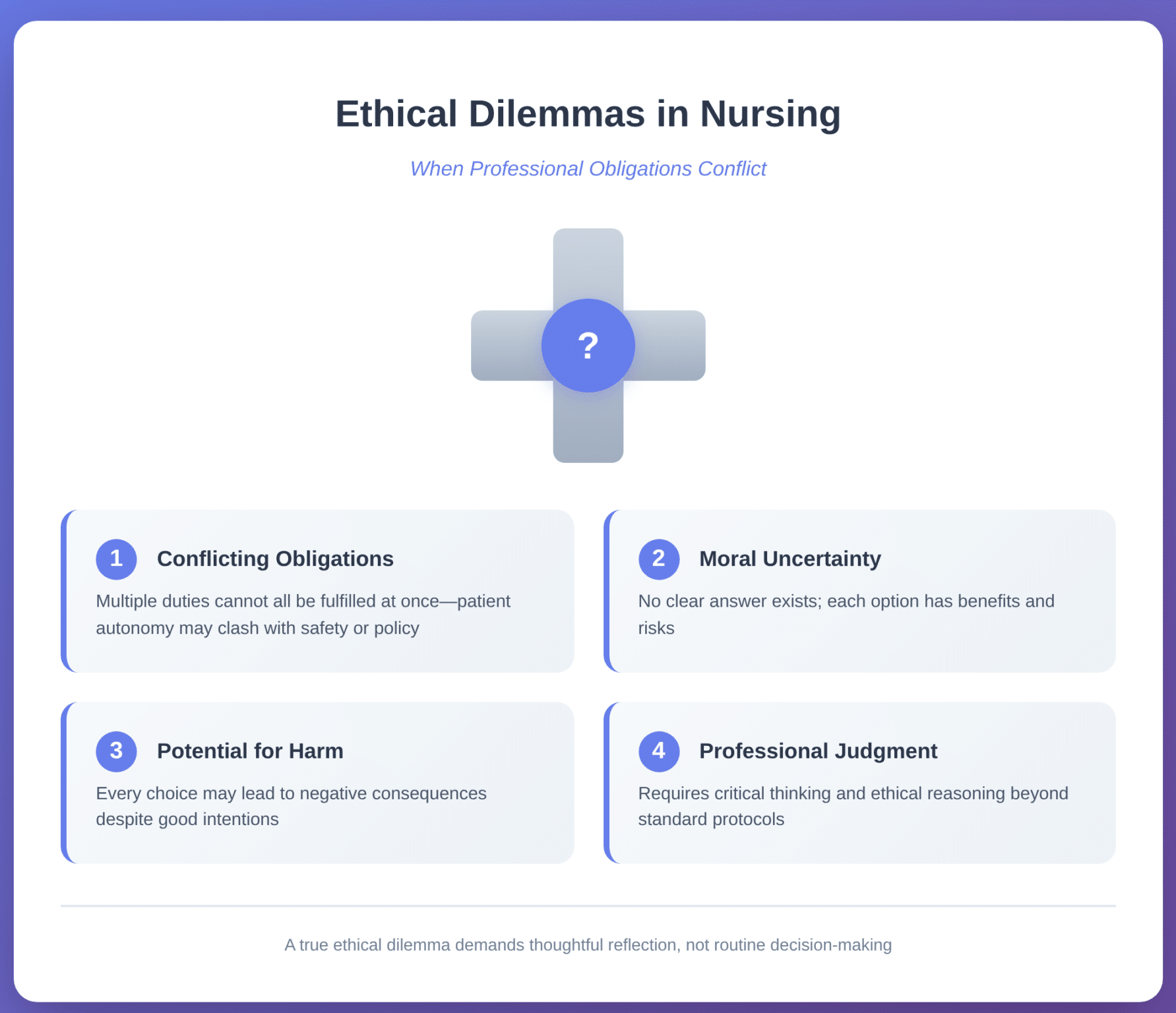
An ethical dilemma in nursing occurs when a nurse must choose between competing actions, each supported by professional reasoning, yet no option fully satisfies all ethical obligations. These situations go beyond routine clinical challenges and require thoughtful reflection because they involve conflicting values, duties, or responsibilities within the workplace.
A situation qualifies as an ethical dilemma when the following conditions are present:
- Conflicting ethical obligations
- The nurse faces two or more obligations that cannot all be fulfilled simultaneously.
- For example, respecting a patient’s autonomy may conflict with institutional rules or safety concerns.
- Moral uncertainty
- There is no clear or universally accepted solution.
- Each option carries potential benefits and risks, making it difficult to determine what is ethically preferable.
- Potential for harm
- Any chosen action may lead to negative consequences, even when the nurse’s intention is preventing harm.
- Ethical dilemmas rarely offer “perfect” outcomes.
- Need for professional judgment
- Resolution requires critical thinking, ethical reasoning, and professional judgment, rather than automatic reliance on protocols.
Nurses commonly encounter these dilemmas because of their unique position in healthcare systems. As frontline clinicians, nurses are responsible for direct patient care while also being accountable to organizational expectations. They frequently interact with managers, follow company policy, and work under institutional pressures such as staffing constraints, time limitations, and risk management priorities. Additionally, nurses often have access to important information about patients that may not be shared broadly, placing them in ethically sensitive situations where discretion and accountability are essential. These overlapping responsibilities make ethical conflict an inevitable part of daily nursing practice, particularly during extenuating circumstances such as emergencies or resource shortages.
Moral Dilemma vs Ethical Dilemma in Nursing
Although closely related, moral dilemmas and ethical dilemmas are not identical. Understanding their distinction helps nurses better interpret and respond to challenging situations.
A moral dilemma arises from an individual nurse’s internal belief system and sense of morality. It reflects personal convictions about what feels morally right or wrong, shaped by upbringing, culture, religion, and personal values. Moral dilemmas are often internal and emotional, creating discomfort even when professional expectations are clear.
An ethical dilemma, by contrast, is grounded in shared professional norms and standards. It reflects expectations that apply collectively to the nursing profession, regardless of individual beliefs. Ethical dilemmas require nurses to act in ways that uphold professional integrity, even when personal values are challenged.
The overlap between the two becomes evident in practice. For example:
- A nurse may feel that offering a white lie could reduce a patient’s anxiety.
- Professionally, however, nursing standards emphasize honesty and telling the truth to support informed decision making.
- The internal conflict reflects a moral dilemma, while the obligation to adhere to professional expectations reflects an ethical dilemma.
Recognizing this distinction allows nurses to separate personal discomfort from professional responsibility. It also supports reflective practice, helping nurses acknowledge emotional responses while still acting in accordance with ethical obligations.
Common Ethical Issues and Types of Ethical Dilemmas Nurses May Face
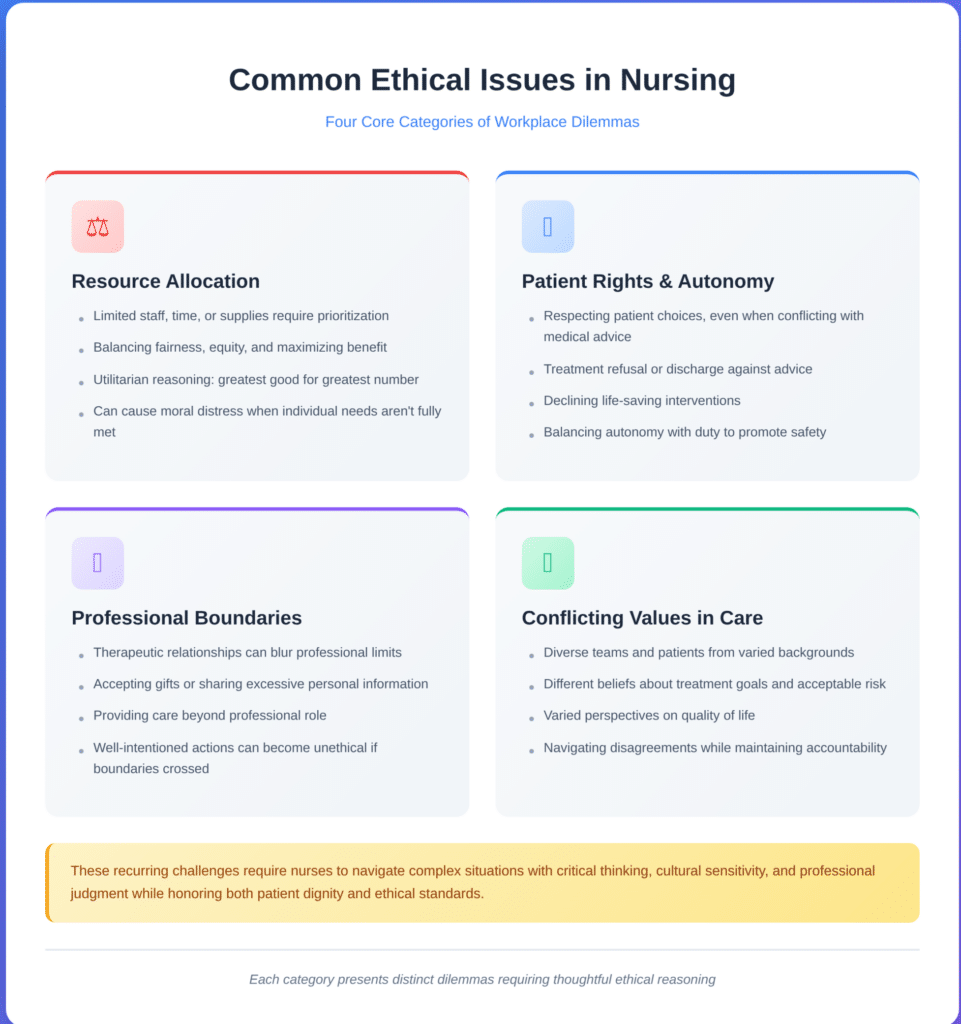
Nursing practice involves recurring ethical challenges that arise across diverse clinical settings. These challenges fall into several broad categories of common ethical issues, each presenting distinct types of ethical dilemmas.
1. Resource Allocation
- Limited staffing, time, or supplies may require nurses to prioritize care.
- Decisions often involve considerations of fairness, equity, and maximizing benefit.
- Ethical reasoning in these situations may align with utilitarian principles focused on what is good for the greatest number, a concept associated with John Stuart Mill and the greatest number of people.
- While pragmatic, such decisions can cause moral distress when individual patient needs cannot be fully met.
2. Patient Rights and Autonomy
- Nurses are ethically obligated to respect patient choices, even when those choices conflict with medical advice.
- Ethical dilemmas arise when patients refuse treatment, request discharge against advice, or decline life-saving interventions.
- Nurses must balance respect for autonomy with professional duties to promote safety and well-being.
3. Professional Boundaries
- Close therapeutic relationships can blur professional limits.
- Ethical concerns may arise when nurses:
- Accept gifts
- Share excessive personal information
- Provide care beyond their professional role
- Even well-intentioned actions can become unethical practices if boundaries are crossed.
4. Conflicting Values in Care Delivery
- Nurses work within diverse teams and serve patients from varied cultural and philosophical backgrounds.
- Differences in beliefs about treatment goals, acceptable risk, or quality of life can lead to ethical conflict.
- In such cases, nurses must navigate disagreements respectfully while maintaining professional accountability.
These categories illustrate the wide range of types of ethical dilemmas nurses may encounter. Recognizing patterns in ethical conflict enables nurses to anticipate challenges, evaluate options thoughtfully, and choose a defensible course of action that aligns with professional responsibilities and patient-centered care.
Ethics, Professional Standards, and Accountability in Nursing
The Role of Ethical Standards and the Nursing Code of Ethics
Ethical practice in nursing is grounded in clearly defined professional expectations that guide behavior, decision making, and accountability. Ethical standards provide a shared framework that helps nurses distinguish right or wrong actions within complex clinical environments, particularly in the workplace, where competing priorities and pressures are common. These standards are not abstract ideals; they function as practical tools that support consistency, fairness, and trust in professional nursing practice.
At the center of these standards is the code of ethics, which articulates the values, duties, and responsibilities expected of every nurse. The code serves several essential functions:
- Defining professional norms
- It establishes a baseline for acceptable conduct.
- It clarifies how nurses should act when faced with uncertainty or conflict.
- Supporting accountability
- Nurses are expected to comply with ethical guidance even when doing so is difficult.
- Ethical accountability extends beyond individual actions to include responsibilities toward patients, colleagues, and organizations.
- Guiding responses to ethical issues
- When nurses are facing an ethical dilemma, the code provides direction for evaluating options and choosing a defensible response.
- It reinforces ethical consistency across different care settings.
Ethical standards intersect with multiple layers of responsibility. Legally, nurses must adhere to laws and regulations governing patient care, documentation, and safety. Professionally, nurses are accountable to regulatory bodies, employers, and the nursing profession itself. Morally, nurses are expected to act ethically, demonstrating integrity, honesty, and respect for human dignity. These layers are interconnected: failure to meet ethical obligations can result in legal consequences, professional discipline, or loss of public trust.
For example, if a nurse observes misconduct that compromises patient safety, ethical standards require action even when reporting may be uncomfortable. In such situations, professional ethics prioritize patient protection and accountability over personal loyalty to colleagues or fear of conflict. Ethical standards therefore function as both a guide and a safeguard, helping nurses act with confidence and clarity when navigating complex professional responsibilities.
Moral Principles That Guide Ethical Nursing Practice
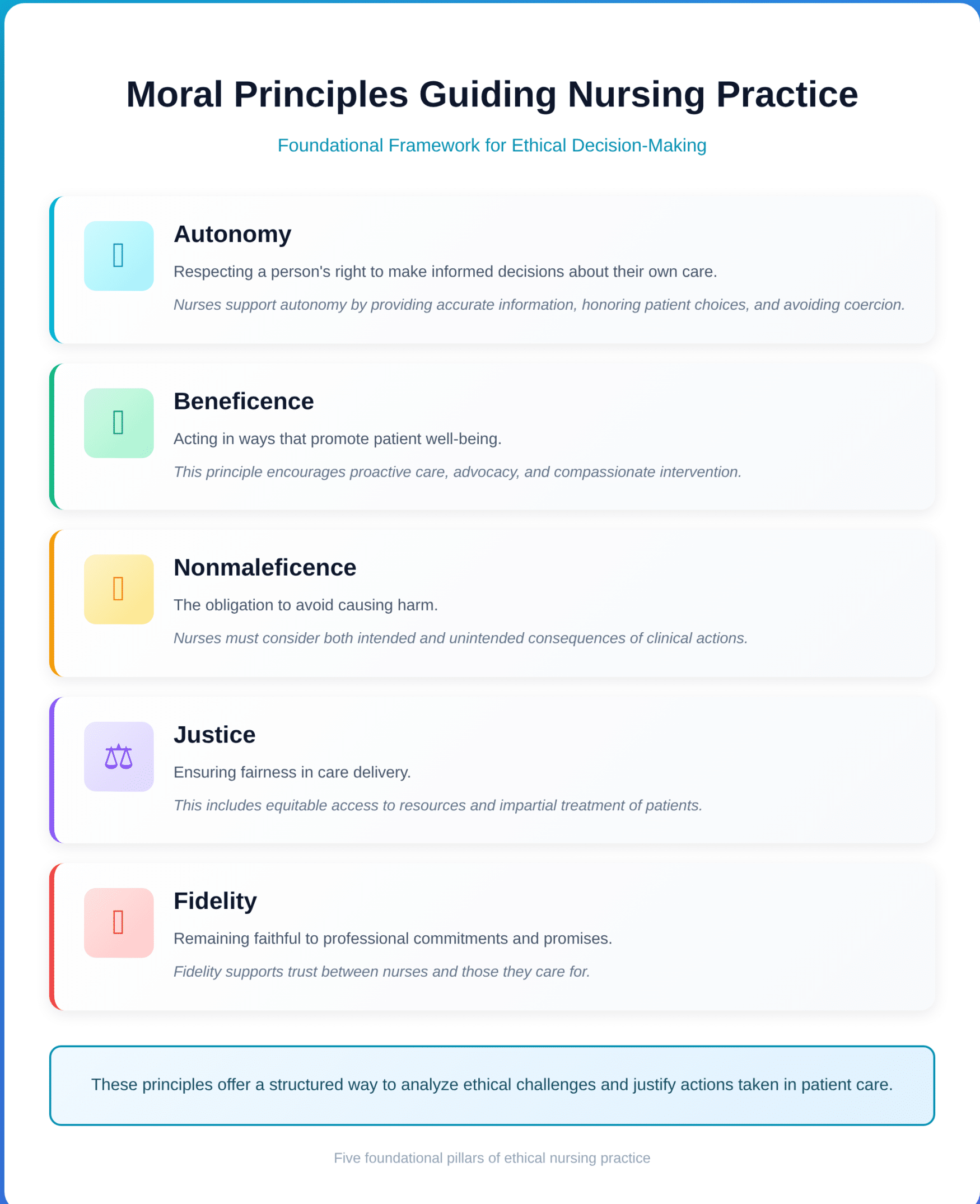
Ethical nursing practice is further shaped by foundational moral principles that inform how nurses evaluate situations and make decisions. These principles offer a structured way to analyze ethical challenges and justify actions taken in patient care.
Key moral principles include:
- Autonomy
- Respecting a person’s right to make informed decisions about their own care.
- Nurses support autonomy by providing accurate information, honoring patient choices, and avoiding coercion.
- Beneficence
- Acting in ways that promote patient well-being.
- This principle encourages proactive care, advocacy, and compassionate intervention.
- Nonmaleficence
- The obligation to avoid causing harm.
- Nurses must consider both intended and unintended consequences of clinical actions.
- Justice
- Ensuring fairness in care delivery.
- This includes equitable access to resources and impartial treatment of patients.
- Fidelity
- Remaining faithful to professional commitments and promises.
- Fidelity supports trust between nurses and those they care for.
Applying these principles requires thoughtful evaluation rather than rigid rule-following. In practice, principles may conflict, requiring nurses to weigh priorities and justify decisions. For example, respecting autonomy may clash with beneficence when a patient refuses a recommended treatment. In such cases, nurses must carefully assess the situation, consider the patient’s values, and support informed choice while continuing to provide compassionate care.
Moral principles also guide nurses in situations involving professional boundaries, resource limitations, and interprofessional collaboration. They help nurses assess not only what can be done, but what should be done, reinforcing ethical reflection as a core component of professional practice. By consistently applying moral principles, nurses strengthen ethical reasoning skills and contribute to a culture of accountability, trust, and professionalism within healthcare environments.
Ethical Decision-Making in Complex Nursing Situations
Ethical Decision-Making Frameworks Used in Nursing
Complex nursing situations often present ethical dilemmas where multiple courses of action are possible, each with potential benefits and risks. To navigate these challenges effectively, nurses rely on structured ethical decision-making frameworks that provide a systematic approach to resolving conflicts while upholding professional standards.
A commonly used framework involves the following step-by-step process:
- Recognize the ethical issue
- Identify the situation as an ethical dilemma rather than a routine clinical decision.
- Example: A nurse may notice a coworker administering medication incorrectly. The nurse must determine whether to intervene immediately, report the error, or follow additional institutional protocols.
- Gather relevant information
- Collect data about the patient’s condition, preferences, legal obligations, and organizational policies.
- Include perspectives from team members, patients, families, and managers.
- Example: Understanding a patient’s advance directives before making a recommendation about life-sustaining treatment.
- Identify stakeholders and their interests
- Recognize all parties affected by the decision, including patients, families, managers, and the workforce.
- Assess potential conflicts and ethical priorities.
- Consider ethical principles and standards
- Apply moral principles such as autonomy, beneficence, nonmaleficence, justice, and fidelity.
- Refer to the code of ethics, institutional policies, and legal requirements.
- Evaluate possible courses of action
- Examine potential outcomes and weigh benefits and harms.
- Consider how each option aligns with professional and ethical standards.
- Make a decision and implement a course of action
- Choose the most ethically defensible option.
- Take steps to advocate for the patient while complying with institutional company policy and ethical standards.
- Reflect and review outcomes
- After implementation, assess the decision’s impact on all stakeholders.
- Use lessons learned to strengthen future ethical decision making.
Managing Conflicts Between Patient Wishes, Family Demands, and Organizational Policies
Nurses frequently encounter ethical dilemmas in the workplace when patient choices conflict with family expectations or organizational policies. These scenarios require careful balance and professional judgment.
- Navigate competing interests ethically
- Prioritize the patient’s autonomy while considering legal and institutional constraints.
- Example: A patient may refuse a treatment recommended by the healthcare team, while family members insist on proceeding. The nurse must advocate for the patient’s decision while explaining implications to the family respectfully.
- Exercise advocacy and professional judgment
- Nurses act as patient advocates, ensuring that their voice is represented in care planning.
- Ethical practice involves both telling the truth to clarify risks and benefits and evaluating the best possible outcomes within existing policies.
- Example: In end-of-life care, a nurse may need to mediate discussions about DNR orders, ensuring the patient’s freedom of choice is honored even if family members disagree.
- Document the decision-making process
- Accurate documentation provides transparency and protects both the patient and the clinician.
- Documented ethical reasoning demonstrates how decisions align with moral principles and professional standards.
When and How to Escalate Ethical Concerns
Certain ethical dilemmas may exceed a nurse’s individual capacity to resolve and require escalation:
- Involving nurse managers
- Managers provide guidance, institutional authority, and support for difficult ethical decisions.
- Example: Reporting a co-worker’s misconduct in medication administration or breaches of confidentiality.
- Consulting ethics committees
- Formal committees offer structured evaluation of complex dilemmas involving multiple stakeholders.
- Example: An ethics committee may review cases where patient autonomy conflicts with legal obligations or family demands.
- Documentation and professional protection
- Maintaining clear records ensures compliance with ethical standards, organizational policy, and legal obligations.
- Documentation supports transparency, accountability, and defensible decision-making in retrospective reviews.
Confidentiality, Privacy, and Information Disclosure
Ethical Responsibilities Related to Patient Confidentiality and Privacy
Confidentiality and privacy are cornerstones of ethical nursing practice, forming the foundation of trust between nurses and patients. Maintaining confidential information is not only a professional obligation but also a legal requirement in most healthcare systems. Ethical responsibilities regarding confidentiality involve both legal and ethical foundations:
- Legal Foundations
- Nurses must comply with regulations that protect patient information, such as HIPAA in the United States.
- Legal obligations extend to proper handling of medical records, verbal communication, and electronic data.
- Failure to protect patient privacy may result in penalties, termination, or legal action.
- Ethical Foundations
- Ethical principles such as autonomy, fidelity, and nonmaleficence underscore the importance of safeguarding sensitive information.
- Maintaining privacy is part of ethical standards that define right and wrong in the workplace.
- Protecting confidentiality demonstrates respect for the patient’s dignity and promotes trust in the therapeutic relationship.
- Professional Standards
- The code of ethics emphasizes that nurses must manage information responsibly, only disclosing details when it is necessary for care or legally mandated.
- Nurses must exercise professional judgment to balance information sharing with privacy obligations, avoiding shortcuts that could compromise ethical compliance.
Example: A nurse receives information about a patient’s diagnosis of a communicable disease. Ethical and legal obligations require the nurse to share this information only with relevant healthcare providers directly involved in care, not with other team members or visitors.
Ethical Dilemmas Involving Disclosure of Patient Information
Disclosure of patient information often creates ethical dilemmas where nurses must weigh competing interests. Several common scenarios illustrate these challenges:
- Unauthorized Sharing
- Sharing patient information outside of professional boundaries is unethical and may be illegal.
- Example: A nurse discussing a patient’s condition with family members without consent. Even with good intentions, this constitutes an ethical breach.
- Social Media and Digital Records
- Digital platforms introduce new risks for unethical practices, such as posting identifiable patient information online.
- Nurses must recognize that even de-identified information may inadvertently disclose patient identity.
- Example: Sharing images of wound care procedures on social media, even for educational purposes, without proper anonymization, violates confidentiality.
- “Need-to-Know” vs Curiosity
- Nurses must differentiate between information necessary for clinical care and information accessed out of curiosity.
- Ethical dilemmas arise when team members request access to patient records without legitimate care-related purposes.
- Moral principles such as justice and fidelity guide nurses to restrict access appropriately.
Balancing Team Communication With Respect for Patient Privacy
Effective healthcare delivery depends on collaboration, yet collaboration must respect privacy. Nurses face the challenge of sharing information for safe patient care while upholding ethical standards:
- Ethical Collaboration
- Sharing information with relevant team members is essential for coordinated care.
- Nurses should follow company policies and institutional norms regarding communication channels and access permissions.
- Example: During handovers, only pertinent patient details are shared with oncoming staff, ensuring that sensitive information is not broadcast unnecessarily.
- Maintaining Trust While Working in Teams
- Trust among nurses and co-workers depends on consistent respect for privacy.
- Ethical practice requires careful management of shared information, demonstrating loyalty to professional responsibilities rather than personal relationships.
- Example: A nurse may be asked by a colleague for patient details; ethical judgment dictates withholding information that is not essential for direct care, thereby preventing unethical practices.
Ethical Dilemmas Involving Coworkers and Workplace Misconduct
Recognizing Unethical Behavior in the Nursing Workplace
Nurses are frequently placed in situations where they must evaluate not only patient care but also the behavior of team members. Recognizing unethical practices or misconduct is a critical aspect of maintaining professional integrity and ensuring patient safety. Ethical dilemmas arise when nurses observe colleagues acting in ways that violate professional or institutional standards, especially when direct intervention may cause conflict or personal risk.
Common forms of unethical behavior in the nursing workplace include:
- Negligence
- Failing to provide care that meets established standards can endanger patients.
- Example: A nurse repeatedly neglects to check a patient’s vital signs, resulting in delayed detection of deterioration. Observing this requires the witnessing nurse to make difficult decisions about intervention.
- Abuse
- Any form of physical, emotional, or psychological harm inflicted on patients violates moral principles and professional ethical standards.
- Example: A coworker verbally belittles a patient with dementia during routine care. Nurses must recognize the severity of abuse and understand their ethical obligation to intervene.
- Falsification of Records
- Deliberately altering medical documentation constitutes unethical conduct with potential legal consequences.
- Example: A nurse backdates medication administration logs to cover an omission. Such misconduct may compromise patient safety, violate compliance standards, and require immediate reporting.
- Boundary Violations
- Blurring professional boundaries can compromise trust, patient care, and workplace ethics.
- Example: Accepting personal favors from patients or providing care beyond scope may create conflicts of interest or ethical dilemmas.
Ethical Responses to Coworker Misconduct
Addressing unethical behavior among colleagues demands moral courage, professional responsibility, and careful judgment. Nurses must balance accountability with respect, ensuring that interventions are constructive rather than punitive. Key approaches include:
- Moral Courage and Professional Responsibility
- Nurses have a duty to act when observing misconduct, even if it involves challenging co-workers or hierarchical authority.
- Moral courage involves taking appropriate action while navigating potential retaliation fears.
- Addressing Behavior Respectfully and Ethically
- Engage the coworker directly, when appropriate, using a private and professional approach.
- Example: If a coworker demonstrates a minor lapse in infection control, a nurse may respectfully remind them of proper protocol and encourage correction.
- Escalation to a manager or supervisor may be necessary if the behavior persists or risks patient harm.
Reporting Misconduct to Protect Patient Safety
In some cases, addressing unethical behavior requires formal reporting to protect patients and maintain institutional accountability. Nurses may face an ethical dilemma between loyalty to colleagues and the obligation to ensure safety.
- Whistleblowing vs Retaliation Fears
- Whistleblowing involves reporting misconduct to higher authority when direct intervention is insufficient.
- Example: Reporting repeated falsification of medication records to hospital administration or an ethics committee.
- Nurses may fear retaliation, social isolation, or termination, which underscores the importance of supportive workplace policies and structured reporting mechanisms.
- Ethical and Legal Obligations to Report
- Ethical responsibility mandates that patient safety and preventing harm take priority over personal relationships.
- Legal frameworks often protect nurses who report misconduct in good faith, reinforcing the principle of compliance with ethical and institutional standards.
- Example: Reporting patient abuse ensures adherence to code of ethics and protects the clinician from potential liability.
Ethical Challenges in End-of-Life Care and Patient Autonomy
End-of-life care is one of the most ethically complex areas of nursing practice. Nurses often face ethical dilemmas that involve balancing patient autonomy, professional judgment, and family expectations, all while navigating organizational policies and moral responsibilities. These scenarios require thoughtful application of ethical standards, moral principles, and structured decision-making to ensure care aligns with patient-centered values.
Ethical Dilemmas in Life-Sustaining Treatment Decisions
Decisions regarding life-sustaining treatment present some of the most challenging ethical dilemmas in the workplace. Nurses must weigh clinical realities, patient wishes, and ethical obligations.
- DNR Orders
- “Do Not Resuscitate” (DNR) orders are formal directives that limit resuscitation efforts in case of cardiac or respiratory arrest.
- Ethical challenges arise when patients’ wishes conflict with family expectations or when clarity about the patient’s capacity is lacking.
- Example: A patient with terminal illness may request a DNR, but family members insist on full intervention. The nurse must advocate for the patient’s decision while ethically managing the family’s distress.
- Withdrawal vs Continuation of Care
- Nurses frequently encounter dilemmas when considering whether to continue aggressive interventions or focus on comfort and preventing harm.
- Ethical reasoning involves weighing beneficence (promoting well-being) against nonmaleficence (avoiding unnecessary suffering).
- Example: A nurse caring for a patient on mechanical ventilation may recognize that continued treatment is unlikely to improve prognosis. The nurse must communicate the implications and advocate for a course of action consistent with the patient’s values and best interests.
These decisions often require collaboration with team members, consultation with managers, and alignment with institutional company policy, ensuring that the patient’s rights remain central to the care plan.
Respecting Patient Autonomy When Families Disagree
Patient autonomy is a cornerstone of ethical nursing practice, but conflicts with family members can create significant moral and ethical tension. Nurses must carefully navigate these situations, balancing ethical obligations to the patient with the need for constructive collaboration.
- Advance Directives
- Written documents, such as living wills or healthcare proxies, specify patient preferences regarding treatment in situations where they may lose decision-making capacity.
- Ethical dilemmas occur when families challenge these directives or request actions contrary to the patient’s documented wishes.
- Example: A patient has a clear advance directive refusing dialysis, but family members insist on continuation. The nurse must advocate for honoring the patient’s choice, ethically resisting pressure to override autonomy.
- Substitute Decision-Makers
- When patients are incapacitated, designated proxies or legally recognized decision-makers speak on their behalf.
- Nurses must ensure that decisions made by these representatives reflect the patient’s values and previously expressed preferences, rather than the family’s convenience or personal values.
- Example: A nurse may encounter a substitute decision-maker who requests aggressive treatment contrary to the patient’s known wishes. Navigating this requires diplomacy, ethical clarity, and adherence to ethical standards.
Navigating Prognosis, Hope, and Ethical Nursing Judgment
End-of-life care often places nurses in emotionally charged situations where ethical judgment and communication skills are essential.
- Communicating Ethically
- Nurses must deliver information honestly while providing support and hope. Balancing realism with compassion requires sensitivity to the patient’s emotional state and cultural context.
- Example: A nurse may explain that a patient’s cancer prognosis is poor while emphasizing symptom management and quality of life, guiding decisions without imposing personal values.
- Emotional and Moral Distress in Nurses
- End-of-life scenarios can generate moral distress, particularly when nurses feel constrained by family demands, institutional policies, or clinical limitations.
- Ethical reflection, team support, and consultation with ethics committees help nurses manage stress while ensuring patient-centered care.
- Example: A nurse may feel discomfort when continuing invasive treatment perceived as futile but must respect the patient’s or surrogate’s wishes while documenting ethical reasoning.
Preventing and Preparing for Ethical Dilemmas in Nursing
Proactively preventing ethical dilemmas and preparing nurses to respond effectively is essential to maintaining a safe, professional, and patient-centered workplace. Prevention involves not only individual education but also fostering a culture of integrity, accountability, and open communication. By integrating structured ethics training and establishing supportive systems, nurses are better equipped to navigate complex situations while adhering to ethical standards and professional moral principles.
Education and Training in Ethics and Ethical Decision-Making
Education and training are foundational strategies for preparing nurses to manage ethical dilemmas in practice. Structured programs strengthen ethical decision making, enhance confidence, and promote ethical standards compliance.
- Ethics Training Programs
- Hospitals and healthcare institutions increasingly provide formal ethics training programs that cover topics such as confidentiality, patient autonomy, end-of-life care, and professional boundaries.
- Training emphasizes the code of ethics, highlighting real-world scenarios where nurses may face dilemmas.
- Example: A nurse attends a workshop on ethical dilemmas involving coworker misconduct, learning steps to navigate reporting procedures while maintaining professional relationships.
- Benefits include increased awareness of common ethical issues, improved adherence to legal and professional obligations, and enhanced moral judgment when making complex decisions.
- Simulation and Case-Based Learning
- Simulation exercises and case studies allow nurses to practice responding to ethically challenging scenarios in a safe environment.
- Example: A simulation may involve a patient refusing a critical intervention, forcing nurses to weigh beneficence, autonomy, and institutional policy while role-playing communication strategies.
- Case-based learning encourages reflection on ethical principles, decision-making frameworks, and potential consequences, preparing nurses for real-life situations without compromising patient safety.
- These exercises also develop skills in advocacy, moral courage, and balancing competing interests among team members, patients, and families.
Creating an Ethical Workplace Culture
Preventing ethical dilemmas also requires a systemic approach, embedding ethics into the organizational culture. Nurses function best in workplaces that prioritize transparency, respect, and accountability.
- Open Communication
- Encouraging open dialogue about ethical concerns allows nurses to raise questions, share insights, and report misconduct without fear of retaliation.
- Example: Regular ethics rounds or interdisciplinary meetings provide opportunities to discuss ethical dilemmas in the workplace, enabling collaborative problem-solving and reflective practice.
- Open communication reinforces trust between staff, management, and patients, promoting adherence to ethical standards.
- Leadership Support
- Leaders and managers play a critical role in modeling ethical behavior, providing guidance, and backing staff who raise ethical concerns.
- Example: A nurse manager supports a clinician in whistleblowing against unsafe practices, demonstrating organizational commitment to patient safety and professional integrity.
- Supportive leadership ensures that nurses feel empowered to act ethically even under challenging circumstances.
- Avoiding Unethical Shortcuts Under Pressure
- High-pressure environments can tempt nurses to take shortcuts that compromise patient safety or violate ethical standards.
- Training and policies should emphasize sustainable, ethically sound practices that balance efficiency with moral responsibility.
- Example: During a staffing shortage, a nurse may be tempted to skip thorough medication reconciliation. Ethical training reinforces that patient safety and preventing harm must take priority over expediency.
Conclusion
Ethical dilemmas are an inevitable aspect of nursing practice, arising from the complex interplay between patient needs, family expectations, professional responsibilities, and organizational policies. Whether navigating patient autonomy, end-of-life decisions, confidentiality, or coworker misconduct, nurses must balance multiple competing interests while upholding ethical standards, moral principles, and legal obligations. These challenges require more than technical skill—they demand ethical decision making, professional judgment, and moral courage.
Understanding the distinctions between moral dilemmas and ethical dilemmas, recognizing common ethical issues, and applying structured decision-making frameworks enable nurses to respond thoughtfully and responsibly. By integrating education, simulation, and reflective practice, nurses can anticipate potential ethical conflicts, strengthen their advocacy skills, and develop confidence in choosing an ethically defensible course of action.
Equally important is the cultivation of an ethical workplace culture. Open communication, leadership support, and clear guidance on reporting misconduct empower nurses to address dilemmas constructively and prevent unethical practices. Fostering such an environment not only protects patients but also supports the well-being and moral integrity of the nursing workforce.
Ultimately, ethical practice in nursing is about consistently striving to do what is right or wrong in alignment with professional codes, legal requirements, and the patient’s best interests. By embracing ethical awareness, continual education, and reflective decision-making, nurses uphold the trust placed in them, enhance patient care, and contribute to a healthcare system that values fairness, accountability, and compassionate care.
Frequently Asked Questions
What are some examples of ethical dilemmas in nursing?
- A patient refuses life-saving treatment (autonomy vs beneficence).
- Reporting a coworker’s misconduct or negligence.
- Balancing patient privacy with team communication.
- End-of-life care decisions, such as DNR orders or withdrawal of life support.
- Allocation of limited resources, like ICU beds during high demand.
What are the five common ethical dilemmas?
- Patient autonomy vs medical advice – respecting patient choices that conflict with clinical recommendations.
- Confidentiality breaches – maintaining privacy while sharing information for care.
- End-of-life decisions – determining life-sustaining treatment and respecting advance directives.
- Resource allocation – fair distribution of limited healthcare resources.
- Professional boundaries and misconduct – addressing unethical practices or coworker misconduct.
What are the 4 types of ethical dilemmas?
- Moral dilemmas – conflict between competing moral principles, e.g., honesty vs compassion.
- Clinical dilemmas – involve patient care decisions, e.g., withdrawing treatment.
- Organizational/administrative dilemmas – conflicts arising from company policy or staffing constraints.
- Social/ethical dilemmas – broader societal or legal issues, e.g., equitable access to care.
What are the top 5 ethical issues in healthcare?
- Patient autonomy and informed consent
- Confidentiality and privacy (HIPAA compliance)
- End-of-life care and life-sustaining treatment
- Allocation of scarce resources
- Professional misconduct and accountability