ATI RN Pediatric Nursing Online Practice 2023 B Study Guide
Summary of RN Pediatric Nursing Online Practice 2023 B
The RN Pediatric Nursing Online Practice 2023 B is a comprehensive clinical assessment designed to evaluate a nurse’s proficiency in caring for pediatric patients across the developmental spectrum, from infancy to adolescence. This 60-question exam emphasizes critical thinking, prioritization frameworks (such as Airway-Breathing-Circulation and Urgent vs. Non-Urgent), and safety protocols essential for high-quality pediatric care.
A significant portion of the RN Pediatric Nursing Online Practice 2023 B focuses on high-acuity physiological adaptation. Complex burn management is a major theme, testing the nurse’s ability to manage fluid resuscitation, prevent hypothermia, monitor for sepsis, and educate families on long-term rehabilitation including compression garments. Respiratory and cardiac competencies are rigorously tested through scenarios involving Cystic Fibrosis care, management of hypercyanotic spells in Tetralogy of Fallot, and recognizing signs of respiratory distress like nasal flaring or retractions in newborns.
The exam also addresses chronic condition management and metabolic disorders. It evaluates knowledge on Type 1 Diabetes (insulin administration and DKA recognition), Celiac disease dietary restrictions, and sickle cell anemia screening. Neurological assessments are prominent, covering seizure precautions, identifying increased intracranial pressure (ICP) in brain tumors, and distinguishing between bacterial meningitis and other infections.
Furthermore, the RN Pediatric Nursing Online Practice 2023 B prioritizes health promotion and safety. It includes essential guidelines for car seat installation, sunburn prevention, and recognizing signs of physical abuse or neglect. Psychosocial aspects, such as differentiating sleep terrors from nightmares and supporting families in hospice care, ensure the nurse is prepared to address the holistic needs of the child and family unit. This assessment serves as a vital tool for validating the clinical judgment required in diverse pediatric healthcare settings.
Struggling with Nursing Assignments or ATI/NCLEX Practice?
Get 100% original, expertly written nursing papers, care plans, case studies, and exam reviews – delivered on time!
Get Nursing Assignment Help NowTrusted by 10,000+ nursing students • 24/7 support • Plagiarism-free guarantee
RN Pediatric Nursing Online Practice 2023 B Answers with Rationale
| # | Question / Scenario | Correct Answer / Action | Detailed Rationale |
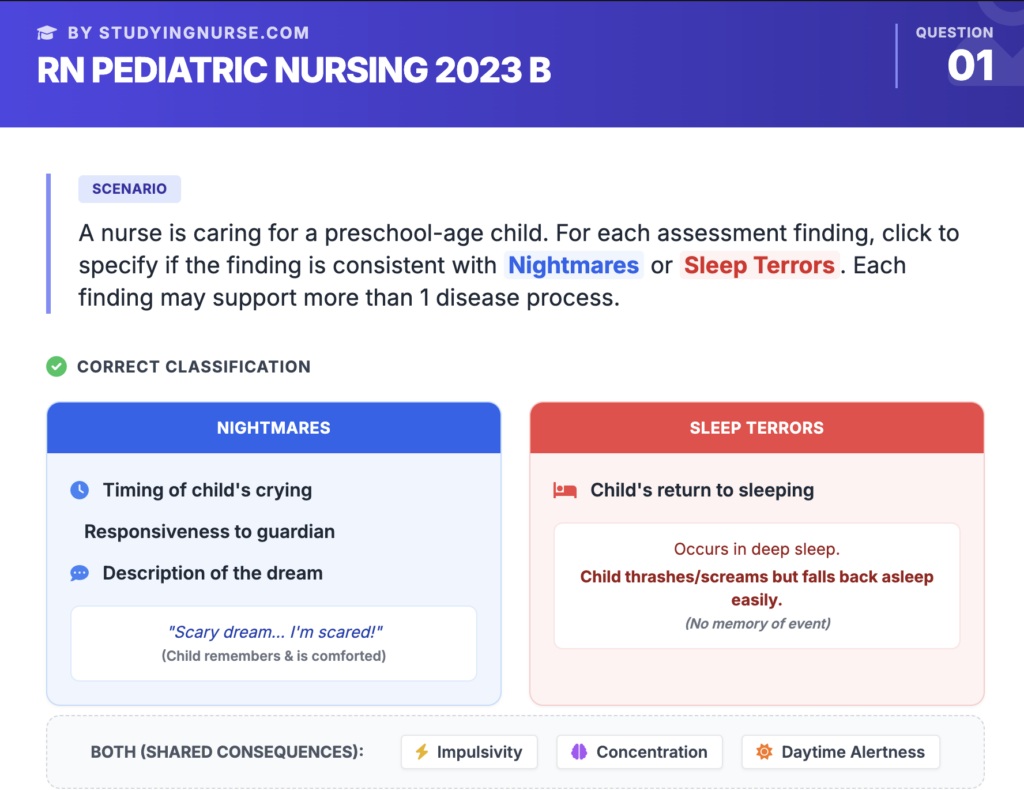
| 1 | A nurse is caring for a preschool-age child. For each assessment finding, click to specify if the finding is consistent with nightmares or sleep terrors. | Nightmares: – Timing of crying – Child’s responsiveness to guardian – Child’s description of dream Sleep Terrors: – Child’s return to sleeping Both: – Impulsivity – Child’s concentration – Daytime alertness | Nightmares: Awakening during the night after a scary dream. The child is often crying, fearful, believes the dream is real, and is responsive to comfort. Sleep Terrors: Partial awakening from deep sleep. Child may thrash or scream but does not remember the episode, is not comforted by others, and falls back asleep easily. Both: Both cause sleep disturbances leading to impaired concentration, fatigue, and impulsive behaviors. |
| 2 | A nurse is caring for a toddler who has acute otitis media and a temperature of 40° C (104° F). After administering acetaminophen, which of the following actions should the nurse plan to take to reduce the toddler’s temperature? | Dress the toddler in minimal clothing | Dressing the toddler in minimal clothing exposes the skin to air, which maximizes heat evaporation from the skin, effectively helping to reduce the body temperature. |
| 3 | A nurse on a pediatric unit is caring for a school-age child. After reviewing the information in the child’s medical record, which of the following findings should the nurse report to the provider? (Select 4) | 1. Arterial Blood Gases (ABGs) 2. WBC Count 3. Oxygen Saturation 4. Respiratory Assessment | ABGs: Indicate respiratory alkalosis (hyperventilation/hypoxia). WBC Count: Above reference range, indicating infection/inflammation. Oxygen Saturation: Decreased despite supplemental oxygen. Respiratory Assessment: Shows distress (tachypnea, retractions, wheezing). |
| 4 | A nurse is caring for a preschooler who has congestive heart failure. The nurse observes wide QRS complexes and peaked T waves on the cardiac monitor. Which of the following prescriptions should the nurse clarify with the provider? | Potassium chloride | Wide QRS complexes and peaked T waves are classic signs of hyperkalemia (high potassium). Administering more potassium (potassium chloride) would worsen this dangerous imbalance. |
| 5 | A nurse is caring for a toddler. Complete the diagram… specify what condition the client is most likely experiencing, 2 actions to take, and 2 parameters to monitor.1 | Condition: Cystic Fibrosis2 Actions:3 1. Educate guardian about sweat chloride testing4 2. Prepare toddler for chest physiotherapy5 Parameters:6 1. Oxygen saturation level7 2. Stools | The symptoms (respiratory infections, salty sweat, fatty stools/steatorrhea, failure to gain weight) strongly point to Cystic Fibrosis. Actions: Sweat chloride test confirms diagnosis; chest PT helps clear mucus. Parameters: Monitor O2 for respiratory status and stools for malabsorption/enzyme efficacy.8 |
| 69 | A school nurse is preparing to administer atomoxetine 1.2 mg/kg/day PO to a school-age child w10ho weighs 75 lb. Available is atomoxetine 40 mg/capsule. How many capsules should the nurse administer per day? | 1 capsule | 1. Convert lb to kg: $75 \text{ lb} / 2.2 = 34.09 \text{ kg}$ 2. Calculate dose: $1.2 \text{ mg} \times 34.09 \text{ kg} = 40.9 \text{ mg}$ 3. Divide by available dose: $40.9 / 40 = 1.02$ 4. Round to nearest whole number: 1 |
| 7 | A nurse is caring for a toddler who is experiencing acute diarrhea and has moderate dehydration. Which of the following nutritional items should the nurse offer to the toddler?11 | Oral rehydration solution12 | Oral rehydration solutions (ORS) are specifically designed to replace electrolytes and water by pro13moting the reabsorption of sodium and water in the intestines, which is critical for treating dehydration. |
| 8 | A nurse is caring for a toddler. Click to highlight the findings that require follow-up. | – Toddler appears lethargic – Toddler is uninterested in eating – Ribbon-like, foul-smelling stools – Hypoactive bowel sounds – Abdomen distended – Palpable fecal mass – Blood pressure 110/70 mm Hg | These findings indicate the toddler’s constipation has worsened and suggest Hirschsprung’s disease (megacolon), characterized by ribbon-like stools, distention, and palpable masses. The elevated BP and lethargy also indicate distress. |
| 9 | A nurse in a provider’s office is caring for a preschooler (Atopic Dermatitis teaching). Which statements indicate teaching was effective? (Select all that apply) | 1. “We should apply a skin emollient immediately after bathing our child.”14 2. “We should keep our child’s fingernails trimmed short.”15 3. “We should use a mild detergent for our laundry.”16 | Emollients: Lock in moisture when skin is damp.17 Trim18med nails: Prevent skin damage/infection from scratching. Mild detergent: Reduces allergens and itching. |
| 10 | A nurse is preparing to administer ibuprofen 5 mg/kg… to an infant who weighs 17.6 lb. Available is ibuprofen 100 mg/5mL. How many mL should the nurse administer per dose? | 2 mL | 1. Convert lb to kg: $17.6 \text{ lb} / 2.2 = 8 \text{ kg}$ 2. Calculate dose: $5 \text{ mg} \times 8 \text{ kg} = 40 \text{ mg}$ 3. Calculate volume: $\frac{40 \text{ mg}}{100 \text{ mg}} \times 5 \text{ mL} = 0.4 \times 5 = \textbf{2 mL}$ |
| 11 | A nurse is providing dietary teaching to the parent of a school-age child who has celiac disease. The nurse should recommend which of the following foods? | White rice | Celiac disease requires a strict gluten-free diet (No wheat, barley, rye, or oats). White rice is naturally gluten-free and safe to consume. |
| 12 | A nurse on a pediatric unit is admitting a preschooler… The nurse should identify that the child is at risk for developing ______ as evidenced by ______. | Risk: Splenomegaly Evidenced by: Positive mononucleosis rapid test | The positive rapid test indicates Infectious Mononucleosis (Epstein-Barr Virus). A common and serious complication of mono is splenomegaly (enlarged spleen), placing the child at risk for splenic rupture. |
| 13 | A nurse is assessing an infant who has pneumonia. Which of the following findings is the priority to report? | Nasal flaring | Using the Airway, Breathing, Circulation (ABC) framework, nasal flaring is a sign of severe acute respiratory distress and increased work of breathing, requiring immediate intervention. |
| 14 | A school nurse is caring for a child following a tonic-clonic seizure. Which of the following actions should the nurse take first? | Check the child’s respiratory rate | Using the ABC priority framework, the first post-ictal action is to assess breathing. If the child is not breathing, rescue breaths may be required. |
| 15 | A nurse is providing discharge teaching… for a child who is 1 week post-op cleft palate repair. For which team member should the nurse initiate a referral? | Speech therapist | A cleft palate (and its repair) significantly affects the structures needed for speech. Speech therapy is essential immediately following repair to support proper articulation and development. |
| 16 | A nurse is planning developmental activities for a newly admitted 10-year-old child who has neutropenia. Which activity should the nurse plan? | Provide the child with a book about adventure | Neutropenia requires isolation to prevent infection. Reading is a solitary, safe activity. Developmentally, school-age children (industry vs. inferiority) enjoy stories where they can imagine themselves as powerful or skillful. |
| 17 | A nurse is caring for a school-age child who is receiving a blood transfusion. Which manifestation should alert the nurse to a possible hemolytic transfusion reaction? | Flank pain | Flank pain is a classic sign of a hemolytic reaction, caused by the breakdown of Red Blood Cells (hemolysis) lodging in the kidneys. |
| 18 | A nurse is caring for an infant… with Tetralogy of Fallot who begins to have a hypercyanotic spell. Which action should the nurse take? | Place the infant in a knee-chest position | The knee-chest position (“Tet squat”) increases systemic vascular resistance. This forces more blood through the pulmonary artery (to the lungs) rather than shunting it to the body, improving oxygenation. |
| 19 | A nurse is creating a plan of care for a newly admitted adolescent who has bacterial meningitis. How long should the nurse plan to maintain droplet precautions? | For 24 hr following initiation of antimicrobial therapy | The client is considered contagious until they have received at least 24 hours of antibiotic therapy. Droplet precautions prevent spread to others. |
| 20 | A nurse is planning care for a school-age child who has a tunneled central venous access device. Which intervention should the nurse include? | Use a semipermeable transparent dressing to cover the site | A semipermeable transparent dressing allows visual inspection of the insertion site for infection while providing a barrier against microorganisms. |
| 21 | A nurse is planning care for a school-age child in the oliguric phase of acute kidney injury (AKI) with a sodium level of 129 mEq/L. Which intervention should be included? | Initiate seizure precautions | Sodium of 129 mEq/L indicates hyponatremia. Severe hyponatremia causes cerebral edema and significantly increases the risk of neurological deficits and seizures. |
| 22 | A nurse is teaching the guardian of a 6-month-old infant about car seat use. Which statement indicates understanding? | “I should secure the car seat using lower anchors and tethers instead of the seat belt.” | The LATCH system (Lower Anchors and Tethers for Children) is designed to secure car seats directly to the vehicle frame. If used, the seat belt is not necessary (and using both can sometimes be unsafe depending on the manufacturer). |
| 23 | A nurse is caring for an infant who has RSV. Which action should the nurse implement in infection control? | Have a designated stethoscope in the infant’s room | RSV is spread by direct contact with secretions. Droplet/Contact precautions require dedicated equipment (stethoscope, BP cuff) to remain in the room to prevent cross-contamination to other patients. |
| 24 | A nurse is assessing a 3-year-old toddler at a well-child visit. Which manifestation should the nurse report to the provider? | Respiratory rate 45/min | A respiratory rate of 45/min is significantly elevated (tachypnea) for a 3-year-old (expected range 20-25/min), indicating potential respiratory distress or dysfunction. |
| 25 | A nurse is reviewing the laboratory report of a 7-year-old child receiving chemotherapy. Which test should the nurse review to evaluate for anemia? | Hgb (Hemoglobin) | Chemotherapy suppresses bone marrow (myelosuppression). Anemia is the reduction of Red Blood Cells, evaluated by checking Hemoglobin (Hgb) and Hematocrit levels. |
| 26 | A nurse is providing discharge teaching to the parent of a school-age child who has moderate persistent asthma. Which instruction should the nurse include? | “Pulmonary function tests will be performed every 12 to 24 months to evaluate how your child is responding to therapy.” | Pulmonary Function Tests (PFTs) are vital for tracking the progression of lung disease and the effectiveness of the treatment plan as the child grows. |
| 27 | A nurse is caring for an infant receiving treatment for severe dehydration. Which finding indicates the treatment is effective? | Capillary refill less than 2 seconds | Delayed capillary refill is a sign of dehydration/poor perfusion. A return to normal refill time (<2 seconds) indicates blood volume and hydration status are restored. |
| 28 | A nurse is receiving change-of-shift report for four children. Which child should the nurse assess first? | A toddler who has a concussion and is experiencing an episode of forceful vomiting | Forceful vomiting in a child with a head injury (concussion) is a sign of increased intracranial pressure (ICP). This is a neurological emergency requiring immediate assessment. |
| 29 | A nurse is assessing a school-age child who has peritonitis. Which finding should the nurse expect? | Abdominal distention | Peritonitis (inflammation of the abdominal lining) causes an ileus (bowel paralysis) and fluid accumulation, leading to significant abdominal distention. |
| 30 | A nurse is assessing an infant who has a ventricular septal defect (VSD). Which finding should the nurse expect? | Loud, harsh murmur | A VSD allows blood to shunt from the high-pressure left ventricle to the low-pressure right ventricle, creating a characteristic loud, harsh murmur. |
| 31 | A nurse is performing a physical assessment on a 2-week-old male newborn. Which finding is priority to report? | Substernal retractions | Substernal retractions indicate increased work of breathing and significant respiratory distress. In a newborn, this can quickly progress to respiratory failure (ABC priority). |
| 32 | A nurse is monitoring the oxygen saturation level of an infant using pulse oximetry. The nurse should secure the sensor to which area? | Great toe | For infants, the great toe is a common and accurate site for pulse oximetry probes. A sock should be placed over it to secure it and block ambient light. |
| 33 | A nurse is caring for a 4-year-old child rescued from a home fire. Which findings require immediate follow-up? (Select 3) | 1. Partial- and full-thickness burns to anterior chest and neck 2. SaO2 89% on room air 3. Heart rate 150/min | Chest/Neck Burns: Risk of inhalation injury and airway edema (obstruction). SaO2 89%: Indicates hypoxia/respiratory distress. HR 150: Tachycardia indicates shock/hypovolemia. |
| 34 | Burn patient case study (4-year-old). Which potential provider prescriptions are Anticipated or Contraindicated? | Anticipated: – Insert indwelling urinary catheter – Provide 100% oxygen via face mask – Weigh the child Contraindicated: – Apply sterile gauze soaked with cool 0.9% sodium chloride | Anticipated: Catheter monitors urine output (fluid status). Oxygen treats hypoxia. Weight is needed for fluid resuscitation calculations. Contraindicated: Wet, cool dressings on extensive burns (>10% TBSA) can cause hypothermia. Burns should be covered with clean, dry cloth. |
| 35 | Burn patient case study (Day 4). The nurse should first address the client’s ______, followed by the client’s ______. | First: Temperature Followed by: Pain | Temperature: Fever on day 3-5 suggests wound sepsis/infection, which is life-threatening (Sepsis is an urgent physiological threat). Pain: Severe (8/10) but secondary to the risk of sepsis. |
| 36 | Burn patient case study (Day 14). Prescriptions: Anticipated or Contraindicated? | Anticipated: – Change morphine to family-controlled analgesia (PCA) – Obtain wound culture – Place on pressure-reduction mattress Contraindicated: – Limit daily protein intake | PCA: Effective for pain management. Culture: Malodorous green drainage indicates infection. Mattress: Prevents pressure injuries (occiput). Contraindicated: Burn patients are in a hypermetabolic state and require High Protein/High Calorie diets for healing. |
| 37 | The nurse is caring for the child following hydrotherapy… SaO2 is 93%, Respiratory rate 24/min, Temp 35.8 C. Which actions should the nurse take? (Select all that apply) | 1. Provide 100% oxygen via face mask 2. Check anterior neck and chest dressing for bleeding 3. Place a warm blanket on the child 4. Keep the child’s head in a neutral position | O2: Corrects hypoxia (SaO2 <95%). Bleeding: Standard post-procedure check. Warm Blanket: Corrects hypothermia (35.8 C). Neutral Head: Prevents contractures and protects neck grafts. |
| 38 | Discharge teaching for burn patient (Day 36). Which statements indicate understanding? (Select 6) | 1. “I should apply a moisturizer to the scar tissue.” 2. “I will use a measured spoon… to give hydroxyzine.” 3. “I can give hydroxyzine every 6 hours as needed.” 4. “Puppet play can be helpful…” 5. “I need to assess for redness… before applying splint.” 6. “My child will need to use a compression garment…” | Moisturizer: Reduces itching. Measured Spoon: Ensures accurate dosing. Hydroxyzine: Manages itching (PRN). Puppet Play: Emotional expression. Splint Check: Prevents pressure ulcers. Compression: Minimizes hypertrophic scarring. |
| 39 | A nurse is preparing to collect a sample from a toddler for a sickle-turbidity test. Which action should the nurse take? | Perform a finger stick | The sickle-turbidity test (Sickledex) is a screening tool that can be performed via a finger stick. Positive results require confirmation via electrophoresis. |
| 40 | A hospice nurse is caring for a preschooler… Parent says “I cannot cope anymore…”. Which statement should the nurse make? | “Let’s talk about some of the ways you have handled previous stressors in your life.” | This therapeutic communication technique encourages the parent to reflect on their own coping mechanisms and strengths, opening a dialogue about managing the current crisis. |
| 41 | A nurse is planning to teach caregivers about protecting children from sunburns. Which instruction should be included? | “Choose a waterproof sunscreen with a minimum SPF of 15.” | A minimum SPF of 15 is recommended (though often higher is better) applied prior to sun exposure to reduce UV damage. |
| 42 | A parent asks when their child with varicella (chickenpox) will no longer be contagious. What is the response? | “When your child’s lesions are crusted, usually 6 days after they appear.” | Varicella is contagious from 1-2 days before the rash appears until all lesions have crusted over (scabbed). |
| 43 | A nurse is caring for a school-age child who has peripheral edema. Which assessment should be performed to confirm peripheral edema? | Palpate the dorsum of the child’s feet | Pressing against a bony prominence (like the top of the foot) for 5 seconds assesses for pitting edema, a sign of fluid overload or heart failure. |
| 44 | Teaching a parent about preventing Sudden Unexplained Infant Death (SUID). Which instruction should be included? | “Give the infant a pacifier at bedtime.” | Evidence shows that pacifier use during sleep is a protective factor against SUID/SIDS. (Breastfeeding is also protective). |
| 45 | Discharge teaching for a toddler with a lower leg cast applied 24 hr ago. Report which finding? | Restricted ability to move the toes | Restricted movement indicates neurovascular compromise (nerve damage or compartment syndrome). This is a medical emergency requiring immediate attention to prevent permanent damage. |
| 46 | Teaching a child with Type 1 Diabetes about insulin. Which statement indicates understanding? | “I will give myself a shot of regular insulin 30 minutes before I eat breakfast.” | Regular insulin is short-acting with an onset of 30-60 minutes. It should be administered 30 minutes before meals so the peak effect coincides with food absorption. |
| 47 | A nurse is caring for a toddler who has partial thickness burns on their right arm. Which action should the nurse take? | Cleanse the affected area with mild soap and water | For minor/partial thickness burns, cleansing with mild soap and tepid water removes loose tissue and debris, preventing infection. |
| 48 | A nurse is assessing a school-age child who has meningitis. Which finding is the priority to report? | Petechiae on the lower extremities | A petechial or purpuric rash is a sign of Meningococcemia (meningococcal sepsis). This indicates the infection has spread to the blood, leading to rapid shock and death. |
| 49 | A school nurse is providing an in-service about education for students who have ADHD. Which statement indicates understanding? | “I will teach challenging academic subjects to students who have ADHD in the morning.” | Students with ADHD often have better focus and concentration in the morning. Additionally, stimulant medications administered in the morning are at peak effectiveness during this time. |
| 50 | A nurse is planning nutrition for a preschooler who has cystic fibrosis. Which intervention should be included? | Increase fat content in the child’s diet to 40% of total calories | Cystic Fibrosis causes pancreatic insufficiency (poor fat digestion). Patients need high-fat, high-calorie diets (up to 40% fat) to maintain growth and nutrition. |
| 51 | A school nurse is assessing an adolescent who has scoliosis. Which finding should the nurse expect? | A unilateral rib lump | Scoliosis (lateral curvature of the spine) causes asymmetry. When the child bends forward at the waist (Adam’s Forward Bend Test), a unilateral rib hump is visible due to spinal rotation. |
| 52 | A nurse is preparing to administer an immunization to a 4-year-old child. Which action should the nurse plan to take? | Administer the immunization using a 24-gauge needle | For intramuscular injections in preschoolers, a 22 to 25-gauge needle is appropriate to minimize pain while delivering the medication effectively. |
| 53 | A nurse is assessing a school-age child who has an infratentorial brain tumor. Which finding is a manifestation of increased intracranial pressure (ICP)? | Difficulty concentrating | Manifestations of increased ICP include irritability, difficulty concentrating, inability to follow commands, headache, and vomiting due to pressure on brain structures. |
| 54 | A nurse is assessing a child with Diabetic Ketoacidosis (DKA). Which respiratory finding should the nurse expect? | Deep respirations of 32/min | These are Kussmaul Respirations (rapid and deep). The body is attempting to blow off carbon dioxide (an acid) to compensate for the metabolic acidosis caused by DKA. |
| 55 | A nurse is reviewing lumbar puncture results for suspected bacterial meningitis. Which finding indicates bacterial meningitis? | Increased protein concentration | Bacterial meningitis typically presents with: Increased Protein, Decreased Glucose, and Increased WBCs in the CSF. |
| 56 | A nurse is caring for a school-age child who has appendicitis and rates abdominal pain as 7/10. Which action should the nurse take? | Give morphine 0.05 mg/kg IV | A pain score of 7/10 is severe. Opioid analgesics (like morphine) are appropriate for management. Pain management does not mask appendicitis signs significantly and is humane care. |
| 57 | A child receiving cefazolin via IV bolus develops diffuse flushing and angioedema. After stopping the infusion, which medication should be administered first? | Epinephrine | The symptoms (flushing, angioedema) indicate Anaphylaxis. Epinephrine is the first-line drug of choice to reverse bronchoconstriction and vasodilation. |
| 58 | A nurse is caring for a child who has experienced a tonic-clonic seizure. Which action should the nurse take during the immediate postictal period? | Place the child in a side-lying position | The side-lying position prevents aspiration of saliva or vomit, which is a high risk during the postictal phase when the child is drowsy or unconscious. |
| 59 | A school nurse is assessing an adolescent who has multiple burns in various stages of healing. Which behavior indicates possible physical abuse? | Denies discomfort during assessment of injuries | A “blunted response” to pain or injury, or denying pain associated with obvious trauma, is a psychological coping mechanism seen in victims of chronic abuse. |
| 60 | A nurse is teaching the guardian of a 6-month-old infant about teething. Which statement should the nurse make? | “Your baby might pull at their ears when they are teething.” | Teething pain radiates to the ears. Infants often pull at their ears to relieve the discomfort. Other signs include drooling, fussiness, and difficulty sleeping. |