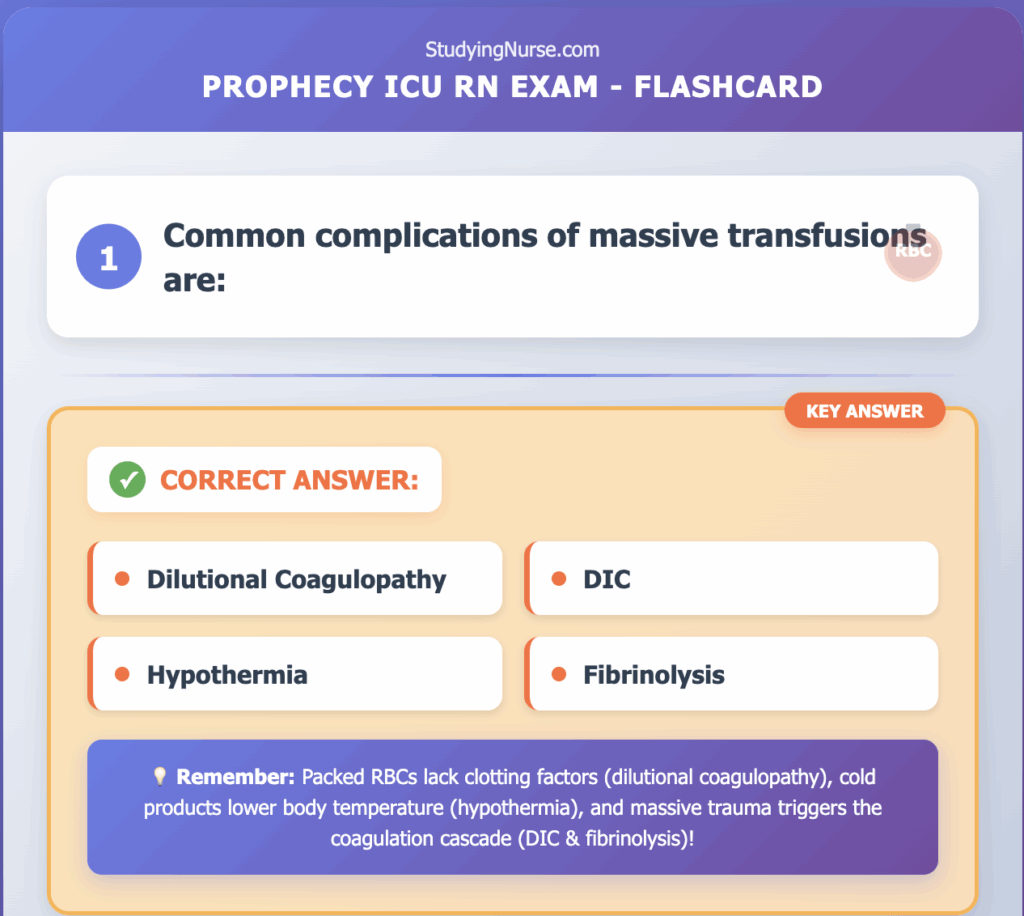
| 1 | Common complications of massive transfusions are… 1 | Dilutional Coagulopathy, DIC, hypothermia, and fibrinolysis 2 | Massive transfusion replaces volume but dilutes clotting factors. Stored blood is cold (hypothermia) and citrate in blood binds calcium, affecting clotting. |
| 2 | ABG pH 7.25, pCO2 40, pO2 90, HCO3 20mEq/L 3 | Metabolic Acidosis 4 | Low pH (acidosis) + Normal PaCO2 + Low HCO3 (metabolic) indicates primary metabolic acidosis. |
| 3 | Long term use of TPN may lead to: 5 | Liver Failure 6 | TPN bypasses the GI tract, leading to bile stasis, steatosis, and eventual hepatic dysfunction. |
| 4 | Which of the following is a potential complication of high PEEP 7 | Pneumothorax 8 | High Positive End-Expiratory Pressure increases intrathoracic pressure, risking alveolar rupture (barotrauma). |
| 5 | What is a common assessment finding for a patient returning from a small bowel resection? 9 | Hypoactive bowel sounds 10 | Anesthesia and bowel manipulation during surgery typically cause temporary paralytic ileus. |
| 6 | Your patient suddenly becomes diaphoretic, anxious, tachycardic, and has clammy skin. Which of the following would you suspect? 11 | Hypoglycemia 12 | These are classic signs of sympathetic nervous system activation triggered by low blood sugar. |
| 7 | The staff nurse asks the nursing assistant to check on a patient… The patient is experiencing chest pain… Which of the following can the staff nurse delegate to the assistant? 13 | Gathering vitals and assessing the cause for the change in status | Note: While the text selects this option, technically a CNA cannot “assess cause.” They can only gather vitals. However, compared to other options (calling MD, giving meds), this is the “best” distractor available in this specific test bank. |
| 8 | Your patient returned from PACU… attempts to eat a candy bar and begins to choke. The physician is unable to clear the airway. You would expect to prepare for which emergency procedure? 15 | Bronchoscopy | If manual clearance fails, a bronchoscope is required to visualize and retrieve the foreign object from the airway. |
| 9 | The initial insulin therapy for a patient with acute DKA is usually administered by which route | Intravenous bolus followed by a continuous infusion | IV delivery ensures immediate onset to reverse ketosis, while continuous infusion prevents rapid drops in glucose. |
| 10 | Screening tests for DIC include: 19 | D-Dimer and FDPs 20 | Elevated Fibrin Degradation Products and D-Dimer indicate the simultaneous clotting and bleeding characteristic of DIC. |
| 11 | Which of the following hormones is secreted by the hypothalamus in an effort to regulate water balance? 21 | ADH 22 | Antidiuretic Hormone (Vasopressin) regulates water retention in the kidneys. |
| 12 | Which of the following IV sedatives would most likely be ordered for a non-intubated patient? 23 | Precedex 24 | Dexmedetomidine (Precedex) sedates without significant respiratory depression, making it safe for non-intubated patients. |
| 13 | Your patient is in bed and eating lunch when they begin to cough and gag. Suddenly they become dyspneic and bradycardic… What do you suspect happened? 25 | Aspiration 26 | Food entering the airway triggers a vagal response (bradycardia) and airway obstruction (dyspnea). |
| 14 | Which of the following is a response of the cardiovascular system to early sepsis? 2727 | Increased cardiac output and reduced systemic vascular resistance 28282828 | Early “warm” sepsis is characterized by vasodilation (low SVR) and compensatory tachycardia (high CO). |
| 15 | Which patient would you expect to be extubated? 29 | Patient is awake, follows commands with RR of 14, FiO2 40%, and PEEP 5 30 | This patient meets the criteria: neurological stability and minimal respiratory support requirements. |
| 16 | Hypertensive crisis 31 | Nicardipine 32 | Nicardipine (Cardene) is a calcium channel blocker used for rapid, titratable blood pressure reduction. |
| 17 | Your patient sustained a crushed pelvis… You notice a pinkish sediment in the urinary catheter tubing and decreased urinary output. Which condition would you suspect? 33 | Rhabdomyolysis 34 | Muscle trauma releases myoglobin (causing pink/tea urine), which obstructs renal tubules leading to kidney failure. |
| 18 | Which class of drugs should be avoided in patients with asthma? 35 | Beta Blockers 36 | Non-selective beta-blockers can cause bronchoconstriction. |
| 19 | CAM-ICU is a measure for which condition? 37 | Delirium 38 | Confusion Assessment Method for the ICU is the gold standard for monitoring delirium. |
| 20 | Which of the following drugs would you expect to administer in a patient diagnosed with myasthenia gravis? 39 | Mestinon 40 | Pyridostigmine (Mestinon) improves muscle strength by preventing the breakdown of acetylcholine. |
| 21 | ABG pH 7.56, paCO2 24 mmHG, HCO3 23 mEq/L 41 | Respiratory Alkalosis 42 | High pH (alkalosis) + Low PaCO2 (respiratory) indicates respiratory alkalosis. |
| 22 | When assessing a chest tube, which of the following indicates a possible air leak 43 | Excessive bubbling in the water chamber 44 | Continuous bubbling in the water seal chamber suggests air is leaking from the lung or the tubing system. |
| 23 | Which of the following medications improves contractility, increases stroke volume, and increases cardiac output? 45 | Dobutamine 46 | Dobutamine is a beta-1 agonist/positive inotrope used to treat heart failure. |
| 24 | Muffled heart sounds would indicate what condition? 47 | Cardiac tamponade 48 | Fluid in the pericardial sac acts as an insulator, muffling the sound of the heartbeat (part of Beck’s Triad). |
| 25 | Pain assessment in an unconscious patient 49 | Requires astute assessment skills using multiple approaches 50 | Nurses must rely on physiological indicators (HR, BP) and behavioral scales (like CPOT) rather than self-report. |
| 26 | Which of the following tests should be performed prior to administering tPA 51 | CT Scan 52 | A CT scan is mandatory to rule out hemorrhagic stroke before giving clot-busting drugs. |
| 27 | Which of the following classes of drugs are used in an effort to therapeutically decrease venous return and reduce peripheral vascular resistance? 53 | Vasodilators 54 | Dilating vessels increases the “tank” size, dropping preload (venous return) and afterload (resistance). |
| 28 | Identify the type of renal failure that results from bilateral obstruction of urine outflow 55 | Post-renal failure 56 | “Post-renal” refers to causes downstream from the kidney (ureters, bladder, urethra). |
| 29 | A patient exhibits hypotension without an increase in HR is indicative of 57 | Neurogenic Shock 58 | Disruption of the sympathetic pathways prevents the compensatory tachycardia normally seen in hypotension. |
| 30 | Your patient is taking… Zoloft, Lanoxin, Protonix, lasix, and coumadin. Which medication would you hold for a blood pressure of 80/50? 59 | Lasix 60 | Diuretics decrease intravascular volume, which would further exacerbate hypotension. |
| 31 | A patient was admitted with a hemoglobin of 6, hematocrit of 25, has clammy skin, confusion, and agitation, BP 80/40, HR 145. What type of shock is this? 61 | Hypovolemic 62 | Low blood counts combined with shock signs indicate hemorrhagic (hypovolemic) shock. |
| 32 | The patient is admitted with suspected Guillain-Barre syndrome. The nurse would expect CSF analysis to reveal which of the following to confirm the diagnosis? 63 | CSF protein of 60 mg/dL and WBC 0 cells/mm3 64 | “Albuminocytologic dissociation” (high protein with normal WBC count) is the hallmark finding in GBS. |
| 33 | Your patient is receiving IV medications of Nitroglycerin and Verapamil. Which of the following should the nurse observe for during the assessment? 65 | Hypotension 66 | Combining a nitrate (vasodilator) with a calcium channel blocker can cause severe, compounding hypotension. |
| 34 | CVP measures the pressure in the 67 | right atrium 68 | Central Venous Pressure is a direct measure of right atrial pressure/preload. |
| 35 | Which lab value is used to determine the severity of sepsis 69 | lactic acid 70 | Elevated lactate indicates tissue hypoxia and anaerobic metabolism due to poor perfusion. |
| 36 | Which of the following hormones is secreted by the thyroid gland? 71 | calcitonin 72 | The thyroid secretes T3, T4, and Calcitonin (which lowers blood calcium). |
| 37 | An adrenocorticotropic hormone (ACTH) stimulation test would be ordered for which diagnosis? 73 | Adrenal crisis 74 | This test measures the adrenal glands’ ability to respond to stress hormones, diagnosing Addison’s/Adrenal insufficiency. |
| 38 | The most common cause for the patient to file a nursing negligence claim is 75 | Ineffective communication 76 | Breakdowns in communication (with patients or other providers) are the root cause of most malpractice suits. |
| 39 | Which medication is a paralytic 77 | Vecuronium 78 | Vecuronium is a nondepolarizing neuromuscular blocking agent. |
| 40 | 90% of thrombi develop in which area of the body? 79 | Legs 80 | Deep Vein Thrombosis (DVT) in the lower extremities is the primary source of venous clots. |
| 41 | Which of the following medications is usually the first to be administered during status epilepticus 81 | Ativan 82 | Lorazepam (Ativan) is the benzodiazepine of choice for rapid seizure termination. |
| 42 | Pt’s BP on admission was 110/40, and Hgb was 10.5. The BP is now 80/50 and pt is vomiting coffee ground emesis. You expect Hgb to be: 83 | 8 84 | Active GI bleed (coffee grounds) + hemodynamic instability implies significant blood loss, lowering Hgb. |
| 43 | You note the appearance of a U wave on the ECG tracing… check laboratory values for the presence of 85 | Hypokalemia 86 | U waves are a specific EKG change associated with low potassium levels. |
| 44 | Allen test 87 | Must be performed prior to A-line insertion 88 | Ensures the ulnar artery can supply blood to the hand if the radial artery is occluded by the catheter. |
| 45 | low sodium, low potassium, and moderate protein 89 | Diet best for patient with renal failure? 90 | Renal failure patients cannot filter electrolytes well and require protein restriction to limit nitrogenous waste buildup. |
| 46 | You’re caring for a 49 yo head trauma pt with an ICP line. What is the formula for calculating the CPP? 91 | MAP-ICP 92 | Cerebral Perfusion Pressure = Mean Arterial Pressure minus Intracranial Pressure. |
| 47 | Pneumonia Pt presents with fever, chills, cough, SOB and chest pain. Which diagnosis would you anticipate? 93 | Pneumonia 94 | (Note: The source text lists “Pneumonia” in the question column, but these are the classic signs of pneumonia). |
| 48 | CVP normal range 95 | 2-8 mmHg 96 | This is the standard physiological range for central venous pressure. |
| 49 | Pt presents with stiff neck, headache and fever for the last 24 hr. What condition would you suspect? 97 | Bacterial meningitis 98 | This triad of symptoms (nuchal rigidity, headache, fever) strongly suggests meningitis. |
| 50 | Hypotensive crisis, which med would you anticipate giving? 99 | Levophed 100 | Norepinephrine (Levophed) is a potent vasoconstrictor used to restore BP in shock states. |
| 51 | Hypotonic solution 101 | 0.45% NS 102 | Half-normal saline is hypotonic (lower osmolarity than blood plasma), pushing fluid into cells. |
| 52 | What pathological condition might you suspect in a patient with a serum sodium of 165 and serum osmolality of 330? 103 | Diabetes Insipidus 104 | Hypernatremia and high serum osmolality result from massive free water loss, characteristic of DI. |
| 53 | Med commonly used to decrease ICP 105 | Mannitol 106 | Mannitol is an osmotic diuretic that pulls fluid from brain tissue into the vasculature to reduce intracranial pressure. |
| 54 | ABG 7.35, paCO2 60mmHg, HCO3 38 mEq 107 | Compensated respiratory acidosis 108 | Normal pH (compensated) + Acidic CO2 + Alkaline HCO3 (compensatory) = Compensated Respiratory Acidosis. |
| 55 | Contraindicated for Lorazepam 109 | Pt with acute angle-closure glaucoma 110 | Benzodiazepines can have mild anticholinergic effects, potentially increasing intraocular pressure in narrow-angle glaucoma. |